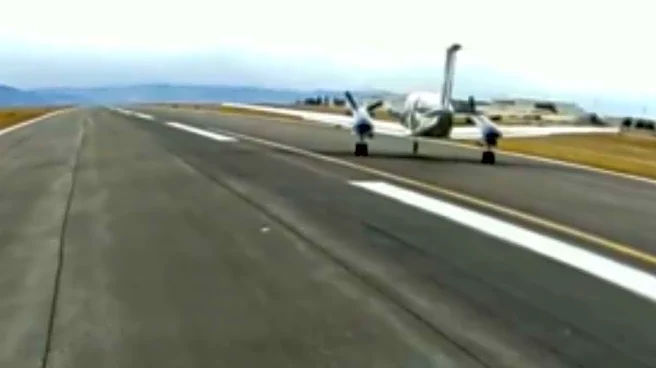

A Beech B200 Super King Air N479BR, operated by Buffalo River Aviation, recently left the aviation geeks and spectators alike in awe after reports of the tiny aircraft landed itself after on-board pilot
incapacitation surfaced online. However, there have been significant updates in this “historic” story since it went viral on social media. Initially, it was believed that the twin-engine Beechcraft Super King Air, enroute from Aspen to Denver, made an emergency landing using its Garmin Emergency Autoland feature following the incapacitation of the two pilots on board.
Additionally, it was reported that the aircraft, with no passengers on board, “experienced a rapid, uncommanded loss of pressurisation”, that deployed the Garmin Emergency Autoland and landed at the Rocky Mountain Metropolitan Airport. Furthermore, the emergency system was heard communicating with the ATC, informing them about the aircraft’s tail number and the situation of pilots.
NEW: A plane has landed itself using "Autoland" at the Rocky Mountain Metropolitan Airport near Denver, becoming the first emergency autoland.
According to the FAA, two people were on board when the pilot lost communication with air traffic control.
The twin-engine Beechcraft… pic.twitter.com/UejG80whSd
— Collin Rugg (@CollinRugg) December 24, 2025
So what exactly happened?
“Pilots Remained Alert”
There have been some gaps in the story, per Flightradar24. The Swedish company, popular for its real-time aircraft flight tracking on maps, reported that the pilots on board “remained alert and able to operate the aircraft”.
However, the aircraft triggered the Emergency Autoland owing to the complex situation that arose and also landed safely with no further incident.
The pilots not only decided to leave the system engaged but also monitored the Autoland’s performance, including the communications it made in the process.
“Due to the complexity of the specific situation, including instrument meteorological conditions, mountainous terrain, active icing conditions, unknown reasons for loss of pressure, and the binary (all-or-nothing) function of the Garmin emergency systems; the pilots, exercising conservative judgement under their emergency command authority (FAR 91.3) made the decision to leave the system engaged while monitoring its performance and attempting communications as able within the constraints of the system,” Flightradar24 quoted Buffalo River Aviation’s statement.
“While the system performed exactly as expected, the pilots were prepared to resume manual control of the aircraft should the system have malfunctioned in any way,” it added.
What Is Garmin’s Emergency Autoland?
Garmin Emergency Autoland system can activate in certain conditions, including scenarios where the pilot fails to interact with the flight deck for an extended period.
Using the Emergency Descent Mode (EDM), Autoland takes charge.
“EDM will descend the aircraft to a lower altitude and if the pilot still does not interact with the flight deck, Autoland will automatically engage and land the aircraft,” Garmin notes on its website.
Does Emergency Autoland Work With No Fuel?
Emergency Autoland factors in the amount of fuel on board during its activation and monitors the fuel usage throughout the flight while it is in use.
“Emergency Autoland takes into consideration the amount of fuel on board at the beginning of an Autoland activation and continues to monitor fuel flow and fuel burn throughout the Autoland sequence. If the aircraft should run out of fuel, it will go into under speed protection,” the website adds.
Will Emergency Autoland Ditch In Water?
The Emergency Autoland is designed to find hard runaways equipped with a GPS approach for lateral and vertical guidance, according to Garmin. The Autoland will not ditch the aircraft in the water but will continue to navigate the aircraft to a destination it supports. In a situation where Autoland is unable to locate an appropriate destination, it will continue to climb and search, and enter into under speed protection configuration should the fuel in the tank run out.
/images/ppid_a911dc6a-image-177101053501199609.webp)

/images/ppid_59c68470-image-177101003680064644.webp)







/images/ppid_59c68470-image-177100753350744656.webp)
/images/ppid_a911dc6a-image-17710070301901476.webp)
/images/ppid_a911dc6a-image-177100572282276854.webp)