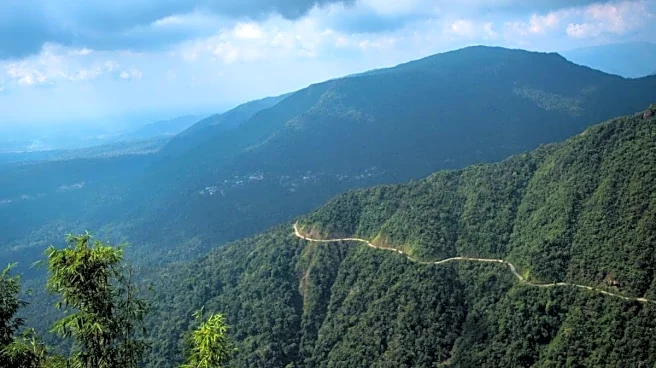




The Aravalli Range, which is the oldest mountain range in India, has never been as well-known as the Himalayas and the Western Ghats. The Aravallis, which go through Gujarat, Rajasthan, Haryana, and Delhi, are both old in terms of geology and bad for politics. Their steady disappearance over the years—due to mining, real estate growth, and weaker regulations—has been a slow administrative decision rather than a terrible environmental disaster. So, the current debate about the Aravallis isn’t just about conservation. It has to do with how India deals with land, growth, and environmental limits.
From an ecological asset to a ‘wasteland’
The Aravallis are important for the environment, even though they are quiet. They act as a natural barrier against Thar desertification, recharge groundwater
aquifers, control microclimates, and protect the Delhi-NCR region from heat and air pollution. Researchers have often warned that the Aravallis’ decline makes heat waves, dust storms, and groundwater depletion in northern India worse.
But for most of independent India’s planning history, the Aravallis were not seen as ecological infrastructure. A lot of the range, mostly in Haryana and Rajasthan, was called “gair mumkin pahad” (uncultivable hill) or “revenue wasteland”. This bureaucratic branding has big effects. These hills were easier to lease, mine, flatten, and make money off of when they were classified as non-forest land.
Mining for quartzite, limestone, and stone aggregates has come a long way since the 1970s. Even when there were worries about the environment, extraction often went on with temporary permits or state-level exemptions. The Aravallis become a sort of bank for cities.
Judicial clarity, administrative ambiguity
The legal history of the Aravalli conflict is extensive and remarkably clear. Beginning in the 1990s, the Supreme Court of India issued historic judgments restricting mining and building in ecologically sensitive areas of the range, primarily in Haryana and Rajasthan. The court acknowledged the Aravallis as a fragile ecosystem whose destruction posed direct threats to public health and environmental stability.
However, judicial purpose has often clashed with administrative misinterpretation. State governments responded not with blatant resistance but with technical manoeuvres such as revising forest boundaries, selectively applying the Forest Conservation Act, or contending that some hill tracts did not qualify as “forest” under strict legal definitions. As a result, the debate switched from overt illegality to procedural compliance with no environmental impact.
More recently, proposed modifications to land-use rules, environmental clearance processes, and compensatory afforestation norms have raised concerns that the Aravallis are being surreptitiously opened up again—this time under the guise of infrastructure, housing, and strategic development.
The Gurugram effect: Real estate and ecology
The Aravalli conflict is most noticeable in Gurugram and Faridabad. Previously marginal hill systems, these places are now part of one of India’s most aggressive real estate corridors. As land values surged, the economic incentive to redefine hills into developable parcels increased.
Luxury housing complexes, farmhouses, resorts, and roads have slowly eroded Aravalli tracts, frequently fragmenting wildlife corridors and flattening hillocks. Environmental impact assessments have routinely underestimated cumulative impacts, interpreting projects as isolated interventions rather than as part of a larger landscape shift.
This poses an important governance question: who is responsible for saying no when ecological assets are entrenched within growth zones? The Aravalli debate demonstrates how India’s environmental control structure fails when conservation clashes with revenue and investment movements.
Compensatory afforestation is not an option
One of the most worrying things about the current debate is that it focuses on compensatory afforestation as a way to solve environmental problems. The idea that planting saplings somewhere else can make up for cutting down old-growth hill ecosystems shows a basic lack of understanding of how ecosystems work.
The Aravallis are not just tree-covered land; they are complicated systems of landforms that have formed over billions of years. Plantation drives on nearby land parcels can’t do what they do to recharge aquifers, stabilise soil, and moderate climate. When you treat compensatory afforestation as an equivalent substitute, you turn ecology into math. This is something that India’s environmental administration has had to deal with many times.
Climate change makes things more dangerous
The return of the Aravalli debate is especially scary because it comes at a time when the weather is getting worse. In North India, heat waves are lasting longer, groundwater levels are dropping, and air pollution is rising. The Aravallis are the main barrier against all three.
It would be bad for the environment and bad for the economy to destroy them now. The long-term costs of more demand for cooling, public health problems, water shortages, and being more likely to have disasters far outweigh any short-term benefits of development. But these costs are still mostly hidden from policy-making because they don’t show up on balance sheets or in state revenue forecasts.
A case study on environmental governance
The Aravalli issue eventually reveals a wider pattern in India’s environmental politics. Ecologically essential landscapes without iconic status are the most vulnerable to administrative deterioration. Protection exists on paper, but enforcement is fractured on the ground, and accountability is spread across departments.
This is why the Aravallis are significant outside Haryana and Rajasthan. They are a test case for whether India can shift from reactive, court-driven environmental protection to proactive, science-led administration. Without institutional clarity on what defines a non-negotiable ecological asset, legal disputes will continue to replace policy vision.
Beyond an environmental footnote
The Aravallis are frequently mentioned in public discourse only when judicial cases or mining scandals emerge. However, addressing them as separate controversies misses the point. Their deterioration is not unintentional; it shows how India prioritises growth, values land, and externalises ecological costs.
India’s oldest mountains do not oppose development. They are designed to prevent a collapse. Whether they survive this policy moment will reveal much about the country’s capacity to balance economic ambition and environmental reality.
Anusreeta Dutta is a columnist, political ecology researcher with prior experience as an ESG analyst. Dr Zahid Sultan is an Independent Researcher with a PhD in Political Science. Views expressed in the above piece are personal and solely those of the author. They do not necessarily reflect News18’s views.
/images/ppid_59c68470-image-177021003820870461.webp)

/images/ppid_59c68470-image-177029003593599436.webp)
/images/ppid_a911dc6a-image-177030013841123475.webp)

/images/ppid_59c68470-image-177027754270920305.webp)




/images/ppid_a911dc6a-image-177029587965668094.webp)