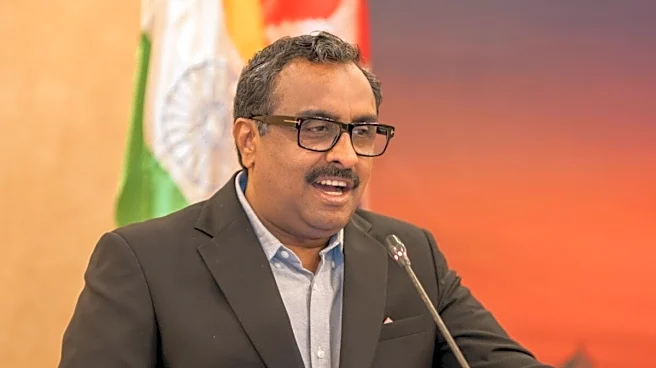



BJP National Vice President Ram Madhav has launched a sharp attack on senior Congress leader P Chidambaram over his criticism of the BRICS Summit, accusing him of displaying a “naraz fufa (sulking uncle)” tendency and questioning whether his remarks reflected a lack of understanding of the changing global geopolitical order.
In a strongly worded opinion piece in The Indian Express titled “A BRICS primer for the ‘naraz fufas’”, Madhav directly targeted Chidambaram’s remarks questioning what India had gained from its participation in BRICS and other multilateral groupings.
“Senior Congress leader P Chidambaram’s comments on the 18th BRICS Summit being held in Delhi betray the ‘naraz fufa’ tendency, if not ignorance about current global geopolitics,”
Madhav wrote.
The BJP leader was referring to Prime Minister Narendra Modi’s recent “naraz fufa” jibe at Opposition critics, likening them to an elderly relative at a family gathering who is perpetually unhappy and finds reasons to complain.
Madhav argued that while countries would ordinarily take pride in hosting a major multilateral gathering, Chidambaram had instead dismissed the Delhi summit. “Normally, countries take pride in hosting important multilateral events. But for Chidambaram, the BRICS summit is a useless exercise,” he wrote.
Chidambaram had questioned the tangible gains India was getting from its participation in several international groupings. “We are part of BRICS, we are part of SCO, we are part of G20, and we are part of Quad. What benefits are we getting out of that? I can’t see,” Chidambaram had said in an interaction with ANI.
Madhav’s counterargument is that judging BRICS only through the prism of immediate, measurable benefits ignores the grouping’s growing geopolitical weight.
He pointed out that BRICS now has 11 member countries and another 10 partner countries, with several more nations waiting to join. The grouping, he wrote, now represents around 50 per cent of the world’s population, 40 per cent of the global economy and 26 per cent of global trade.
Madhav contrasted this with the G7, writing that the grouping of major Western powers represents less than 10 per cent of the global population, despite accounting for around 44 per cent of global GDP.
He also sought to underline the scale of India’s role as the current BRICS chair. India assumed the chair for the fourth time in January and, according to Madhav, has hosted more than 350 high-level engagements over the past seven months covering political and security issues, economics, culture and people-to-people ties.
The BJP leader further argued that India’s role in BRICS cannot be separated from the wider transformation of global power equations. “The global order built in the aftermath of World War II stands largely dissolved today,” he wrote, adding that a new order was yet to emerge.
Madhav described the current geopolitical uncertainty through an evocative reference to Italian Marxist thinker Antonio Gramsci, saying the period between the old order and the new one resembles what Gramsci called the “time for monsters.”
Madhav argued that multilateral platforms such as BRICS become more, rather than less, important. He pointed to India’s role in the G20, saying New Delhi played a “catalytic role” at the Bali summit in 2022 and the New Delhi summit in 2023 in helping achieve consensus despite tensions over the Russia-Ukraine conflict.
The BRICS summit, Madhav noted, is also taking place amid the US-Iran conflict, with Iran, Saudi Arabia and the UAE – all BRICS members – coming together in New Delhi after the conflict. He said India’s experience in managing competing interests and Prime Minister Modi’s “enormous goodwill and bonhomie” with leaders could help the summit produce a unanimous declaration.
The Chidambaram-Madhav clash has thus added a political layer to the BRICS debate, with the Congress leader demanding clearer, tangible outcomes from India’s multilateral engagements, while Madhav argues that the strategic value of BRICS lies in India’s ability to shape an emerging global order rather than simply count immediate deliverables.




