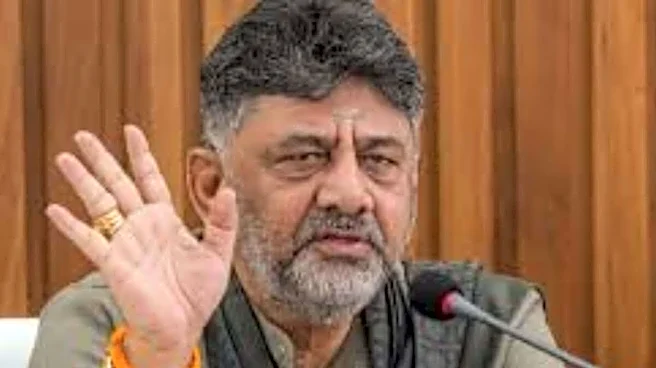






Aimed at making citizen grievance redressal the centrepiece of governance, the Karnataka government is setting up a dedicated department with a full-time minister and secretary to exclusively monitor, track, and ensure the resolution of public complaints across departments. The initiative, conceived by Chief Minister DK Shivakumar, seeks to institutionalise grievance redressal as a standalone function of government rather than leaving it as an additional responsibility of individual departments. Explaining the thinking behind the decision, Principal Secretary to the Chief Minister and senior IAS officer Munish Moudgil told CNN-News18 that the government believes the way it responds to citizens is the most important indicator of governance. “The
Honourable Chief Minister believes that citizen grievance redressal is one of the most important criteria by which to judge the performance of a government. We want to reach citizens in the most efficient way possible and understand first-hand what they are experiencing,” Moudgil said. According to him, while the government delivers thousands of services through different departments, there has so far been no single institution dedicated exclusively to ensuring that every grievance reaches its logical conclusion. “The government delivers a large number of services to citizens. Having a dedicated, full-time department headed by a minister whose only focus is to ensure the timely response, delivery, and disposal of citizen grievances is a full-time activity. That is why a dedicated department is being set up,” he said. Unlike existing departments that are responsible for service delivery, the new department will monitor whether complaints are being resolved within prescribed timelines and hold departments accountable for delays. “This requires the full-time attention of a secretary, a minister, and an entire department. We believe this cannot be done as an additional or ancillary responsibility. It is a full-fledged priority that the government wants to address with complete attention,” Moudgil said. Describing the department’s role, Moudgil said it would function as the government’s internal watchdog. “It will become the conscience keeper of the entire government,” he said. Drawing a comparison with the private sector, he said every successful organisation invests in customer support and governments should be no different. “Even a small company has a customer care division. If I may put it that way, where is the customer care division of the Government of Karnataka? This department will effectively perform that role,” he said. The department will not replace existing ministries. Instead, each department will continue delivering services while the new grievance redressal department ensures that complaints do not fall through the cracks. “The delivery will continue to be done by the respective departments. This department will continuously track whether every grievance is being addressed on time,” Moudgil explained. The entire system, he said, will be technology-driven, allowing complaints to be monitored from the village level right up to the Chief Minister’s Office. “There will be an IT-based evaluation system. From the last mile in the village to the Chief Minister’s Office, everybody will be able to track where grievances are pending, where they are moving, and how they are being disposed of,” he said. Moudgil said the initiative would further strengthen Karnataka’s Sakala framework, which already provides for time-bound delivery of services and imposes penalties for delays. “Under the Sakala Act, there is already accountability to deliver notified services within a stipulated time. If services are delayed, there are consequences, including departmental proceedings and fines. This department will strengthen that framework and make grievance redressal the core focus,” he said. According to Moudgil, the idea draws from governance models adopted globally, where governments have increasingly recognised citizen grievances as an important measure of administrative performance. “In the 1980s, countries like the UK introduced concepts such as the Citizen’s Charter and citizen entitlements. The philosophy is the same—citizens have an entitlement to services, and the government has a duty to deliver them in a predictable and time-bound manner,” he said. He pointed out that not every grievance relates to a government service. “There are complaints, requests for information, suggestions, and several other issues. We want to comprehensively address all of these through one dedicated department. It cannot be somebody’s additional responsibility while they are handling something else,” he said. Asked what prompted the government to create an entirely new department, Moudgil said the initiative stemmed directly from Chief Minister D.K. Shivakumar’s vision. “Frankly, this entire thought process is the vision of the Honourable Chief Minister. He believes this is among the highest-priority areas that require full-time attention. The vision has come from him, and all of us are working to implement it,” he said. Calling the department a significant governance reform, Moudgil said its success would ultimately be measured by how effectively it improves the relationship between citizens and the government. “We believe this is the most important way of measuring the health of governance itself. If citizens’ grievances are resolved efficiently and on time, it reflects the health of the government,” he said. This department, approved by the Cabinet last week and officially notified, will serve as the government’s central coordination mechanism for tracking public complaints, monitoring their progress, and ensuring that grievances are addressed by the concerned departments within a stipulated time. The move comes as the government looks to streamline the way citizens interact with multiple departments for basic services. Instead of complaints being pursued independently across different offices, the new department will monitor their movement, coordinate with the departments concerned, and seek status updates.




/images/ppid_a911dc6a-image-178244859891589233.webp)

/images/ppid_59c68470-image-178245502062366674.webp)