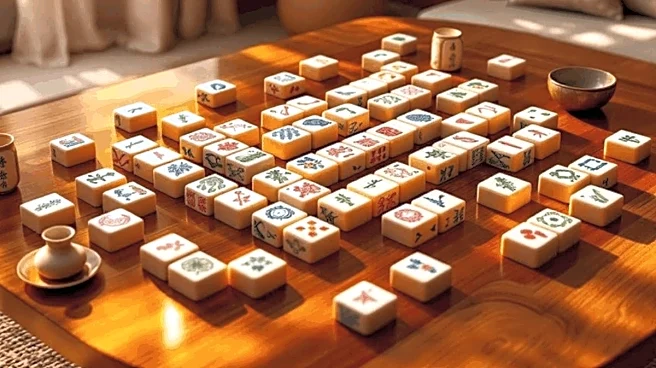



With International Mahjong Day celebrated on August 1, the centuries-old game is once again capturing attention around the world. In India, where Mahjong has quietly gained momentum over the past few years, it has evolved beyond a game into a ritual of connection, conversation and slow luxury.
In an era obsessed with speed, Mahjong asks something radical of its players: slow down. There are no buzzing notifications, no endless scrolling and no pressure to perform for social media. Instead, four people gather around a table as the rhythmic clatter of tiles fills the room and conversations ebb and flow over hours. In a culture increasingly defined by digital distraction, the centuries-old game has quietly become one of the most meaningful ways
to reconnect, with friends, family and, perhaps, even oneself.
Originating in China during the late Qing Dynasty, Mahjong has travelled remarkably well. It became a cultural phenomenon in the United States during the 1920s, remains deeply embedded in communities across Hong Kong, Taiwan, Japan and Singapore, and has recently enjoyed renewed popularity in cities such as New York and London, where Mahjong clubs have become fashionable gathering spaces for younger audiences. Whether played competitively or socially, the game’s enduring appeal has always extended far beyond strategy; it has always been about community, conversation and tradition.
India, too, has found its own relationship with Mahjong.
Over the past few years, the game has quietly built a devoted following across Mumbai, Delhi, Bengaluru, Pune and Kolkata. Once confined largely to enthusiast circles, Mahjong is now finding its way into luxury hotels, members’ clubs, cafés and private homes, where it has become synonymous with slower afternoons, meaningful conversations and screen-free connection. Its growing popularity reflects a broader shift in how people define leisure and increasingly, how they define luxury.
For Ankita Sonawala, Brand Head, Zen Diamond India, Mahjong offers something that feels increasingly rare in modern life: undivided attention.
“Mahjong has always been about bringing people together. You sit around a table for hours, completely present, talking, laughing and enjoying each other’s company. In a world where we’re constantly rushing, that feels incredibly special. I often think of Mahjong as meditation in motion. It gives you the chance to slow down, focus and reconnect with the people around you.”
That philosophy became the inspiration behind Zen Diamond India’s handcrafted Mahjong set. “We believe luxury is about creating moments that stay with you, and Mahjong felt like a beautiful extension of that thought. When we designed our Mahjong set, I wanted it to have the same craftsmanship and attention to detail that goes into our jewellery. I wanted it to feel timeless, something families and friends would gather around for years to come. To me, that’s what modern luxury is really about. Not just what you wear, but the moments you create and the people you share them with.”
Her perspective reflects a noticeable shift within the luxury industry itself. Increasingly, brands are moving beyond products to curate experiences, rituals that foster connection, presence and lasting memories.
For long-time Mahjong enthusiast Nayntara Thacker, the game’s greatest reward has always been the people sitting around the table.
“For me, Mahjong is so much more than strategy and tiles. It’s a tradition of coming together with incredible women, sharing stories, celebrating each other and creating memories I’ll always cherish.”
That sentiment echoes one of Mahjong’s greatest strengths. Unlike many modern forms of entertainment, it doesn’t demand constant stimulation or instant gratification. Instead, it rewards patience, observation and conversation. Every game unfolds differently, shaped not only by the tiles but by the people playing them.
Its resurgence in global cities and its steady rise in India, also mirrors a wider movement towards what many describe as slow luxury. In contrast to experiences built around speed and exclusivity, slow luxury values craftsmanship, intentionality and the luxury of time itself. It is less about collecting things and more about collecting moments.
Perhaps that explains why Mahjong feels so relevant today.
As digital fatigue pushes people to seek more meaningful ways of spending time together, analogue rituals are finding renewed significance. Dinner parties are replacing crowded nights out. Board games are replacing endless scrolling. Long conversations are becoming the ultimate indulgence. Mahjong sits comfortably within that cultural shift, offering an experience that is as social as it is mindful.
In many ways, the game’s growing popularity says as much about our present as it does about its centuries-old history.
In a world where attention has become one of our most valuable currencies, perhaps the greatest luxury isn’t owning something extraordinary. It’s having the time and the company to sit around a table, put your phone away and simply play.