


/images/ppid_59c68470-image-17708100384491046.webp)
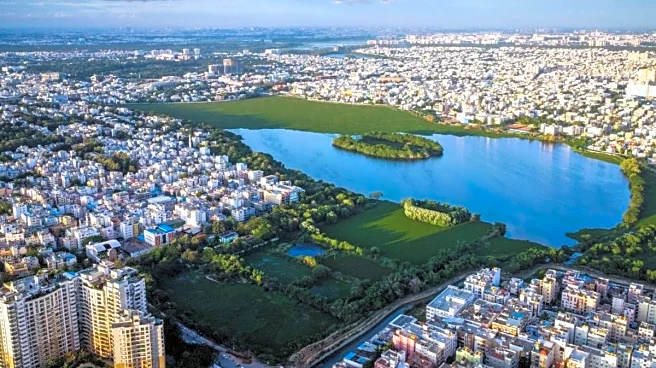
On some mornings, when traffic on the Outer Ring Road stalls into a familiar honk filled standstill, an Vinayak N, old resident of Bellandur likes to point towards the lake and say, almost to himself, “This place once breathed slower.” The techie remembers a time when the air smelled of wet earth, not diesel, and when people gave directions using water channels, not tech parks.
Back then, Bellandur was not a junction you crossed. It was a place you lived with. That memory holds the clue to Bellandur’s name.
Long before glass offices and gated apartments arrived, Bellandur was known as ‘Bellanuru’ in old Kannada records. Linguists and local historians trace the name to two roots.
Bellu or Belli, referring to pale or whitish land, and Ooru or Nuru,
meaning village. Together, Bellanuru described a village surrounded by light coloured, water-soaked soil.
This was not poetic exaggeration. Bellandur grew around one of Bengaluru’s oldest and largest lakes, part of an intricate chain of tanks that once fed agriculture across the region. The soil around the lake stayed moist for most of the year, giving it a pale appearance, especially after the monsoon.
The village took its identity from this landscape. Over generations, Bellanuru softened into Bellandur in everyday speech.
When the Lake Came Before the Locality
Another widely accepted explanation is simpler and deeply Bengaluru in spirit. The lake came first.
Bellandur Lake was a crucial irrigation source, connecting to Varthur and further tanks through rajakaluves or storm water drains. Farmers depended on it, cattle drank from it, and settlements naturally clustered around it.
In many parts of old Bengaluru, villages were named after the most dominant feature in their environment. In this case, the settlement near Bellandur Lake became Bellandur. Maps may have changed, but the lake kept the name alive.
The Silver Water Story
There is also a gentler explanation passed down in local conversations. Some elders say the word Belli refers to silver, not soil. On clear nights, the lake reflected moonlight so brightly that it appeared silver from a distance.
Whether fact or folklore, the story reveals how closely people once observed their surroundings. Even if historians raise eyebrows, the idea persists, because Bellandur was once beautiful enough to inspire such stories.
The irony is hard to miss. A name rooted in water and land now belongs to one of Bengaluru’s most congested corridors. Bellandur today is known for tech campuses, ORR bottlenecks, and the lake that regularly makes headlines for all the wrong reasons. Yet the name has not changed.
It still whispers of a village shaped by water, of soil that held moisture, of a time when geography named places, not real estate brochures.
When traffic finally moves and the old resident turns away from the lake, the city rushes back in. But the name Bellandur stays, stubborn and unchanged. It reminds Bengaluru that this place was not built overnight, and that beneath the asphalt and glass lies a much older story.
A village named after water. A city that grew too fast to remember why.








/images/ppid_a911dc6a-image-177081110529020723.webp)

/images/ppid_a911dc6a-image-177081107284816998.webp)
/images/ppid_a911dc6a-image-177081102966228140.webp)