


/images/ppid_a911dc6a-image-178513567407616360.webp)
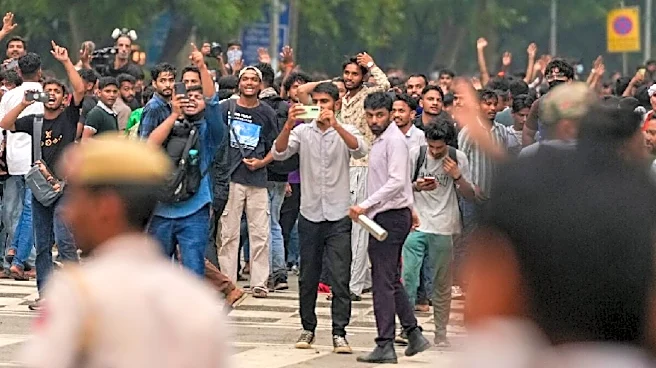
The Supreme Court’s recent observations on police action during student protests have brought the spotlight on a lesser-known legal remedy available to citizens when the State violates their fundamental rights. Hearing a matter related to police action last week against protesting students at Jantar Mantar, the court remarked that authorities cannot resort to a lathicharge merely because people are agitating. It also indicated that if police excesses are established, compensation could be awarded.
Read More: ‘Can’t Lathicharge Just Because There Is Agitation’: SC On Police Action During Student Protests
The discussion has revived an important legal question: Can courts actually direct governments to pay compensation for wrongful police action?
The answer is yes, and the legal basis is the Constitution, not just sympathy. In India, courts can award what is called public law compensation when police action during a protest becomes excessive, arbitrary, or violates fundamental rights, especially the right to life and personal liberty under Article 21.
What The Law Says
The core constitutional provision is Article 21, which protects life and personal liberty. Courts have repeatedly held that if state action violates this right, the victim can seek immediate relief through a writ petition under Article 32 in the Supreme Court or Article 226 in the High Courts. In serious cases, the court can order compensation as part of public law remedy.
This is not the same as filing a regular civil suit for damages. Public law compensation is a constitutional remedy against the State for breach of fundamental rights. The idea is that when a person suffers due to illegal police action, waiting years for ordinary litigation may not be an effective remedy.
Which Cases Shaped This Rule
The Supreme Court developed this principle in landmark cases such as Rudul Sah v. State of Bihar and Nilabati Behera v. State of Orissa. In those cases, the court made clear that compensation can be awarded in public law when the State violates fundamental rights. The remedy is based on constitutional responsibility, not private negligence alone.
The Court later used the same principle in many custodial violence and police excess cases. The logic is that if the State’s own machinery harms a citizen unlawfully, the Constitution allows the court to provide immediate monetary relief. That is why compensation is often called a constitutional remedy.
How It Applies To Lathicharge
A lathicharge is not automatically illegal. Police can use force to maintain order if the situation truly demands it, but the force must be necessary and proportionate. If protesters are peaceful, or if baton charge is used without adequate warning or against people who do not pose an immediate threat, courts may treat it as excessive force.
In such a case, a court can ask whether the police acted within the law, whether the protest was unlawful, whether the force was justified, and whether the injuries were caused by a clear abuse of power. If the answer shows a rights violation, compensation can follow. Recent court observations have reinforced that agitation alone cannot be a blanket reason for baton charge.
Other Laws That May Apply
Besides constitutional remedies, criminal law can also come into play. Depending on the facts, police conduct may attract offences relating to hurt, grievous hurt, wrongful restraint, assault, or even culpable use of force. After the criminal law overhaul, these offences are now found under the Bharatiya Nyaya Sanhita (BNS) rather than the old IPC for new cases.
An inquiry may also be ordered under police rules, executive instructions, or human rights procedures. In many cases, courts direct a factual inquiry first, and then decide whether compensation should be paid by the State. If the evidence shows misconduct by individual officers, the government may later recover the amount from them or initiate departmental action.
What Public Law Compensation Means
Public law compensation is immediate relief for a constitutional wrong. It is awarded because the victim’s fundamental rights were violated, not because the court is calculating every financial loss in detail. The amount is often fixed by the court on a broad assessment of injury, seriousness of the violation, and the need for deterrence.
That is why compensation in a lathicharge case can vary widely. A minor injury may lead to limited relief, while a serious beating, permanent disability, or death can lead to much higher compensation. The court is not only compensating the victim; it is also reminding the State that force must be controlled by law.
/images/ppid_a911dc6a-image-178522507613710829.webp)


/images/ppid_a911dc6a-image-17852226321122392.webp)

/images/ppid_a911dc6a-image-178517303502191737.webp)


/images/ppid_a911dc6a-image-17850691354656803.webp)