



Mathura, best known as the birthplace of Lord Krishna, is now drawing attention for a very different reason. Investigators say parts of the Uttar Pradesh district have emerged as one of India’s largest cybercrime hubs, earning the nickname “Mini Jamtara” as police intensify efforts to dismantle an organised network of online fraudsters operating from villages near the Rajasthan and Haryana borders.
The latest crackdown unfolded on the morning of July 7, when police teams, assisted by drones, raided eight villages across the district. As officers moved in, hundreds of suspects reportedly fled through fields and narrow lanes in an attempt to evade arrest.
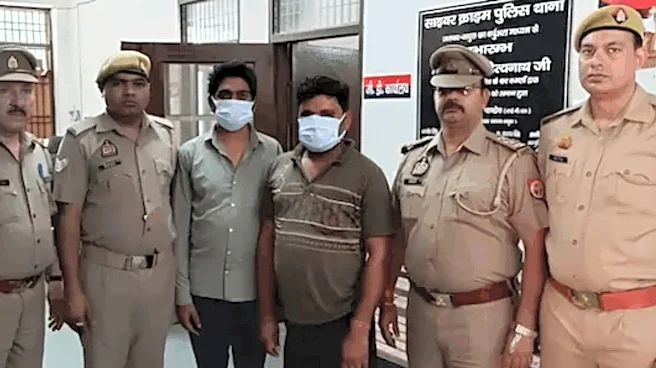
After hours of searches and questioning, police arrested 42 people, describing the operation
as one of the biggest efforts yet to break the district’s expanding cybercrime network.
Hundreds Of Cases, Thousands Of Digital Trails
According to police, 177 cyber fraud cases have been registered in Mathura over the past year, leading to the arrest of 312 suspects.
Officials said the latest operation was driven by digital intelligence gathered through the National Cybercrime Reporting Portal (NCRP) and the Centre’s Sanchar Saathi platform. Investigators have traced nearly 7,000 mobile numbers and around 1,400 bank accounts allegedly linked to cyber fraud originating from the villages under surveillance.
Those arrested include alleged kingpins as well as operatives performing different roles within what police describe as a highly organised network spread across multiple states.
How Mathura Became ‘Mini Jamtara’
A study published three years ago by the Future Crime Research Foundation, a startup affiliated with IIT Kanpur, identified Mathura as one of India’s leading cybercrime hotspots, overtaking Jamtara in Jharkhand and Nuh in Haryana.
According to the report, nearly 80 per cent of cybercrime cases in India originate from just 10 locations. Rajasthan’s Bharatpur accounted for the highest share at 18 per cent, followed by Mathura (12 per cent), Nuh (11 per cent), Deoghar (10 per cent), Jamtara (9.6 per cent), Gurugram (8.1 per cent), Alwar (5.1 per cent), Bokaro (2.4 per cent), Karmatand (2.4 per cent) and Giridih (2.3 per cent).
Police Map 18 Villages Linked To Online Fraud
Investigators have identified 18 villages under the Govardhan, Barsana, Shergarh, Chhata and Kosi police station limits as suspected centres of organised cybercrime.
Most of these villages lie close to the Rajasthan and Haryana borders, which police believe has helped the network flourish. Bharatpur is around 40 kilometres away, while Nuh and Alwar are approximately 107 kilometres and 111 kilometres away respectively, making it easier for suspects to cross state boundaries and evade law enforcement.
The villages are located roughly 70 kilometres from Mathura city, around three hours from Delhi and about one hour from Agra.
Previous Crackdowns Exposed The Network
The latest operation follows a series of police crackdowns in the cybercrime-hit villages over the past year. During one major operation, more than 300 police personnel from multiple police stations raided the villages of Devseras, Mudseras, Madaura and Nagla Akatiya in Govardhan, arresting 37 suspected cyber fraudsters, while more than 120 others fled through fields and crossed into neighbouring Rajasthan.
Police deployed drones to track suspects, but many used standing crops to evade capture. The operation led investigators to identify several major hideouts, makeshift huts allegedly used to carry out online fraud, escape routes and other locations linked to the network. Authorities also began mapping 18 villages believed to be cybercrime hotspots to support future intelligence-led raids.
Investigators said one group of fraudsters arrested during the operation had allegedly cheated 187 people across the country of more than Rs 50 lakh in just 25 days, with police recovering incriminating chats and digital evidence during the searches.
A Criminal Network Operating Like A Business
Speaking to The Indian Express, Mathura Senior Superintendent of Police Shailesh Kumar said raids are continuing based on cybercrime complaints and intelligence inputs, adding that sustained operations have significantly reduced the network’s reach.
Another police official described the operation as functioning “like a small industry”, where many young people, lured by the promise of quick money, are abandoning education and traditional employment in favour of cyber fraud.
Police said many of the 312 suspects arrested over the past year already had records on the centralised cybercrime coordination portal. Investigators found that several phone numbers and bank accounts were linked to FIRs and complaints registered across multiple states.
Authorities believe the syndicate operates through specialised groups. One team arranges rented bank accounts, SIM cards and fake ATM cards, another identifies and contacts potential victims, while a third group withdraws the fraudulently obtained money. Each group reportedly receives a fixed share of the proceeds.
Fraud Carried Out From Open Fields
Investigators said the gangs are involved in a range of online scams, including fraudulent OLX transactions using fake QR code payment requests, bogus advance payment demands and fake hotel booking websites designed to cheat unsuspecting victims.
Members of the network allegedly communicate through encrypted messaging platforms such as Telegram to coordinate operations and share information.
Police also revealed that many of the frauds are carried out from open fields rather than houses. The strategy allows suspects to spot approaching police vehicles from a distance and escape before raids can begin. Combined with the proximity to neighbouring states, investigators say this has made dismantling the network particularly challenging.
Even so, authorities insist that continued intelligence-led operations and digital tracking are steadily tightening the net around what they believe has become one of India’s most organised cybercrime ecosystems.