
/images/ppid_a911dc6a-image-177939303354854007.webp)
Nearly eight decades after the trauma of Partition violently carved the subcontinent apart, Lahore is executing a startling administrative about-turn. Pakistan’s Punjab Cabinet, chaired by Chief Minister Maryam Nawaz, has officially approved a sweeping plan engineered by the Lahore Authority for Heritage Revival (LAHR)—headed by former Prime Minister Nawaz Sharif—to strip away decades of bureaucratic Islamisation from the city’s maps.
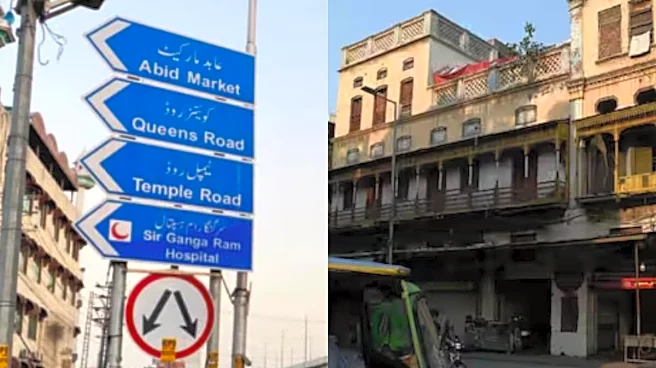
Across the cultural capital, the metal signboards are changing. Islampura has officially reverted to its original title of Krishan Nagar. Sunnat Nagar is once again Sant Nagar, and Mustafaabad has transformed back into Dharampura. Even iconic traffic junctions are getting a historical reset: Babri Masjid Chowk has been
stripped of its reactive title to become Jain Mandir Chowk once more, while the commercial epicentre of Maulana Zafar Ali Khan Chowk has reclaimed its flamboyant pre-1947 identity as Lakshmi Chowk.
To casual observers, this appears to be a profound moment of historical reconciliation. However, political analysts and regional experts argue that beneath the pristine coats of paint on these new street signs lies a calculated geopolitical strategy—one that is fundamentally destined to clash with an unyielding structural reality on the ground.
The Soft-Power Gambit: Subcontinental Geopolitics
The sudden rush to restore Hindu, Sikh, Jain, and colonial-era names to Lahore’s alleys is not merely a localised exercise in urban conservation; it is an aggressive exercise in cultural diplomacy directed squarely at India. By orchestrating this visual transformation, the ruling Pakistan Muslim League-Nawaz (PML-N) is attempting to bypass the frozen, militarised diplomatic channels of New Delhi and appeal directly to the Indian public and the global diaspora.
The strategy seeks to build a narrative of Punjabi shared heritage and secular inclusivity. By preserving Sikh-era frescoes at Lahore Fort, showcasing paintings of Princess Bamba Sutherland, and restoring the legendary wrestling akharas and historic cricket grounds at Minto Park, the Sharif administration is attempting to project Lahore as a progressive, tolerant oasis. This cosmetic multiculturalism is designed to place Pakistan on the moral high ground, creating a stark visual contrast at a time when several Indian municipalities are actively renaming Mughal-era cities and railway stations.
The Structural Firewall: Why the Strategy Fails
While changing the nomenclature on a map is a swift administrative task, rewriting the deep-seated structural realities of modern Pakistan is entirely different. The fundamental reason this soft-power strategy cannot translate into actual diplomatic leverage or true societal pluralism rests on three insurmountable structural barriers.
First, there is the reality of near-total demographic erasure. In 1947, non-Muslims accounted for roughly 40 per cent of Lahore’s vibrant population; today, following decades of migration and institutional marginalisation, the minority population is a microscopic fraction. Reverting a street name to “Jain Mandir Chowk” carries an unintentional, bitter irony when the actual historical Jain temple at that very crossroads was demolished by mobs in 1992 and has never been fully reconstructed or returned to a living community of worshippers.
Second, the structural legal framework of the state remains fundamentally unchanged. A progressive street sign cannot decouple itself from Pakistan’s stringent blasphemy laws, which civil rights organisations note continue to be disproportionately weaponised against vulnerable local minorities. The cosmetic safety of a restored name does not alter the lived experience of local Christians, Sikhs, or Hindus who face systemic vulnerabilities regarding forced conversions and the security of their places of worship in the deep interior of the province.
Finally, the entire initiative hits an absolute geopolitical wall in the form of a heavily securitised border regime. Even if millions of Indians or members of the global Sikh and Hindu diaspora are moved by the poetic restoration of Lakshmi Chowk or Sant Nagar, they cannot physically visit them. The near-impossible visa restrictions maintained by both New Delhi and Islamabad ensure that this shared history remains locked behind layers of barbed wire and military checkpoints.






/images/ppid_a911dc6a-image-177939652584428477.webp)