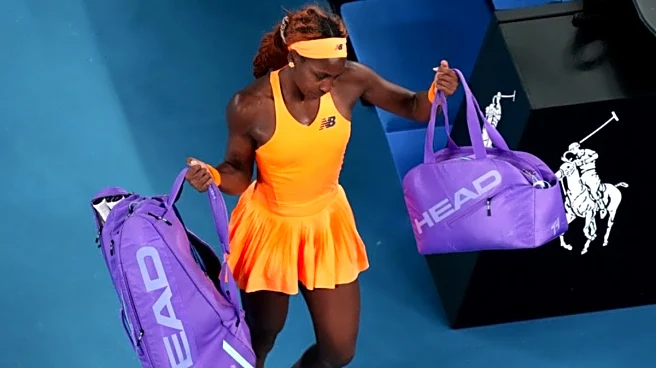

The WTA has thrown its support behind players calling for greater privacy away from the court, after footage of Coco Gauff smashing her racket following her Australian Open quarter-final loss ignited widespread
debate.
Gauff, visibly frustrated after her defeat to Elina Svitolina on Tuesday, sought out a camera-free space near Rod Laver Arena to vent her emotions — only to later discover the moment had been broadcast globally.
#CocoGauff smashed her racket into the concrete floor after her #AustralianOpen quarterfinal loss to #ElinaSvitolina on Tue. She has called for more privacy for tennis players. “Certain moments – the same thing happened to Aryna (Sabalenka) after I played her in the final of the… pic.twitter.com/Dmf1yRM3m4
— Shanghai Daily (@shanghaidaily) January 29, 2026
The incident left the American unhappy and reignited concerns over the constant surveillance of players at tournaments.
Coco Gauff addresses lack of privacy at the Australian Open
(via australianopen/YT) pic.twitter.com/nqKZxR36EZ
— Just Women’s Sports (@justwsports) January 27, 2026
Several leading players, including Iga Swiatek, Jessica Pegula and Amanda Anisimova, spoke out in support of Gauff, highlighting the lack of private off-court areas for athletes to decompress.
WTA Chair Valerie Camillo said the concerns raised were “completely valid”.
New:
Statements from the WTA and WTA chair Valerie Camillo, backing their players’ complaints about invasive cameras in backstage areas of the Australian Open. https://t.co/XmM5nL5bMD pic.twitter.com/qVGf8DrG5l
— Ben Rothenberg (@BenRothenberg) January 29, 2026
“This is a very human and fair request,” Camillo said on Thursday. “Athletes need spaces where they can recover and not feel constantly under scrutiny. Providing that space is part of our responsibility as a sport.”
She added that the WTA was committed to listening to players and taking action, noting that steps had already been taken to reduce the number of cameras in off-court areas at WTA events.
Tennis Australia, which organises the season-opening Grand Slam, defended the placement of cameras as a way to offer fans a “deeper connection” with players, but acknowledged the need for compromise.
“We want to listen to the players and really understand what their needs and wants are,” tournament director Craig Tiley told Tennis Channel.
“We’ve heard you, and whatever adjustments we need to make, we will make. It’s a fine line between player promotion, event promotion, and where the cameras are.”
(with Reuters inputs)