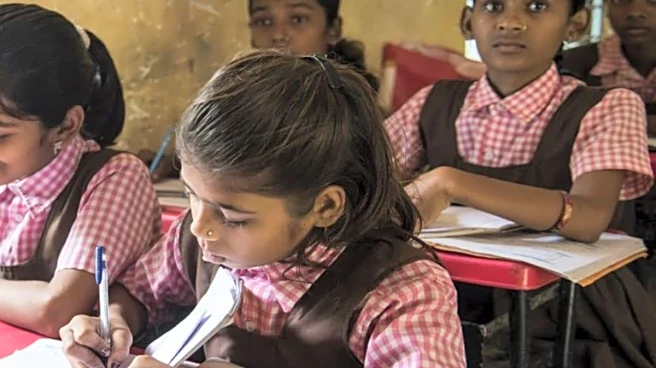



The Supreme Court of India has issued a landmark directive aimed at revitalising the Right to Education (RTE) Act, declaring that the admission of underprivileged children into private educational institutions must be treated as a “national mission”. In a significant judgement, a bench of Justice PS Narasimha and Justice Atul S Chandurkar ordered state and central government authorities to frame comprehensive rules to ensure the effective implementation of the 25 per cent reservation for children from economically weaker sections (EWS) and socially disadvantaged groups in private, unaided, non-minority schools.
The apex court expressed concern over the “systemic gaps” that have historically hindered the successful integration of EWS students
into elite private institutions. While the RTE Act has mandated this quota for over a decade, the court noted that many seats remain vacant due to bureaucratic hurdles, lack of public awareness, and delayed reimbursement of fees by state governments to private schools. To rectify this, the court has directed authorities to establish a transparent, centralised online admission portal in every state to minimise human interference and ensure that the selection process is based strictly on merit and eligibility within the reserved category.
Beyond the initial admission process, the Supreme Court emphasised that the responsibility of the state does not end once a child enters the school gates. The bench highlighted the need for “monitoring mechanisms” to ensure that EWS students are not marginalised or discriminated against within the school environment. The new rules are expected to include guidelines for providing free uniforms, textbooks, and stationery, alongside remedial coaching to help bridge the learning gap for students coming from varied socio-economic backgrounds. The court asserted that true social transformation can only be achieved when children from diverse strata of society learn and grow together in the same classrooms.
The judgement also addressed the long-standing grievance of private school managements regarding the timely reimbursement of costs. The court directed that the newly framed rules must include a fixed timeline for the release of funds by the government, ensuring that the financial burden of the quota does not compromise the overall quality of education. By framing this as a national mission, the Supreme Court has placed the onus squarely on the executive to move beyond mere policy-making and towards a robust, enforceable framework that guarantees every child their fundamental right to quality schooling, regardless of their financial status.
/images/ppid_a911dc6a-image-17707256352893847.webp)








/images/ppid_a911dc6a-image-177053106052618533.webp)

/images/ppid_a911dc6a-image-177053103082570723.webp)