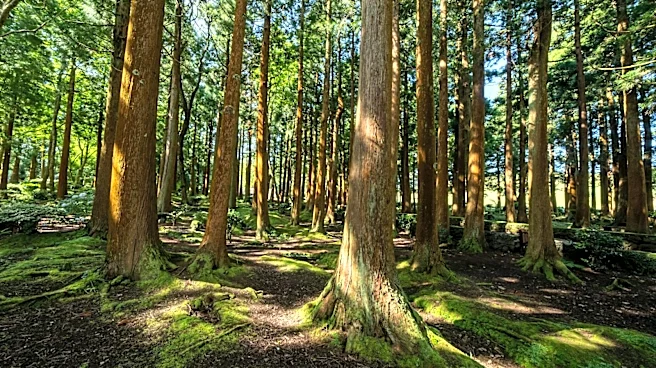




Beneath the soil, trees may be doing something far more complex than just growing roots. They may be recognising their own offspring—and helping them survive. Research over the years has suggested that trees are connected through underground fungal networks, often referred to as the “wood wide web.” These networks allow trees to share water, carbon and nutrients across a forest. But what’s more surprising is how selective that sharing can be. Studies indicate that some trees can distinguish between their own seedlings and unrelated plants nearby. When resources are limited, they appear to send more nutrients to saplings that are genetically related to them. In simple terms, they may be prioritising their own “children.” This happens through symbiotic
relationships with fungi in the soil. The fungi connect the roots of multiple plants, creating a network through which nutrients and chemical signals can travel. Through this underground network, a mature tree can actually pass on carbon and nutrients to nearby seedlings, helping them survive in tough conditions—like when they’re stuck in the shade or competing for limited resources. What’s interesting is that this support doesn’t seem random. Experiments with species like Douglas fir have shown that “mother trees” tend to send more resources to their own offspring than to unrelated plants growing nearby. In a way, they appear to favour their own. Researchers see this as a biological advantage—something that improves the chances of closely related plants surviving and growing. But it’s not just about nutrients. Trees also seem to communicate warnings through these same networks. When one tree is under stress—say from pests or disease—it can send chemical signals through the soil. Nearby plants pick up on those signals and start activating their own defences before the threat even reaches them. Of course, this doesn’t mean trees are consciously recognising their “children” the way humans do. Scientists explain it as a chemical and genetic process. There’s no intention or awareness involved. But the outcome still ends up looking surprisingly familiar. However, there exist different views concerning the reliability of such behaviour. According to some researchers, the distribution of resources is mainly governed by factors such as location or the environment, and not necessarily the relationship between the individuals. Despite this debate, however, the scientific world cannot ignore the impact of this study. Instead of viewing forest trees as separate entities competing against each other for resources, we can now see how forest environments operate like complex systems where there exists both cooperation and competition. At times, the cooperation may even occur right before our very eyes.








/images/ppid_a911dc6a-image-177644254433856139.webp)