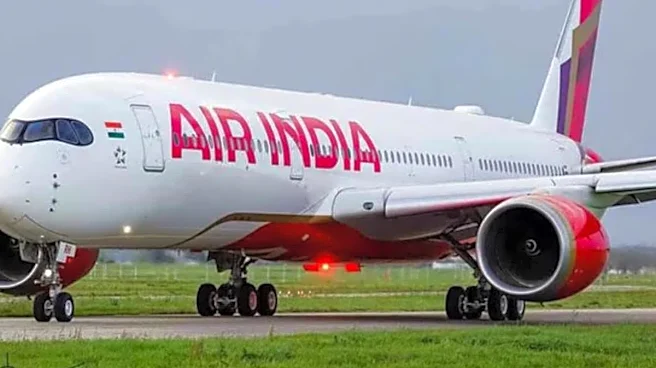



For years, passengers travelling on Air India’s domestic and international flights enjoyed complimentary meals. The perk helped distinguish full-service airlines from budget carriers, where passengers typically pay extra for almost everything. But that may soon change.
Air India is reportedly considering making meals optional for some economy-class passengers on select domestic and short-haul international routes. Passengers who choose not to take a meal could receive a discount on their ticket price.
The proposal raises a bigger question for an airline battling higher fuel costs, a weakening rupee and rising operating expenses amid the fallout of the Iran-Israel conflict: Is India’s flagship carrier quietly redefining what “full-service” travel
means?
Why Air India Is Looking To Cut Costs
Air India is operating in one of the toughest environments the aviation industry has faced in years. Airlines are dealing with rising fuel costs, airspace disruptions linked to the West Asia conflict, a weaker rupee and increasing operational expenses.
Reports suggest that Air India posted a full-year loss of Rs 26,798 crore, inflicting a $743 million hit on Singapore Airlines’ bottom line in the first full year since the carrier acquired a 25.1% stake in the Tata Group airline.
Singapore Airlines (SIA) reported a 57.4% fall in full-year net profit to $930 million (SGD $1.18 billion) even as operating profit surged 39% to $1.89 billion (SGD 2.4 billion). Its annual statement also showed Air India’s hefty annual losses.
The airline has already announced sweeping international schedule cuts between June and August, including 40% reduction in North America operations, and suspended flights on several overseas routes as part of broader cost-control measures.
Services on routes such as Delhi-Chicago, Delhi-Newark and Mumbai-New York are being temporarily suspended, although the airline has added four extra Mumbai-Newark flights, taking that route to seven weekly services.
At the same time, India’s aviation market remains fiercely competitive. Airlines often slash fares to attract passengers, leaving little room to absorb rising costs.
This creates a difficult balancing act. Airlines need to keep tickets affordable while finding ways to improve profitability. That pressure is forcing carriers to re-examine everything from flight schedules to in-flight services. Now, even complimentary meals are under scrutiny.
Why Airlines Are Ending The ‘Free’ Experience
Over the last two decades, airlines around the world have steadily moved towards what’s known as “unbundling” — separating services that were once included in the ticket price.
Instead of paying for one all-inclusive fare, passengers increasingly pay separately for meals, baggage, preferred seats, lounge access and priority boarding. The logic is simple. Not every passenger wants every service.
Currently, low-cost carriers (LCCs) operate under three models: ultra low-cost carriers (ULCCs), traditional low-cost carriers and hybrid low-cost carriers.
ULCCs focus on extreme cost efficiency, operating mostly short-haul, point-to-point routes via secondary airports to reduce expenses.
LCCs operate similarly but may include some medium-haul routes and use a mix of secondary and major airports. LCCs distribute tickets both directly and through select third-party sales channels, focusing on competitive promotions.
A traveller on a one-hour flight may prefer a cheaper ticket rather than paying for a meal they do not intend to eat. Airlines, meanwhile, reduce costs while generating additional revenue from passengers who choose extras. This model has already become standard among low-cost carriers.
The difference is that Air India has traditionally positioned itself as a full-service airline. If meals become optional, the gap between full-service and budget airlines could become much smaller than before.
What It Means For Passengers
For many travellers, the proposal could actually mean cheaper fares. Reports suggest passengers who opt out of meals could save more than Rs 250 on certain routes. For families booking multiple tickets, the savings could be meaningful.
A growing number of passengers may welcome the flexibility. Younger travellers, frequent flyers and business commuters often prioritise price over in-flight meals, particularly on shorter routes. Many already carry their own food or prefer eating at the airport before departure.
According to a Times Of India report, Air India could be looking at unbundling lounge access for business class passengers because those opting out of this could get cheaper flight tickets. Lounge operators charge Rs 1,100-Rs1,400 user at metro airports and Rs 600-Rs 700 at non-metros.
However, passengers may start wondering what other services could eventually become optional. If meals can be removed from the fare, could baggage allowances be next? Could lounge access, seat selection or other benefits gradually become add-ons?
Are Full-Service Airlines Becoming Budget Airlines?
Not exactly. But the line separating the two is becoming increasingly blurred. Today’s airlines operate in a world where passengers expect low fares but also want convenience and comfort. To survive, many carriers are trying to create hybrid models that combine elements of both.
Passengers get a lower base fare and then choose which services they want to pay for. The result is greater flexibility, but also greater complexity. The final cost of travel increasingly depends on the choices a passenger makes after booking.
For airlines, this model offers new revenue opportunities. For travellers, it means paying closer attention to what is, and is not, included in the ticket price.
Could Other Airlines Also Follow?
The debate over complimentary meals reflects the future of air travel. India is one of the world’s fastest-growing aviation markets. It handles roughly 350 million air passengers annually. The number of airports in the country has surged from 74 in 2014 to 163, with a target to reach over 350 airports by 2047.
According to McKinsey data, ULCCs outperformed legacy airlines across the world from 2012 through 2019. This trend was especially pronounced in the years leading up to the Covid-19 pandemic, when ULCCs benefited from structurally leaner cost bases than legacy carriers, thanks to simplified operations and lower overhead and labour costs.
Almost all major US and European legacy carriers (e.g., Delta, American, British Airways) sell “Basic Economy” tickets that exclude checked bags and advance seat assignments.
Carriers like United Airlines, Lufthansa Group, Air France, and Qatar Airways offer unbundled Business Class tiers (sometimes called ‘Light’ or ‘Base’ fares) that do not include lounge access, flexible ticket changes, or advance seat assignments.
Whether Air India will stop serving free meals is not the bigger question. It seems that the era of the traditional full-service airline — where most services came bundled into the ticket price — is slowly coming to an end.
/images/ppid_59c68470-image-178089756597095710.webp)



/images/imfZ6nBC-image-178088853565746568.webp)