

/images/ppid_59c68470-image-178859002374538077.webp)

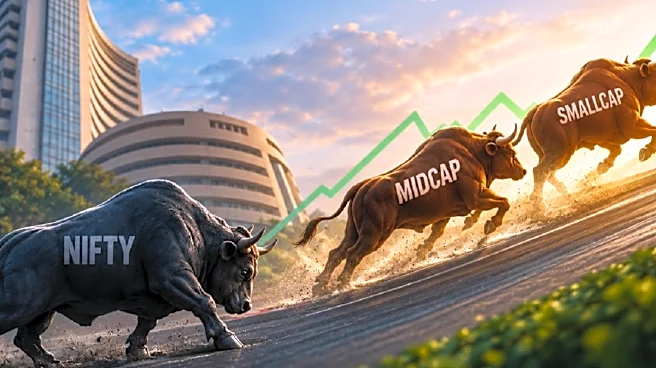
India’s benchmark Nifty has increasingly diverged from the broader market, with mid-cap and small-cap indices trading near or at lifetime highs even as the large-cap index struggles to gain meaningful momentum.
The divergence comes despite a relatively strong macroeconomic backdrop. India’s Q1 FY27 GDP growth came in at 7.8%, auto sales have remained supportive and Japan Credit Rating Agency recently upgraded India’s sovereign rating from BBB+ to A- with a Stable Outlook.
So, why isn’t the strength in the economy translating into a broad-based rally in large caps?
Market experts say the answer lies in a combination of index composition, earnings momentum, liquidity flows and global headwinds.
The Nifty 50 has fallen 4.13 per cent in the past one
year to trade near 23,780. However, the Nifty Smallcap 100 surged 13.48 per cent during the same period at near an all-time high of 20,187, while the Nifty Midcap 100 rose 9.64 per cent to trade at its nearly all-time high of 64,450.
Nifty is concentrated in sectors facing headwinds
Pravesh Gour, senior technical analyst at Swastika Investmart, said the divergence is less about weak fundamentals and more about where liquidity and earnings momentum are concentrated.
“Nifty is heavily dependent on a handful of large-cap sectors, particularly banks, Reliance, IT and FMCG, and these stocks have not delivered the same price momentum as several mid- and small-cap companies,” Gour said.
The broader market, meanwhile, has been driven by sectors such as defence, railways, capital goods, power, renewable energy and electronics, where investors have been betting on stronger structural growth and higher capital expenditure.
Sanjit Singh Paul, smallcase manager, managing partner and principal officer at Modular Advisory Services, said the divergence can be viewed from two perspectives — the changing investor base and the changing sectoral leadership of the market.
“Retail investors are having a shift in risk appetite and are investing more in mid and small-caps, not just directly but through Mutual Funds as well. This has been supported by PMS and AIF inflows as well,” Paul said.
At the same time, sectors that dominate the Nifty — financial services, oil and gas, IT, FMCG and auto — have been relatively subdued, while several sectors driving the broader market have seen stronger earnings growth.
FII flows have not necessarily helped Nifty
Foreign investor flows are another important piece of the puzzle. Although FII flows turned positive in July and remained supportive in August, this did not translate into a broad-based buying spree in Nifty constituents.
Gour pointed out that even after FII inflows of around $3.2 billion in August, the Nifty remained weak because a significant portion of foreign money went into the primary market and selected stocks rather than across Nifty heavyweights.
The recent rise in global bond yields has also complicated the recovery in foreign flows.
“While overall FII flows turned decisively positive in July and the momentum continued into August, the sharp rise in global yields has once again resulted in negative flows in the last week,” said N ArunaGiri, founder and CEO of TrustLine Holdings.
This means that a simple reversal in FII selling may not be enough to trigger a sustained large-cap rally.
IT and financials hold the key
The composition of the Nifty makes sectoral participation particularly important. Financials and IT together account for a significant portion of the index, but both are facing different challenges.
“Both these sectors are facing their own set of headwinds. While the outlook for banks and financials remains reasonably positive, the technology sector has to navigate the growing uncertainties and headwinds arising from AI,” ArunaGiri said.
For banks, the key concern is margins. Paul said net interest margins at several large banks have been under pressure as earlier interest-rate cuts reduced lending yields faster than deposit costs adjusted.
However, stronger economic growth could support credit demand and loan growth. If deposit costs eventually reprice lower and margins stabilise, banking earnings could provide an important catalyst for the Nifty.
“Banking, which has a significant weight in the NIFTY, is particularly important,” Paul said.
Strong GDP alone is not enough
The disconnect also highlights an important distinction between economic growth and stock-market performance. A strong GDP number does not automatically mean that the largest companies in the stock market will deliver the strongest earnings growth.
“Alongside strong GDP growth, however, corporate earnings and EPS need to grow as well,” Paul said.
The June 2026 quarter showed encouraging signs, but investors will need to see that improvement sustained over the next few quarters before large caps can undergo a meaningful re-rating.
This is particularly important because mid- and small-cap valuations have already benefited from expectations of stronger earnings in several new-economy and capex-linked sectors.
Could the broader-market rally eventually feed into Nifty?
There is also a structural explanation for the current divergence. “Smaller companies with sectoral tailwinds grow to become the bigger companies of the future,” Paul said.
The Nifty’s composition changes over time, with companies gaining size and market capitalisation eventually replacing slower-growing constituents. Today’s mid- and small-cap leaders in areas such as defence, capital goods, power, electronics and renewable energy could become tomorrow’s large caps.
“Over time, the new economy sectors, which are currently mid- and small-cap companies, will replace these current stalwarts. That is how the index also churns using the Size factor,” Paul said.
This suggests that the current divergence does not necessarily represent a structural failure of the Nifty. Instead, it could reflect a period of transition in market leadership.
What can bring Nifty back?
In the near term, experts see three broad triggers: lower crude oil prices, softer global bond yields and stronger earnings from Nifty heavyweights. Crude oil prices near $100 a barrel, geopolitical tensions in the Middle East and elevated US bond yields are keeping global investors cautious.
“If crude cools, global yields stabilise and heavyweight earnings improve, a rotation from expensive mid/small caps towards large caps could emerge, allowing Nifty to catch up with the broader market,” Gour said.
Paul similarly expects easing geopolitical tensions, lower crude prices and softer US bond yields to improve the environment for foreign portfolio flows into Indian large caps.
But ArunaGiri is more cautious. “It is difficult for the Nifty and Sensex to deliver any meaningful performance, even if FII flows were to turn dramatically favourable, unless their largest constituents – financials and IT – begin to participate,” he said.
/images/ppid_59c68470-image-178879003628561308.webp)


/images/ppid_59c68470-image-178874252709286077.webp)

/images/ppid_59c68470-image-178875012212046842.webp)
/images/ppid_59c68470-image-178874511880615939.webp)

/images/ppid_59c68470-image-178880008594447409.webp)