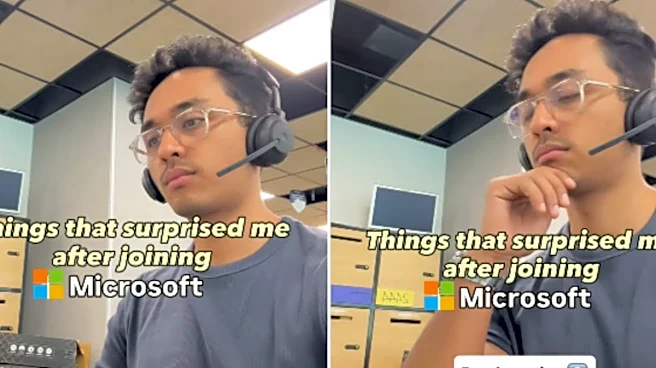



A techie who started his career at TCS has opened up about how his transition to Microsoft changed the way he viewed corporate life. Sharing his experience of working in both service-based and product-driven environments, Sailesh Gurung pointed to major differences in workplace culture, hierarchy, flexibility, perks and ownership.
Gurung said he joined TCS as a fresher immediately after graduation, at a time when his understanding of corporate life was largely limited to following established processes and completing assigned work. “I joined TCS as a fresher right after graduation, so my idea of corporate life was pretty simple: log in, follow the process, log out,” he wrote on Instagram.
However, according to him, his outlook changed considerably
after he joined Microsoft. One of the biggest differences he noticed was the workplace culture and hierarchy. Describing the shift as significant, Gurung said, “The culture shift is REAL”. He explained that hierarchy had felt much more visible in his earlier service-based setup, with multiple levels of approvals and seniority.

“At Microsoft, it feels… flat. You can reach out to anyone, collaborate across teams, and actually be heard,” he said.
Another aspect that surprised him was the relaxed approach to workplace attire. Gurung contrasted his earlier experience of wearing formal clothes regularly, with limited flexibility during the week, with Microsoft’s more casual environment.
“No dress code. Earlier: Formals every day (except Friday freedom). Now: Just be presentable. Wear what you want. Be yourself,” he said.
He also pointed to the range of activities and facilities available on the Microsoft campus, saying the office environment extends beyond work-related responsibilities. According to Gurung, hackathons, cross-team events, gaming zones, chill spaces and areas to rest and reset contribute to a more employee-friendly atmosphere.
The ability to bring family and friends to the campus was another difference he found notable. “You can bring your world to work. At Microsoft, you can bring your family or friends to the campus, show them around, grab food together—even on weekends. That’s something I never experienced in service-based setups,” Gurung wrote.
Beyond workplace perks, he said the biggest professional change for him was the sense of ownership. While his previous experience had sometimes felt shift-based, with work being handed over from one person to another, he said his role at Microsoft involved greater end-to-end responsibility.
“Ownership hits different. Earlier, work felt shift-based. You do your part, the next person takes over. Here, it’s yours. End to end. The responsibility is heavier… but so is the growth (and the pay),” he said.
Gurung also highlighted what he described as smaller but meaningful workplace conveniences, including better food, coffee, infrastructure, massage chairs and spaces where employees can take a break. “It’s like the workplace is designed for humans, not just employees,” he said.
While acknowledging that the two workplaces offered very different experiences, Gurung described his journey as a transition from a “structured service world to a product-driven one”, with each environment teaching him something different.
His post sparked a discussion among social media users, with several people sharing similar experiences.
One user wrote, “So true, even I shifted to a product firm after being in consulting for 10 years. This shift is real, and it’s taking me time to adjust. It’s like a new free way of working, that I haven’t experienced earlier.”
Another user argued that such an environment is not exclusive to Microsoft, saying, “This is the condition of any company with non toxic work culture not just Microsoft.”
A third user agreed with Gurung’s assessment of the workplace culture, commenting, “Could not disagree cultural shift is the best shift + ownership.”
However, not everyone found the idea of ownership surprising. One user, who identified as being from the automobile industry, said, “As someone from automobile industry, I find it weird. It may not always be written but ownership is always ingrained.”
Gurung’s journey also prompted aspiring professionals to seek advice. One user asked, “Bro I’m in the same stepping stone as you are let me know the process to be in MS someday.”
Another commenter, claiming to have spent more than a decade at Microsoft, backed Gurung’s assessment, writing, “100% true, been with MSFT for over 10 years and the culture is by far the best.”
Disclaimer: This article is based on user-generated content. The claims made in the original post have not been independently verified by News18.
/images/ppid_59c68470-image-178819267700747486.webp)