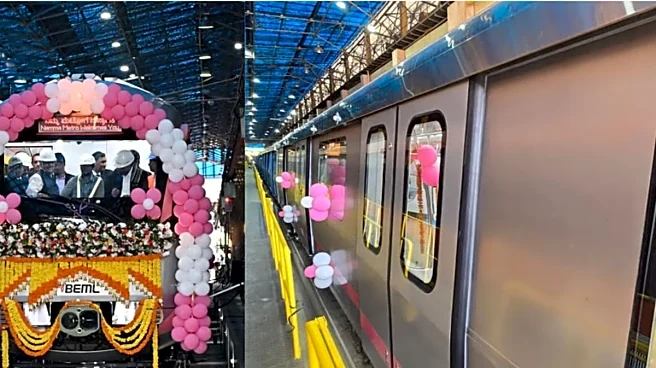




Bengaluru’s Pink Line saw its first driverless metro train run yesterday. The trains are not ready for commuters yet, platforms are still being tested, and full operations are months away. But that didn’t stop people from noticing one thing immediately. The front cabin was empty.
For a city that has grown used to peeping into the glass cabin and spotting a loco pilot focused on the track ahead, the silence felt strange. This wasn’t shock. It was hesitation. Bengaluru has embraced technology before, but it has also learned to ask questions the hard way.
Here are the 10 questions a common Bengaluru commuter is already asking, and the answers that matter.
- If there is no driver, who is actually driving the train?
No one sitting inside the train, but the train is not “alone”.
Driverless metros are controlled
from a central operations control centre. Every movement, speed change, stop and restart is monitored live by trained staff watching multiple screens, feeds and system alerts. Think of it less like a car without a driver and more like a plane on autopilot with air traffic control watching every second.
- If someone jumps on the track, who will stop the train?
This is the biggest fear in Bengaluru, and understandably so.
The system uses automatic train protection. If anything abnormal is detected ahead, the train applies emergency brakes automatically, often faster than a human reaction. On sections with platform screen doors, physical access to tracks is already blocked. On open sections, CCTV feeds and intrusion alerts are constantly monitored from the control room.
No driver does not mean no brakes.
- What if the software fails or hangs, like a phone does?
Metro software does not work like mobile apps.
These systems are designed with multiple redundancies. If one layer fails, another takes over. If something does not match safety parameters, the train defaults to the safest option: stopping. Driverless systems are built to fail safely, not fail fast.
- Who decides when to stop in an emergency?
The train does not “decide” on its own.
Sensors detect speed, distance, obstacles and signal conditions. If limits are crossed, the system stops automatically. At the same time, human controllers in the control room can manually halt trains across sections if needed. There is always a human override, just not inside the cabin.
- Can a driverless train see better than a human?
In many ways, yes.
Humans get tired, distracted, stressed. Systems do not blink, sneeze or zone out. Cameras, sensors and signalling systems monitor conditions continuously. That said, systems lack instinct, which is why they are paired with human supervision from the control centre.
It is not humans replaced. It is humans relocated.
- What about sudden crowd behaviour, panic or chaos inside coaches?
Just like today’s metro, emergency communication systems remain active.
Passengers can use emergency buttons, alarms and intercoms to alert staff. The difference is that the response comes from the control room and platform staff, not the front cabin. Trains can be halted, announcements made and help dispatched within seconds.
- Why remove the driver at all? Wasn’t the old system working fine?
It was working, but cities are planning for scale.
Driverless metros allow tighter schedules, more frequent trains, lower human error risk and better coordination during peak hours. For a city like Bengaluru, where future ridership is expected to explode, automation is about capacity, not cost-cutting alone.
- Has this worked elsewhere, or are we guinea pigs?
We are late, not early.
Driverless metros operate safely in cities like Singapore, Paris, Dubai and parts of China. Even in India, systems are moving toward higher automation levels. Bengaluru is catching up, not experimenting blindly.
- What if power goes off mid-journey?
Power failures are already planned for.
Backup power systems allow trains to brake safely and communicate with the control centre. Evacuation procedures, platform protocols and rescue drills remain part of operations, just as they are now.
Driverless does not mean powerless.
- Will people eventually trust this?
Probably. Slowly.
People once feared elevators without operators, flyovers without policemen, and ATMs without bank staff. Trust did not come from explanations. It came from repetition. From trains running every day without incident.
In Bengaluru, trust arrives after habit sets in.
The Real Story Is Not Technology, It Is Transition
The Pink Line’s driverless train is not just a technical milestone. It is a psychological one. For many commuters, the unease has little to do with engineering and everything to do with habit. For years, a human presence in the front cabin offered silent reassurance, even if that person never interacted with passengers.
What often helps calm that anxiety is context. Driverless metro systems have been operating for decades in cities such as Singapore and Paris, some since the late 1980s and early 2000s. Dubai’s fully automated Metro has been running without drivers for over 10 years, carrying millions of passengers daily. Delhi and Mumbai metros also have driverless trains running successfully for years.
These systems have logged billions of passenger journeys with strong safety records, not because humans were removed, but because multiple layers of technology and human supervision work together.
In Bengaluru, trust will not arrive overnight. It will arrive one smooth ride at a time. The empty cabin that feels unsettling today may soon become just another reflection commuters walk past, eyes already back on their phones, the city moving quietly forward beneath their feet. That is how cities change, one quiet doubt at a time.

/images/ppid_a911dc6a-image-177089857481720650.webp)

/images/ppid_a911dc6a-image-177089866690032944.webp)
/images/ppid_a911dc6a-image-177089871495294861.webp)
/images/ppid_a911dc6a-image-177089853476914935.webp)
/images/ppid_a911dc6a-image-177089863165870219.webp)