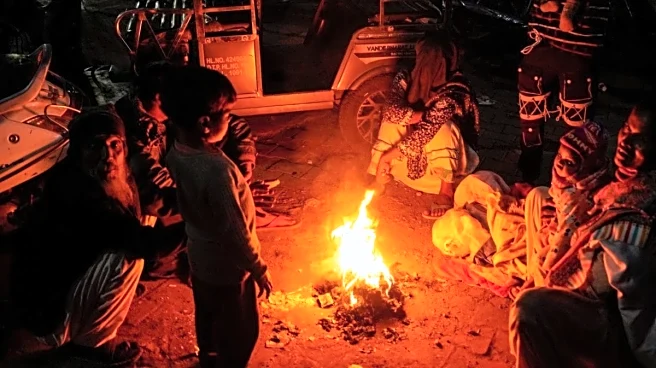

Several parts of northern India are set to remain in the grip of freezing temperatures, with the India Meteorological Department issuing a cold wave warning for the next few days in Delhi and the National
Capital Region, as well as Haryana, Punjab, Rajasthan, Uttar Pradesh, Uttarakhand and Himachal Pradesh, according to official information on Sunday.
In the bulletin issued on Sunday, the IMD said that cold wave to severe cold wave conditions are very likely at isolated places over Himachal Pradesh, Rajasthan, west Uttar Pradesh. Isolated places over Haryana, Chandigarh, Delhi, Punjab, Saurashtra and Kutch, and Uttarakhand may witness cold wave conditions on Monday, January 12.
The IMD said cold wave conditions are very likely to continue on Tuesday at isolated places across Himachal Pradesh, Jharkhand, Rajasthan, Uttarakhand and west Uttar Pradesh. In Jharkhand, the cold wave is expected to persist till Thursday.
Surprisingly, the temperatures in plains, including Delhi and Chandigarh, have dipped below those in hilly cities such as Shimla.
The IMD forecast, on Monday, said that Shimla is likely to experience maximum and minimum temperatures of 16 and 9 degrees Celsius respectively. For Delhi, the weather department said the minimum temperature could fall to between 3 and 4.2 degrees Celsius on Monday, while the maximum is expected to remain in the range of 18 to 20 degrees Celsius.
Himachal Pradesh districts such as Shimla and Kullu have not been issued any warnings for the rest of the week, while Delhi is expected to experience cold wave conditions over the next two days, followed by partly cloudy skies in the subsequent two days.
The IMD said there is no major forecast of significant rain or snowfall over the next six days, though several parts of Uttar Pradesh may experience dense fog on Monday. Dense fog is also very likely at isolated places across Bihar, Haryana, Chandigarh, Delhi, Himachal Pradesh, Jammu and Kashmir, Ladakh, Punjab, Rajasthan, sub-Himalayan West Bengal, Sikkim and Uttarakhand.
These areas are likely to be engulfed in dense fog till Thursday, January 15.
The IMD said cold wave and severe cold wave conditions could have wide-ranging impacts, affecting health, agriculture, transport and other aspects of daily life.
The IMD listed several possible impacts, including a higher risk of illnesses such as flu, runny or blocked nose and nosebleeds due to prolonged exposure to cold. It advised people not to ignore shivering, describing it as the first sign of heat loss, and urged them to move indoors.
Prolonged exposure can also lead to frostbite, in which the skin becomes pale, hard and numb, with black blisters forming on exposed parts such as fingers, toes, the nose or earlobes, requiring immediate medical attention in severe cases.
The cold wave may also affect agriculture, crops, livestock, water supply, transport and the power sector in some areas.
/images/ppid_59c68470-image-177073503438256591.webp)