
“The more things change, the more they remain the same.” — Jean-Baptiste Alphonse Karr
Twenty years and many elections later, with changing political actors, Punjab continues to wrestle with the same old issues of the drug menace, joblessness, unending migration, agricultural crisis, governance and mounting debt. Yet another election is in sight; the public faces a bigger dilemma than it did in the past.
Looking at the key poll issues that dominated the past three Assembly elections in Punjab, I found that the issues have changed remarkably little. Political actors have changed. Governments have changed. Fifteen years have passed.
Yet Punjab seems to have been confronting much the same predicament election after election.
The political narratives
are repackaged. But beneath the cacophony, the unease in Punjab remains remarkably familiar.
2007: Congress Hatao
The Congress under Captain Amarinder Singh was accused of not delivering development and enough employment opportunities for the youth; hence, Punjab witnessed large-scale migration of young people during his tenure.
The anger was directed towards Amarinder Singh, who was hailed in public as the Maharaja of Patiala and remained inaccessible to the hoi polloi, or the common people.
The slogan was coined as “Congress hatao”, or remove the Congress.
Captain Amarinder Singh’s government crumbled under its own weight amid rural economic stress, charges of a royal style of governance and anti-incumbency.
The narrative built around the 2012 election was centred on how the Akali-BJP combine would bring a whiff of fresh air to Punjab and ensure all-round development.
2012: Hun Badal Nu Mauka Do
Prakash Singh Badal was a tall political figure, and his promise was: “Congress ko bahut dekh lya, hun Badal nu mauka do” (you have seen enough of the Congress; now give Prakash Singh Badal a chance).
Punjab did listen to Prakash Singh Badal, who believed in taking adversaries along instead of confronting them.
The Congress failed to prove that it was a credible alternative, while Badal modelled himself as a leader who cared for Punjab, Panjabiyat and was a harbinger of Hindu-Sikh unity.
He, no doubt, brought political stability, big-ticket investment and an upgrading of infrastructure (i.e., highways, airports, promotion of Sikh legacies and welfare schemes) without hyping up the work his government did.
Until 2017, the drug menace was not seen as a defining political issue, yet the ugly face of the tragedy was looming large.
Hospitals and drug addiction centres were increasingly visible, but the drug issue was not strong enough to dictate the political narrative and, ultimately, the results at the hustings.
Prakash Singh Badal was given another chance in 2012 on the promise: “Kamm kitta hai, kamm karange” (We have worked and we will work again).
Voters are indeed gullible, but political spin masters are not, as they devise and propagate political narratives ahead of polls.
The Drug Crisis: The Storm Before 2017
While the SAD-BJP combine was still in power, a film called Udta Punjab brought the drug crisis to the fore in 2016, one year ahead of the Assembly elections.
Who knew that the drug crisis would become a defining flashpoint ahead of the elections and bring down Badal’s government in Punjab?
The drug crisis and incidents of sacrilege hit the Akalis hard, making them political pariahs in 2017 and ultimately paving the way for Captain Amarinder Singh’s return from political oblivion. He had been ousted in 2007 amid charges of misgovernance.
2017: Badals Ko Hatao
Captain Amarinder Singh, who had been politically marginalised after his defeat in 2007, returned as the Congress’s principal challenger to the SAD-BJP government.
During the campaign, Amarinder Singh took an oath on Gutka Sahib and promised to break the backbone of the drug mafia within four weeks of assuming office.
The promise became legendary. The visual imagery proved powerful.
But the drug mafia did not disappear. The chitta crisis did not disappear either.
For decades, Punjab’s youth had struggled with traditional substances such as bhukki — poppy husk. The new scourge was chitta, a colloquial term associated with highly addictive synthetic and pharmaceutical opioid mixtures.
The drug mafia spread its tentacles into every nook and corner of Punjab.
The bodies of young Punjabis kept emerging from far-flung villages and cities.
De-addiction centres remained full.
The voters punished the Badals; no party could claim immunity from the ignominy and stigma attached to drugs.
Badlaav 2022 — The Change
AAP swept the elections, winning a record 92 of the 117 seats and virtually decimating the traditional two-party order. The message from the public was unmistakable: Punjab wanted a big change.
The young voter who demanded badlaav in 2022 is now asking whether that change has transformed their life.
The actors have changed. The political lexicon has changed. The predicament has not.
The drug crisis may no longer make headlines every day, but that does not mean it has disappeared.
Young Punjabis continue to die, families continue to suffer, and the crisis refuses to go away.
Headlines often betray the truth.
Reality remains buried somewhere in the middle of the political cacophony.
And this is where the 2027 election becomes more fascinating.
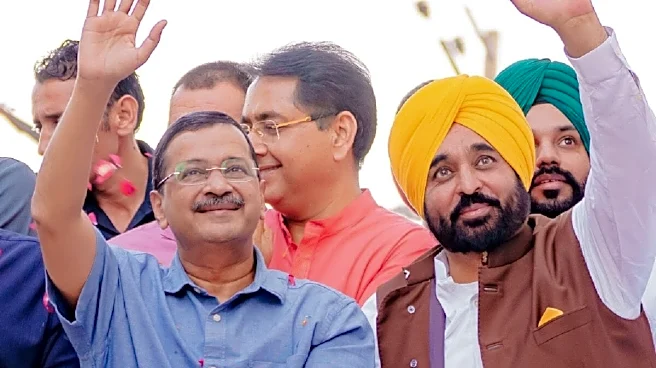
Will the electorate judge the Bhagwant Mann government on its performance? Punjab’s unresolved social and economic anxieties continue to worsen.
Will the old issues — drugs, jobs, agriculture, debt and migration — again determine the election? Or will Punjab finally move beyond them?
Arvind Kejriwal and the AAP leadership will attempt to defy the conventional wisdom that five years in power inevitably produces anti-incumbency.
Punjab, meanwhile, has roughly six months to make up its mind.
The faces may change again.
The slogans certainly remain the same.