
/images/ppid_59c68470-image-17891275881737722.webp)


“There is one more thing” – as expected, the unfolding of the Apple iPhone Fold or Ultra.
Apple named its first foldable phone the iPhone Duo to highlight the device’s two functional displays or dual-screen nature, rather than just its folding design.
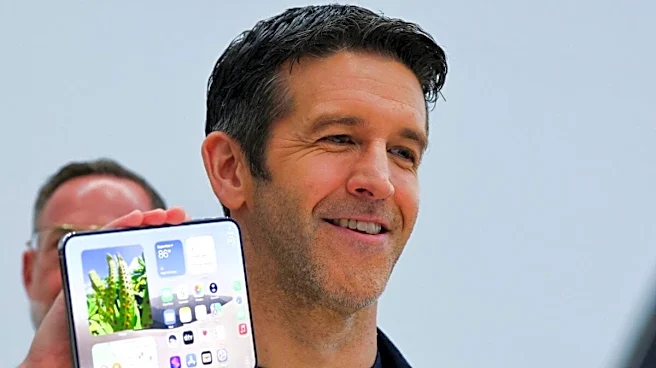
The presentation started with John justifying the need for a portable hub with a bigger display, comparing how others have just joined two phones to achieve that, while highlighting issues such as the aspect ratio and a few other drawbacks. They designed the Duo with the iPad in mind, engineered the display and, with software design, achieved a remarkable innovation that will redefine the experience of using a foldable phone, which he (John) flaunts by revealing the handset and the name – iPhone
Duo.
Part I | Opinion: They Came, They Saw, But Did They Conquer?
I cannot recollect seeing Steve Lemay, Human Interface, or Molly Anderson, Industrial Design, during previous launches. But they both did a fair job narrating how they jointly put the idea and design into production.
Molly presents the similarity of the Duo to a passport, comfortable to hold in one hand, while retaining the versatility of an iPad, with a narrow, uniform border creating a bigger and more immersive display for both landscape and portrait use. She explains how the transition between the iPhone being open and closed was made fluid and intuitive by designing around a consistent aspect ratio. And then (to my joy) she mentions that the FaceTime camera gets hidden behind the display, only to be revealed when required (a melancholic feel).
The custom variable torque profile hinge mechanism precisely controls the opening and closing smoothly. When open, at 5.2 mm, it’s thinner than my iPhone Air, which is 5.4 mm, but not to ignore the slightly thick camera plateau.
But then she mentions the use of a grade-5 aerospace-grade titanium frame. . . Oops!! Just 12 months ago, Apple moved from titanium to an aluminium frame during the launch of the iPhone 17 series to improve thermal heat dissipation and reduce weight. She justified switching to titanium to achieve strength in this thin form factor, with Ceramic Shield added on the back and Ceramic Shield 2 on the front. While it makes sense, I feel the device will heat up with prolonged usage.
We need to wait till we get our hands on the Duo.
Steve briefed us on how they moved the dock from the bottom to the sides to maximise vertical space for content, while also making the controls within easy reach of our thumbs. A minor change that existing iOS users will need to get used to while using the new Duo. The status bar now fits into a compact sphere below the camera on the folded phone to manage the smaller cover display size, i.e. 5.4 inches. Steve goes on to explain how hardware and software integration made it possible to multitask, half-folding the handset to use it like a mini laptop, with the flat part of the display working as a keyboard, along with other details.
When unfolded, the 7.6-inch Super Retina XDR display is 50% larger than that of the iPhone 18 Pro Max and is slightly smaller than Apple’s 8.3-inch iPad mini. My thoughts during the event – can the iPhone Duo replace my iPhone Air and iPad mini? The iPhone Duo will put less stress on my hands while watching a video or reading eBooks, as it weighs 254 grams versus the 297-gram iPad mini. The addition of an Apple Pencil with USB-C later this year will make the Duo an all-in-one device for my use case!
Removing facial recognition to unlock the phone or adding a thumb impression on the lock screen really doesn’t make such a great impact on me, as I still prefer typing the four- or six-digit PIN to unlock my phone or iPad. But critics will surely find this change to be a big deal. I wonder why Apple couldn’t continue keeping the facial recognition feature for the Duo. Immersive spatial audio in both landscape and portrait modes from the speakers is another thing I’m looking forward to, as Joz (Greg Joswiak) mentioned.
Craig Federighi couldn’t impress me much with that ‘more focused wallpaper’ on the lock screen with a minimalist view, split-view multitasking, swapping apps, which we already use on the iPad and MacBook, using orientation or pose, and using the sensors in each half to set it on a table, partially folded, to watch a show or use it as a Rs 2,99,990 bedside clock … duh!
Sixty-six minutes into the show, Johny Srouji (Chief Hardware Officer), who joined Apple in 2008 to lead the A4 custom chip, explained that Apple had kept in mind how consumers dislike the distracting crease, the plastic feel, and susceptibility to scratches and dents while designing the iPhone Duo.
A nano-textured finish created using maskless laser lithography, with every micro-lens written pixel by pixel, reduces glare and reflection, resulting in a perceptually flat matte surface that minimises crease visibility and gives a premium touch. The graphical animation showing 100 tiny precision components with carbon fibre support plates that create a stiff, lightweight hinge made my heart skip some beats!
No wonder AppleCare+ costs a whopping Rs 51,900!
While I cannot quote each point that Joz explained during the presentation, it was a pleasure listening to the detailed hardware architecture in his Israeli accent. Probably I’m more biased towards hardware tech than software.
While many might have been disappointed when Joz mentioned that it would be eSIM-only worldwide, I don’t find it a challenge, as I have been using the iPhone Air for 12 months now. It might be a challenge for those who frequently change their numbers or carriers.
The rear dual-camera system, which lacks a dedicated telephoto lens, might also be disappointing for some. Though, for non-professionals, the 48-megapixel Fusion camera with 2x telephoto, along with the 48-megapixel Fusion Ultra Wide lens, should suffice. In my opinion, a serious photographer might skip the Duo and go for the 18 Pro or 18 Pro Max.
To summarise, here are the key takeaways.
Key takeaways:
- Apple still excels at presentation, product storytelling, and making hardware feel desirable.
- The iPhone 18 Pro offers meaningful internal and camera upgrades, but little visual change.
- Camera controls and photographer-friendly features are among the strongest iPhone 18 Pro improvements.
- Apple’s India pricing is a recurring frustration across iPhone, Watch, and Duo products.
- AirPods 5 may attract buyers because ANC is now available at a lower price point.
- Apple Watch Series 12 and Ultra 4 feel more health-focused but not dramatically new.
- The iPhone Duo is the most interesting launch, combining strong hardware engineering with an extremely high price.
- I am personally drawn to the Duo as a possible replacement for both my phone and iPad mini, but I remain cautious about heat, high pricing, and real-world usability.
- Apple’s strategy with the iPhone Duo feels clear: create a product that signals exclusivity. Not everyone will buy it, and that may be the point. It is aimed at buyers who already choose status-led products like Rolex or Omega watches, Cartier Panthère eyewear, Shiels Jewellers Emerald glasses, or Hermès laptop bags. For others, the more practical route will be buyback offers, EMIs, or discounts on the Pro models. And for the mass market, Apple still has the iPhone 18 and 18e, though buyers may need to wait another six months.
Some open questions:
- How well will the new Apple products “shine” once we have used them hands-on?
- Is the iPhone 18 Pro pricing driven by chip shortages, global price fluctuations, geopolitics, import duty, taxation, or something else?
- Why did Apple not improve the iPhone 18 Pro telephoto lens to 15x or 20x optical zoom?
- Will the iPhone Duo heat up during prolonged use because of the titanium frame?
- Why could Apple not retain facial recognition on the iPhone Duo?
- Will the iPhone Duo’s speakers deliver the promised immersive spatial audio experience?
- Does the iPhone Duo truly “conquer”, or is it mainly a beautifully engineered but very expensive late entry into foldables?
The opinions expressed in this article are those of the author. This is not a sponsored post.