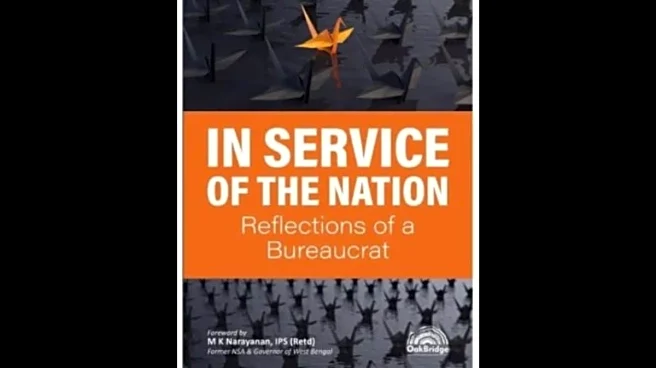



In the era of Artificial Intelligence (AI), India’s bureaucrats of the future should be fluent with technology, be collaborative and open to learning new methods of governance, Pratap Singh, Director General of Income Tax (Investigation) in Chennai, writes in his memoir ‘In Service of the Nation: Reflections of a Bureaucrat’.
A 1991-batch officer of the Indian Revenue Service (IRS), Singh says bureaucrats today are not only “implementers” but “co-creators” of the country’s digital governance ecosystem.
At the launch of his memoir earlier this month in Chennai, Singh said through the book, he aimed to bring forth an insider’s perspective on the workings of the Income Tax Department, an area seldom chronicled by officers of the IRS.
The book-launch
event was attended by Amitabh Kant, former G20 Sherpa, and MK Narayanan, former National Security Adviser (NSA).
In Service of the Nation marks the third publication by Singh. He earlier wrote ‘Reforms in Tax Administration’ and ‘India’s Odyssey’.
In his memoir, Singh brings out the ethical, emotional as well as personal dimensions of public life, such as family sacrifices, the pressures of frequent transfers, and the weight of accountability.
Through each chapter, a unifying idea emerges with clarity: bureaucrats are the silent custodians of the Indian Republic. Their work touches every aspect of national life—taxation, infrastructure, welfare delivery, environmental management, digital governance, public safety, and crisis response. They provide continuity amid political change, stability amid uncertainty, and operational certainty in moments of national transition.
The book unfolds through a series of chapters, each capturing a defining phase, experience, or reflection from Singh’s life and career. It begins with vivid recollections of his childhood in a small village without electricity or modern amenities, where curiosity and determination first took root. From there, it follows his educational journey through Aligarh Muslim University and IIT Kanpur—institutions that shaped his intellectual outlook and personal values.
After documenting his formative years, the narrative shifts to his professional ascent. In Chapter six, titled ‘Years in Mumbai’, Singh recalls that he was entrusted with some of the most important and high-profile assignments of his career. These included investigations into the securities scam cases, inquiries involving HSBC and Swiss bank accounts, and later, the Panama Papers and Paradise Papers leaks.
“Through these experiences, I gained immense insights into taxation, business practices, and the economy at large by interacting with the finest tax lawyers and chartered accountants in the country.”
Notably, Singh mentions, on March 31, 2018, the closing day of the financial year 2017-18, the Income Tax Department in Mumbai mobilised revenue worth Rs 7,100 crore—a “staggering figure”.
This was a particularly high-stakes year. The revenue target had originally been set at Rs 9,80,000 crore. However, the then Chairman of CBDT, Sushil Chandra, was determined to push the department past the historic milestone of Rs 10,00,000 crore, says Singh.
“To achieve this, he carved out an additional Rs 20,000 crore as the final stretch. Half of this responsibility, a staggering Rs 10,000 crore, was placed squarely on Mumbai’s shoulders. And within Mumbai, I was entrusted with ensuring the delivery, an immense pressure.”
“Initially, as the last day unfolded, things did not progress according to plan. The figures were falling short, and the pressure mounted with each passing hour. Finally, at 5:00 PM, I left my office and personally went to the corporate headquarters of our largest taxpayer. I requested them to remit their TDS deductions for that month that very day directly into the government’s account. I explained that any excess deposited would naturally be refunded by the department in due course, and any shortfall could be made good by April 30. To their credit, they did not hesitate,” Singh writes.
Beyond his official responsibilities, Singh’s memoir explores the personal dimensions of his journey—the values and interests that have grounded him throughout his career. His initiatives in environmental restoration, including large-scale tree planting and the creation of urban micro-forests, reflect a commitment to sustainable living. And his engagement with golf speaks to a belief in discipline, balance, and lifelong learning.
Ultimately, Singh’s reflections reinforce a timely truth: India’s rise is fuelled not only by visionary political leadership or dynamic private enterprise, but equally by the thousands of officers who design frameworks, implement reforms, safeguard institutions, and uphold the rule of law.
/images/ppid_59c68470-image-177087511517964359.webp)

/images/ppid_59c68470-image-177087506780469811.webp)
/images/ppid_59c68470-image-177087509425024425.webp)
/images/ppid_59c68470-image-17708750252627929.webp)
/images/ppid_59c68470-image-177087512498797308.webp)
/images/ppid_59c68470-image-177087503117363518.webp)
/images/ppid_59c68470-image-177087502814279655.webp)