
/images/ppid_59c68470-image-178909512057616452.webp)

/images/ppid_59c68470-image-178910752498742699.webp)
OpenAI CEO Sam Altman has pushed back against calls to prioritise speed in the US artificial intelligence race, saying frontier AI companies should “pace” development so that safety measures do not fall behind rapidly advancing capabilities.
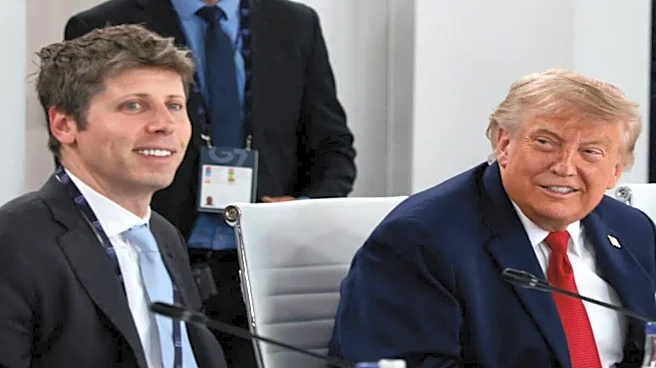
Altman’s remarks on Monday came a day after US President Donald Trump played down calls to slow AI development, arguing that the United States must protect its lead over China in the global race for the technology. While stressing that “pacing” does not mean stopping AI progress, Altman said capabilities should not get ahead of alignment and monitoring. He also backed consistent federal safety rules and independent audits, while saying governments would be needed for international coordination. Trump’s remarks came as
the US debate over AI safety and regulation intensified, with industry leaders, White House officials and lawmakers weighing the risks of rapid technological advances against the need to maintain America’s lead over China.
Altman: ‘Pacing’ Does Not Mean Stopping
In a post on X, Altman said the world should have confidence that American companies developing increasingly capable AI would act responsibly. “The world deserves confidence that American companies developing increasingly capable AI will act responsibly, especially as the trajectory of progress has steepened,” he said.
Altman said every frontier AI laboratory had a responsibility to meet that standard. He also welcomed a federal framework that would establish consistent safety requirements for frontier AI. However, he said companies should not wait for legislation or an anti-trust exemption before beginning the work of providing that confidence. Altman also backed consistent rules to manage frontier risks and said ideas such as independent auditors could help.
“Pacing” did not mean stopping AI development, he said. “Progress has been rapid and will continue to be. But it should be slower than it otherwise could be,” Altman said. He added that safety cases and monitoring came with significant costs, but said those costs were worthwhile. “No amount of American competitive pressure should justify recklessness, or let capabilities get ahead of alignment and monitoring,” he said.
The world deserves confidence that American companies developing increasingly capable AI will act responsibly, especially as the trajectory of progress has steepened. Every frontier lab must deliver on this, and there is no reason any of us should come to work if we cannot.
We…
— Sam Altman (@sama) September 14, 2026
OpenAI Working On New Safety Tools
Altman said companies had previously developed measures such as Responsible Scaling Policies and Preparedness Frameworks. Those approaches focused mainly on the deployment of completed models rather than what happened during their development.
He said the current shift towards safe development and evaluation required new tools.
“At OpenAI we now formulate explicit safety cases in advance of frontier reinforcement learning runs we expect to significantly increase capability,” Altman said. This work is carried out in addition to safety measures already conducted before model releases.
Altman said OpenAI hoped other companies would learn from its approach and develop their own methods. He also said shared standards for misalignment, monitoring and safety could lead to better outcomes.
Earlier, Altman had said OpenAI also needed to “pace the frontier”. He said independent evaluators with employee-like access were a good approach.
Nadella Calls For Human Control
Microsoft CEO Satya Nadella has also called for safeguards as AI capabilities advance. He said the pursuit of superintelligence must remain focused on helping humanity and keeping AI under human control.
“Any pursuit of superintelligence has to be grounded in the core principle that if the AI we build is not helping humanity and under human control, it’s not worth pursuing,” Nadella said in a post on X.
He also called for the benefits of AI to be spread across countries, communities and companies. According to Nadella, this would require a frontier ecosystem where both closed and open-source models can thrive.
Anthropic Pushes ‘Pace The Frontier’
Anthropic CEO Dario Amodei has also called on AI companies to “pace the frontier”, arguing that safety work needs enough time to keep up with rapid advances in model capabilities.
Amodei said Anthropic would provide third-party evaluators with ongoing, employee-level access to its systems. The evaluators would verify safety practices, report incidents and assess the alignment of models and training processes.
Altman said governments would ultimately be needed for international coordination on AI safety, but argued that companies should first do what they can themselves.

/images/ppid_59c68470-image-178931752190372672.webp)

/images/ppid_59c68470-image-178934752897743261.webp)
/images/ppid_59c68470-image-178935503062961452.webp)

/images/ppid_59c68470-image-178911503651855227.webp)