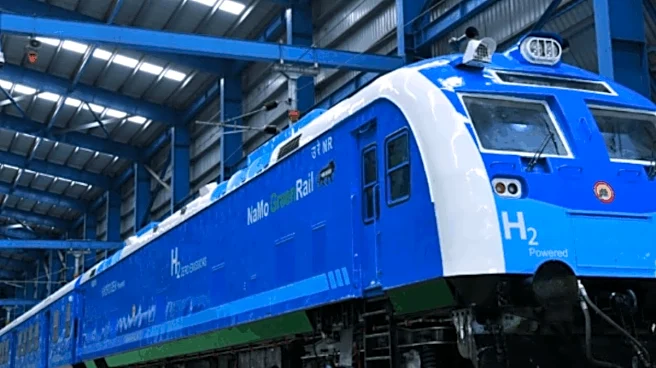

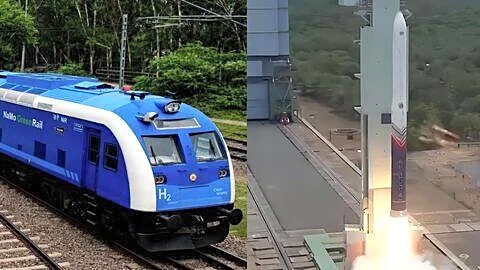
Chandigarh News: Prime Minister Narendra Modi will visit Haryana, Chandigarh and Punjab on Friday to launch infrastructure and development projects worth more than Rs 25,000 crore. The centrepiece of the tour will be the inauguration of India’s first hydrogen-powered fuel cell passenger train at Jind, Haryana.
The train, designed and built in India, marks a major step towards cleaner rail transport. It is one of the world’s longest and most powerful hydrogen-powered passenger trains, with 10 coaches, capacity for around 2,600 passengers, and a 3,200-horsepower propulsion system. Most hydrogen trains currently operating worldwide have only two to four coaches and are used mainly on short regional routes. Let’s take a closer look at India’s first
hydrogen-powered train.
Route And Timings
The hydrogen train will initially operate on the 89-kilometre Jind-Sonipat section of Northern Railway in Haryana.
The route includes:
- Jind Junction
- Jind City
- Pandu Pindara Junction
- Lalit Khera Halt
- Bhambhewa
- Isapur Kheri Halt
- Butana Halt
- Khandrai Halt
- Rabrah Halt
- Lath Halt
- Mohana
- Barwasni Halt
- Sonipat New
- Sonipat
The train will begin operations with a maximum speed of 75 km/h, although it has been designed to run at speeds of up to 110 km/h.
Indian Railways says the route has been selected to test the operational viability, safety and reliability of hydrogen-powered passenger services under regular operating conditions.
How Does The Hydrogen Train Work?
Unlike conventional electric trains, which draw power from overhead wires, or diesel trains, the hydrogen fuel cell train generates its own electricity on board.
According to a report in The Times of India, it uses a Proton Exchange Membrane (PEM) fuel cell, where hydrogen stored in high-pressure cylinders reacts with oxygen from the air to produce electricity. This electricity powers the train’s traction motors.
The process produces only water vapour and heat, with no combustion.
In simple terms: Hydrogen + Oxygen = Electricity + Water vapour
As a result, the train produces no smoke and virtually no direct carbon emissions.
Train Configuration
The train comprises:
- Two Hydrogen Driving Power Cars (DPCs), one at each end.
- Eight passenger trailer coaches.
Each power car produces 1,200 kilowatts (1,600 horsepower), together providing enough power for the train’s design speed of 110 km/h. Each DPC houses:
- Hydrogen fuel cells
- Lithium Iron Phosphate (LFP) batteries
- High-pressure hydrogen storage cylinders
The batteries work alongside the fuel cells to ensure smooth operation under varying conditions.
Where Does The Hydrogen Come From?
Indian Railways has built what it describes as the country’s largest railway hydrogen refuelling facility at Jind. Hydrogen is produced through electrolysis, where electricity splits water into hydrogen and oxygen.
The hydrogen is:
- Stored in dedicated tanks.
- Compressed to 500 bar for efficient storage.
- Supplied to the train at 350 bar through two independent dispensers, allowing both power cars to be refuelled simultaneously and reducing turnaround time.
The facility can store nearly 3,000 kilograms of hydrogen and has been approved by the Petroleum and Explosives Safety Organisation (PESO).
Safety Measures
Indian Railways says the project follows the internationally recognised “defence in depth” safety principle, using multiple independent systems rather than relying on a single layer of protection.
The train and refuelling facility are equipped with:
- Hydrogen leak detectors
- Flame detectors
- Heat sensors
- Smoke detectors
- Continuous ventilation systems to prevent hydrogen build-up
- Automatic hydrogen isolation and shutdown systems
- Real-time monitoring in the driver’s cab
Emergency Operating Modes
The Jind hydrogen facility also includes:
- Automatic shutdown systems
- Water spray fire-control arrangements
- Fire alarm systems
Before passenger operations, the entire hydrogen ecosystem underwent an independent safety assessment by TÜV SÜD, Germany. The project complies with international standards, including NFPA-2 and the ISO 19880 series, as well as statutory safety requirements prescribed by PESO.
The train also completed extensive testing, including:
- Electrical load testing
- Radio-frequency compatibility trials
- Oscillation tests for ride stability
- Emergency braking distance evaluations
before receiving operational approval.
The launch follows one of the world’s largest railway electrification programmes, with more than 99% of India’s broad-gauge railway network now electrified. The hydrogen fuel cell train represents the next stage in that transition, generating electricity on board without relying on overhead electric wires or diesel engines. It also marks the creation of India’s first integrated hydrogen railway ecosystem, covering hydrogen production, storage, refuelling infrastructure and train operations.
Other projects during the Prime Minister’s visit
According to a report in The Hindu, after inaugurating the hydrogen train, the Prime Minister will visit Eklavya Stadium in Jind to launch and lay foundation stones for national highway projects worth Rs 12,470 crore, including: The 157.92-km Delhi-Amritsar-Katra Expressway (Rs 9,680 crore), expected to reduce travel time between Delhi and Katra from 14 hours to six hours.
The Jind-Gohana Greenfield Highway (NH-352A), cutting travel time from two hours to around 40 minutes.
He will also lay the foundation stone for a state-of-the-art Sikh museum in Kurukshetra celebrating the legacy of the Sikh Gurus and dedicate new medical colleges in Bhiwani and Narnaul.
In Chandigarh, the Prime Minister will inaugurate healthcare and road infrastructure projects worth Rs 4,700 crore, including:
- PGIMER’s Advanced Mother and Child Centre, a 300-bed tertiary care facility for high-risk pregnancies and neonatal care.
- A new Advanced Neurosciences Centre bringing neurology, neurosurgery and neuro-critical care under one roof.
- The foundation stone for the PM-ABHIM Critical Care Block, a 150-bed emergency and disaster-response facility.
- The six-lane greenfield highway from IT City to Kurali (Mohali) to improve connectivity between Punjab, Haryana, Himachal Pradesh and Jammu & Kashmir.
The final stop will be Jalandhar, where projects worth more than Rs 5,470 crore will be dedicated to the nation. These include:
- Inauguration of 75 redeveloped railway stations across 20 States, including Jalandhar Cantonment, completed at a cost of Rs 1,570 crore.
- Opening of the Daulatpur Chowk-Kartoli rail line, part of the Nangal Dam-Talwara-Mukerian project.
- Flagging off the new Kartoli-Ambala and Amritsar-Varanasi train services.
- Inauguration of the 30.9-km Package 6 of the Delhi-Amritsar-Katra Expressway.
- Foundation stone for the Southern Ludhiana Bypass.