

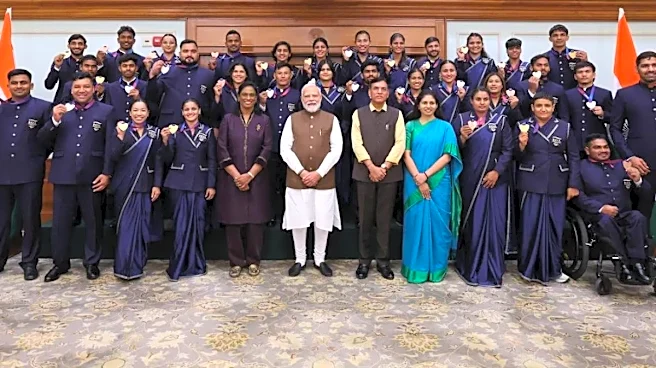
With their chin up and spirits high, they walked the ramp and drew applause from the spectators.
They are former women Naxals who chose to abandon weapons and join the mainstream. At the National Handloom Day event in Raipur, Chhattisgarh, they captivated the audience with their confidence and charisma, proudly walking the ramp and celebrating the rich legacy of handloom craftsmanship.
Wearing handloom sarees, the women –– who once survived in dense forests of Bastar –– carried smiles as they participated in the event to honour the heritage of India.
#WATCH | Raipur, Chhattisgarh: Former women Naxals, who once carried weapons in the dense forests of Bastar, walked the ramp to huge applause at a National Handloom Day event in Raipur after joining
the mainstream. (07.08) pic.twitter.com/51mc8lEXWE
— ANI (@ANI) August 13, 2026
Vishnu Dev Sai, Chhattisgarh Chief Minister and BJP leader, was present at the occasion.
‘Naxal-Free’ Bastar
Earlier this week, CM Sai and Deputy CM Vijay Sharma met with Union Minister for Rural Development and Agriculture Shivraj Singh Chouhan in New Delhi with a request for special relaxations in central infrastructure schemes to advance development in the state’s Bastar region, which has been a witness to various phases of the Maoist insurgency.
Bastar has been declared ‘Naxal-free’, following years of intensive security offensives like ‘Operation Kagar’, and intelligence-led anti-Maoist missions.
Speaking after the meeting, Sai said: “Today, accompanied by our state’s Deputy CM Vijay Sharma, we met with the Union Minister for Rural Development and Agriculture, Shivraj Singh Chouhan; officials were also present during the meeting. After 40-50 years, our Bastar region has finally become Naxal-free, and there is a great need for development there. Connectivity is crucial from a development perspective,” according to ANI.
Why Bastar Was A Threat To India’s Internal Security
Bastar –– a densely forested area in Chhattisgarh –– was long the strategic center of the Communist Party of India (Maoist) insurgency. The region had emerged as a key theater in India’s internal security challenges, marked by guerrilla warfare, landmines, and attacks on crucial infrastructure.
In March this year, a group of 108 Maoist cadres carrying cash reward of Rs 3.29 crore and linked to Dandakaranya Special Zonal Committee (DKSZC) surrendered in Bastar under Chhattisgarh’s “Puna Margem – rehabilitation to rejuvenation” campaign.
This was one of the sharpest breakthroughs in Bastar’s Maoist infrastructure. The cadres included 44 women and functionaries from multiple layers of the Maoist hierarchy.
In May, Union Home Minister Amit Shah visited Bastar and declared the region “Naxal-free”. “Under the leadership of Prime Minister Shri Narendra Modi, Bastar has become Naxal-free, Now, the journey—from security to trust, trust to development, development to prosperity, and prosperity to fulfillment—must be completed within the next five years”, Shah had said.







/images/ppid_59c68470-image-178635502614570838.webp)
