
/images/ppid_a911dc6a-image-177052053041136787.webp)
/images/ppid_a911dc6a-image-177052056227442750.webp)
The Global Chess League, recently made its debut on Indian shores after its successful curtain-raiser edition in the United Kingdom and the follow-up iteration in the United Arab Emirates in the subsequent year, looks to push the boundaries of the sport in the land of the game’s origin.
The exciting endeavour aimed at the proliferation and progress of the sport looks to revolutionise the manner in which the sport is consumed with innovation that appeals to the masses in an unprecedented way.
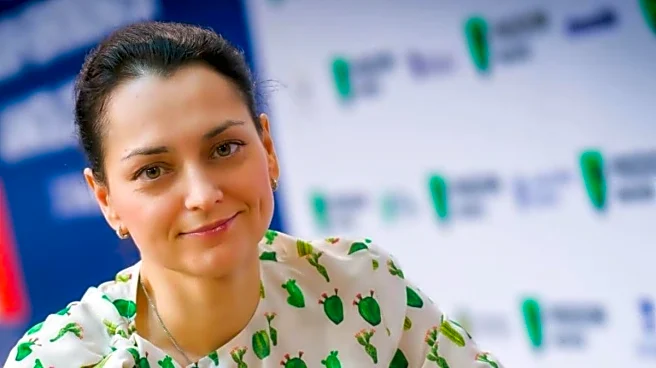
Former World Champion, GM Alexandra Kosteniuk, who represented Triveni Continental Kings at the event held in Mumbai, joined CNN-News18 for an exclusive chat on a variety of topics, ranging from the similarities between the sporting landscapes of India and her
home nation, Russia, the impact of Artificial Intelligence on the game and challenges involved in the making of a chess superpower.
Russia has been a traditional superpower in the world of chess, and India seems to be pulling in that direction in recent times. Do you see parallels between India’s rapid development and Russia’s Chess eco-system?
We can find parallels in everything. But, in general, it’s just a question of focusing on a certain kind of sport. During the Soviet Union era, chess became extremely popular because of the fact that in order to play chess, you don’t need to build stadiums.
You just need a chessboard and chess pieces, so it’s relatively, like, cheap. You don’t need to invest a lot in order to be able to teach people to play chess. And that’s probably why it was picked as one of the main sports in the Soviet Union at the time. And probably, that’s why it’s also popular in India. And with the computers and online possibilities, any kid who has access to the internet has access to global knowledge. They can play online, analyse, get access to databases, and study, which is very important.
Russia inherited this love for the game from the Soviet Union and continued it.
Russia is a big country with a lot of talent, and for a sport, if you focus on it, create role models, bring in results, people follow. Kids will play, and it’s like a circle of life.
And you need to popularise chess in order to bring kids into the game, in order for them to become better and stronger, and have good, strong grandmasters who will deliver results. So it’s like, it’s all connected.
It’s one chain with many links, and somehow it was built up very well in the Soviet Union. Russia kind of continued that tradition, chess tradition, and, it was considered to be and it’s still considered to be normal to be a professional chess player, while, like, for example, in Europe, where I live right now, when people ask me what my profession is, and I say that I’m a professional chess player, they say, ‘Yes, but what do you do for money? Like, what… how do you earn?’
And for them, it’s kind of hard to comprehend that you can actually earn a living with it. In Russia, you don’t have to explain; it’s quite respected. And I think in India, like in Russia, it’s also where you can consider chess, and any popular sport, as a social lift.
In India, as in Russia, if you’re coming from challenging circumstances and situations, and you manage to perform well in chess or in other sports, somehow it helps you a lot in life and to jump a few steps ahead socially. This is very important when parents consider in what direction to guide their children.
Also, of course, historically, chess was invented in India, so you have this historical pride and roots, which is also another important factor to take into account.
Russia and India, being as large and populated as they are, deal with certain kinds of challenges in their pursuit of establishing and advancing their Chess landscape.How do nations, which aren’t blessed with such an abundance of talent and competition, approach the equation?
In terms of smaller countries, Norway, for example, when Magnus Carlsen, out of nowhere, many grandmasters popped up, thanks to him. Usually, in smaller countries, it’s so hard, usually to create one grandmaster. It requires so much effort, investment, and work that it’s more appreciated, in a way.
But that isn’t the case in big countries like India and Russia, where there is an abundance of talent that some players might feel unappreciated. Russia, and I believe India too, is spoiled in the number of grandmasters that if one walks away, there are others in line to try and emulate their predecessor.
However, at times, since there is an abundance of players, the individuals aren’t much appreciated. That is one of the downsides of such nations with a lot of talent. I grew up in the times when the Soviet Union was collapsing, and it was a very hard time, the 90s. It was very hard to find food for the children to eat. We were in desperate situations, and surviving was the main goal.
But despite that, of course, thanks to my parents, I managed to grow up and become a very good chess player. And I was always surrounded by talented players, despite all those difficulties.
I’ve always had this feeling that Chess is so loved, and there are so many players that somehow the country can do more for them, to support them, but since the chess players were winning anyway, what’s the reason to support them, right? Because they’re still winning.
Thanks to this situation and competition, you become so strong because you’re surrounded by quality, and that motivates you. But sometimes, when you live in such an environment, you feel the need to be appreciated more.
Sometimes I feel sorry for such competitive countries and people who live in such an environment, but yeah, that’s life. It’s not always fair.
The AI Revolution seems like it has the potential to alter the game in a manner hitherto unforeseen. While there are massive upsides to it, such as the proliferation in coaching and knowledge transfer, do you see any challenges it might bring along with it?
It’s still too early, but from what I’ve heard, and from some companies that I talk to who are trying to speed it up. The possibilities are just amazing. I’m looking forward to being able, actually, to get access to such mechanisms that will analyse your games, your mistakes, create exercises for you 24X7, and guide you.
In certain areas of the game, it will be a constant tutor that doesn’t get tired or emotional. There is still some time for all that to come in, but I’m really excited by the possibilities, especially with the coaching aspect of things.
But, the beauty is what we like chess for, despite the fact that we understand that engines and computers are much stronger than us is the human factor, we make mistakes, and that’s what we appreciate the game for. So, it will still be a battle between two human beings with their strengths and weaknesses that will excite the masses. The psychology quotient, concentration and an ability to use your knowledge are some of the things that make chess enjoyable.
Chess isn’t a mathematical equation; it is a sport, and sometimes you can’t hold your nerves, which leads to mistakes, and that’s the beauty of it. AI can be helpful or harmful; we can’t know for sure, but we will adapt, that’s for sure.
Mankind will need to adapt and live with it, not only in chess, but the whole world is changing a lot because of the development of artificial intelligence. It’s scary, even, right?
But it is still too early to start analysing and discussing what lies ahead of us because we don’t know, and that’s life. It’s unexpected and unpredictable, and we just have to live with it.
Chess does take a big toll on your mind as such, and couple that with the strains of travelling, media duties, and so on, a player has to deal with on the circuit, how do you manage to stay mentally fit and ready to go?
The Chess world is quite a closed one, but there are many factors, and life is going on as well, and a lot of things that kind of influence you. There are hard moments that you have to deal with and survive.
I mean, people find different ways to proceed. Some work with psychologists, some meditate, some work on their own or with close ones. It depends; it’s very individual.
But setting and finding the right frame of mind is like tuning a musical instrument. It’s very fragile, and if you push too hard, it can break, and if you don’t push enough, it might not be as sharp and hence you need to find those nuances.
And striking this balance is very hard, and that could decide the outcome of the games because some are better prepared, not only chess-wise, but mentally as well.
How do you see an event of such nature as the GCL fitting into the overall scheme of things?
I’ve been playing chess for a very long time, and I like new events and new formats. I’ve always believed in the possibility of creating a product, if you wish, from a chess tournament, a show, to make it entertaining and exciting.
View this post on Instagram
Global Chess League is trying to do exactly that with teams that consist of players who, of course, know each other, but they are not always friends, and they’ve never really played as a team, and chess as an individual sport, so, like, there are many factors.
It’s interesting to see new people coming into chess with their vision, and with their energy, and their desire to create something new out of a very old game. It is my third season, and I can see a lot of work going on with every new season behind the curtains, and they are trying many things to improve constantly.


/images/ppid_59c68470-image-177052506364214257.webp)



/images/ppid_a911dc6a-image-177052463166598718.webp)