

/images/ppid_59c68470-image-176994502354269672.webp)
/images/ppid_a911dc6a-image-176994483076242116.webp)
/images/ppid_a911dc6a-image-176994487119336478.webp)
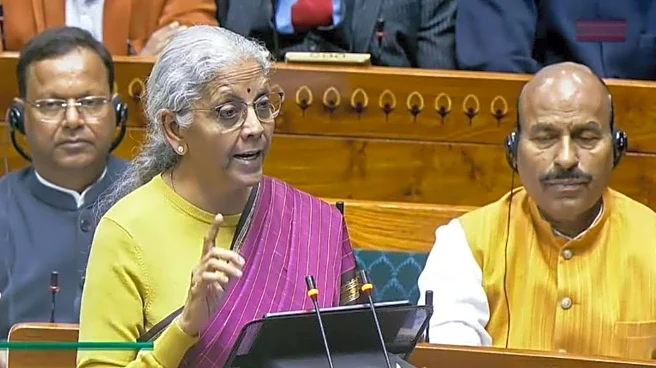
Finance Minister Nirmala Sitharaman on Sunday proposed the creation of a high-level committee to undertake a comprehensive review of India’s banking sector and lay out the next phase of reform-driven growth, pointing to the system’s strengthened fundamentals.
She noted that the banking sector is currently marked by robust balance sheets, record-high profitability, improved asset quality and coverage that now exceeds 98%. “At this stage, we are well placed to futuristically evaluate the measures required to sustain reform-led growth in the sector,” Sitharaman said.
Elaborating on the plan, the finance minister said the proposed panel would have clearly defined terms of reference and would examine the banking ecosystem as a whole. The objective,
she explained, is to develop recommendations that will help the government prepare a long-term roadmap for the sector aligned with India’s 2047 goals. She added that the Department of Financial Services will play a central role in shaping this roadmap.
The high-level committee, formed under the Viksit Bharat vision, will assess the structure, efficiency and preparedness of the banking system to support India’s next phase of economic expansion, while safeguarding financial stability, inclusion and consumer protection. It is expected to study the evolving role of banks in financing growth, strengthening credit delivery, adopting technology, improving governance standards and managing emerging risks in an increasingly complex financial environment.
Alongside banks, Sitharaman outlined a clear direction for non-banking financial companies (NBFCs). She said the government has set specific targets for credit disbursement and technology adoption, particularly for public sector NBFCs. As an initial step to improve scale and efficiency, she proposed restructuring NBFCs into Power Finance Corporation (PFC) and Rural Electrification Corporation (REC), signalling a consolidation effort to strengthen development finance institutions focused on power and infrastructure.
The finance minister also announced a broad review of India’s foreign investment framework. She proposed an overhaul of the Foreign Exchange Management (Non-Debt Instruments) Rules to make them more contemporary and investor-friendly, in line with India’s evolving economic priorities.
To deepen domestic capital markets, Sitharaman unveiled several measures aimed at boosting the corporate bond market. These include a market-making framework with appropriate access to funds and the introduction of derivatives on corporate bond indices to improve liquidity and price discovery. She also proposed total return swaps on corporate bonds to enhance risk management tools and attract greater investor participation.
Focusing on urban financing, Sitharaman announced enhanced incentives to promote larger municipal bond issuances. Cities issuing a single bond of more than Rs 1,000 crore will be eligible for an incentive of Rs 100 crore. At the same time, existing schemes will continue to support smaller and medium towns, with issuances of up to Rs 200 crore remaining eligible for incentives, ensuring broader access to bond markets.
Taken together, the measures reflect the government’s intent to use the banking sector’s improved strength as a foundation for long-term growth, while modernising regulation, expanding capital markets and improving access to long-term finance for infrastructure and urban development—within a framework that emphasises stability, inclusion and consumer protection.
/images/ppid_a911dc6a-image-176994652799396215.webp)









/images/ppid_a911dc6a-image-176994543616533491.webp)