
/images/ppid_59c68470-image-17699225649165937.webp)
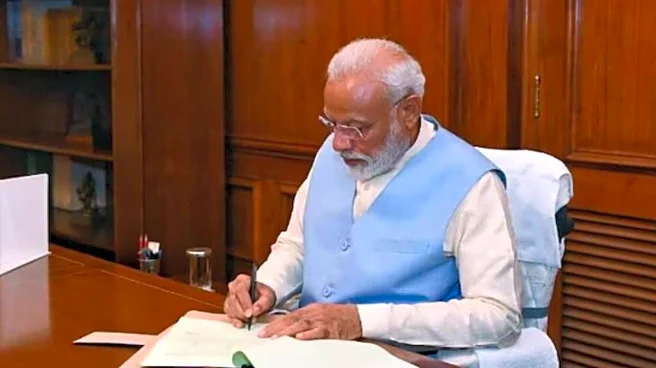
As winter gives way to spring in New Delhi, India’s diplomatic machinery is poised for its most sustained and strategically freighted phase in months. February 2026 promises a barrage of high-profile engagements. Within a span of twenty-eight days, Prime Minister Narendra Modi will welcome heads of state, host the world’s largest artificial intelligence summit, and undertake critical bilateral missions to two nations.
What appears on the surface as a calendar crowded with ceremonial state visits and summits is a carefully orchestrated grand strategy to position India as the indispensable link between the Global South and the architecture of tomorrow’s technological and security orders.
The diplomatic hubba-bubba starts modestly on February 5,
with President Patrick Herminie of Seychelles. Herminie’s visit marks his first journey to India since assuming office last October, and it coincides precisely with the fiftieth anniversary of India-Seychelles diplomatic relations.
Over 35,000 people have registered for the India AI Impact Summit, with attendees from more than 100 countries expected in New Delhi from February 16-20. PM Modi will also play host to Brazilian President Luiz Inácio Lula da Silva and French President Emmanuel Macron. Beyond these, PM Modi’s visit to Israel on February 27–28 is imminent. Rumours are that a trip to Malaysia may also be on the cards, after missing out on the ASEAN summit last year due to domestic commitments.
India’s Claim to Lead the AI Century
By February 19, PM Modi and the world’s attention will converge on New Delhi’s Bharat Mandapam for the India AI Impact Summit. The India AI Impact Summit represents the most consequential of Modi’s February commitments. It is no ordinary conference. It will be the first global artificial intelligence summit ever hosted in the Global South. Its theme: Sarvajana Hitaya, Sarvajana Sukhaya, welfare for all, happiness for all, projects the vision of technology as a democratising force rather than a stratifying one.
India’s motivation is both ideological and strategic. The Modi government has committed Rs 10,300 crore through its IndiaAI Mission to build domestic capacity in artificial intelligence, centered on indigenous solutions tailored to Indian conditions.
The strategy rests on a principle that distinguishes it from prior eras of technology adoption: Eras where imitation served as the blueprint for success in the country. The technologies India develops must serve India first, then the Global South, and finally the world. This logic underpins the creation of nearly 570 artificial intelligence training labs distributed across the country, each designed to democratise access to AI capabilities rather than concentrate them among elite institutions or foreign corporations.
The summit itself will produce more than 15 substantive deliverables, moving the conversation away from the largely declaratory AI governance discussions that have characterised earlier forums, the Bletchley Park summit in the UK, Seoul’s summit in South Korea, and Paris’s forum in 2025. India’s approach will emphasise implementation; how AI can improve healthcare in rural areas, enhance agricultural productivity for smallholder farmers, and strengthen governance through data-driven policymaking.
The summit’s guest list amplifies this message. French President Emmanuel Macron confirmed his attendance specifically to honour India’s co-chairmanship of global AI discussions and to underscore the strategic alignment between France and India on technological sovereignty. Brazilian President Lula’s attendance carries additional weight, signalling BRICS solidarity at a moment when tariff tensions and economic nationalism threaten the unity of the Global South.
The presence of over one hundred global chief executives, from OpenAI, Google, Microsoft, Meta, and other technology giants, alongside ministers from more than fifteen nations, creates a rare space where policy and commercial interests meet on India’s terms.
For PM Modi, the summit legitimises India’s investment in building AI research ecosystems and validates the government’s decision to position India not as a consumer of foreign artificial intelligence but as an architect of its own. Internationally, it signals that India intends to exercise influence over the norms, ethics, and governance frameworks that will govern AI deployment globally.
The Macron Visit
On February 19, Macron will arrive in New Delhi with an agenda that extends far beyond the AI summit’s public sessions. The centrepiece of defence industrial cooperation is going to overshadow every niche agreement that the countries will make. India’s Defence Procurement Board cleared a proposal in mid-January 2026 to acquire 114 additional Rafale fighter jets from Dassault Aviation in what would become India’s largest-ever defence procurement.
The deal, valued at approximately Rs 3.25 lakh crore, represents a strategic pivot in how India approaches defence manufacturing: instead of buying off-the-shelf aircraft, India will domestically manufacture approximately 80 to 96 Rafales with up to 60 per cent indigenous content, whilst receiving 18 aircraft in fly-away condition from France beginning in 2030.
Macron’s visit is expected to crystallise this agreement. Tata Advanced Systems has already begun constructing a final assembly line for Rafale fuselages in Hyderabad, with production scheduled to commence in 2028. HAL and Safran are negotiating a joint engine production facility, also in Hyderabad, whilst an MRO (Maintenance, Repair and Overhaul) hub is planned near Jewar in Uttar Pradesh. If formalised during Macron’s February visit, the French President himself indicated to his diplomatic corps in January that defence industrial cooperation would feature prominently in bilateral talks.
Another major point of discussion has been that the February visit would advance cooperation on rare earth minerals. India’s 2026 budget announcement of dedicated rare earth corridors across Odisha, Kerala, Andhra Pradesh and Tamil Nadu signals India’s intent to scale this effort rapidly. Macron’s endorsement during his February visit will lend European institutional weight to India’s bid to become a centre for rare earth processing and advanced materials manufacturing.
The Lula State Visit
Lula’s state visit from February 19 to 21 is also important. The Brazilian president confirmed in a 45-minute telephone call with Modi on January 22 his intention not merely to attend the AI Impact Summit but to conduct a comprehensive bilateral review spanning defence, trade, health, science and technology, energy, biofuels, and critically, rare earths and mineral processing.
Trump’s unilateral tariffs have disrupted supply chains across both nations, with India and Brazil jointly accounting for nearly $30 billion in bilateral trade. The Brazil-India Business Forum, scheduled for February 21, will bring private sector leaders from both countries to discuss infrastructure development, financial services, and technology partnerships. More strategically, Lula’s visit arrives as India and Brazil coordinate BRICS responses to Western protectionism.
Lula will also inaugurate ApexBrasil’s New Delhi office during his visit, institutionalising Brazil’s commercial presence in India
Israel: Another FTA For India
PM Modi is set to visit Israel on February 27–28. Israeli officials, including Ambassador Reuven Azar, have publicly affirmed that Prime Minister Benjamin Netanyahu has extended an invitation and that preparations are underway, while Indian sources have characterised the trip as advancing a “rapidly expanding strategic partnership. In remarks to Indian media, Ambassador Azar stressed that Israel hopes “to see him [Modi] as soon as possible”.
This will be PM Modi’s first visit to the country in nine years, a gap that underscores the complexity of Indo-Israeli relations within the context of India’s broader West Asian strategy.
The immediate driver of the visit is the launch of formal negotiations for a Free Trade Agreement. In November 2025, India and Israel signed Terms of Reference to initiate structured FTA talks. The talks are expected to address bilateral trade, which stood at $3.62 billion in 2024–25, with India serving as Israel’s second-largest Asian trading partner. Recent trends suggest the relationship has cooled slightly, with Indian exports to Israel declining 52 per cent from $4.52 billion in 2023–24 to $2.14 billion in 2024–25. An FTA is designed to reverse this trend by reducing tariff barriers and facilitating greater commerce in areas where complementarities are strongest.
The centrepiece of Modi’s bilateral engagement with Netanyahu will be formalising India-Israel defence industrial cooperation. In November 2025, the two nations signed a comprehensive Memorandum of Understanding on Defence Cooperation that establishes frameworks for technology sharing, co-development, and co-production of advanced defence systems. The MoU identifies strategic dialogues, military training, defence-industrial partnerships, and collaboration in artificial intelligence, cybersecurity, unmanned systems, and research and development as priority areas.
Israeli defence firms, such as Rafael Advanced Defence Systems, Israel Aerospace Industries, and Elbit Systems, have begun positioning India as a manufacturing hub for exports across the Indo-Pacific. India’s Belrise group has partnered with Plasan to manufacture the ATEMM, with deliveries starting in September 2026. During Modi’s visit, additional joint manufacturing ventures are expected to be announced, including potential partnerships in unmanned aerial systems, cyber defence platforms, and advanced radar systems.
The prime minister’s visit occurs against the backdrop of Middle Eastern turbulence. PM Modi and Netanyahu have held two telephone conversations in recent months, reaffirming a zero-tolerance stance against terrorism and discussing regional developments, including the Gaza Peace Plan. The visit also gives momentum to the India-Middle East-Europe Economic Corridor (IMEC), a connectivity initiative unveiled at the G20 Summit in Delhi in November 2023.
The Seychelles Signal
President Herminie’s visit to India, though less dramatic than the others, completes PM Modi’s February strategy. According to the Ministry of External Affairs, he will meet President Droupadi Murmu and hold wide-ranging talks with PM Modi on bilateral, regional, and international issues, while also travelling to Chennai and Mumbai for business-focused events.
The Seychelles is central to India’s “MAHASAGAR” doctrine. New Delhi has gone out of its way to describe Seychelles as a “key maritime neighbour” that holds a “special place” in the doctrine. Its maritime domain and 1.4 million sq km exclusive economic zone make it central to regional maritime security, blue economy development and marine conservation. It also encompasses crucial shipping lanes, and its ports are potential node points for Indian naval operations and commercial activity.
Over the past year, the MAHASAGAR initiative has been implemented through joint naval exercises and dialogues, most notably the AIKEYME exercise with ten African littoral states, including Seychelles
India has invested substantially in Seychelles’ development, funding the construction of radar systems, gifting naval vessels, and supporting infrastructure projects. The relationship reflects India’s broader Indian Ocean strategy: to position itself as the region’s net security provider and development partner, ensuring that great-power rivalry does not destabilise the waters through which much of global commerce flows. The visit allows Modi to reinforce these bonds while signalling India’s long-term commitment to the Indian Ocean as India’s sphere of strategic interest.
PM Modi’s February calendar, taken as a whole, reveals the architecture of an India that is attempting to be simultaneously a technology leader, a manufacturing hub, a diplomatic bridge between the Global South and the West, and a guardian of its Indian Ocean neighbourhood.
What ties these journeys together is not rhetoric about multipolarity or Global South solidarity, though PM Modi will certainly invoke both. Rather, it is a series of concrete interests pursued through bilateral engagement: defence partnerships, trade agreements, semiconductor ecosystems, artificial intelligence governance frameworks, and regional stability.
/images/ppid_a911dc6a-image-177010087576765026.webp)


/images/ppid_59c68470-image-177005502902670399.webp)

/images/ppid_59c68470-image-177006003434960459.webp)
/images/ppid_59c68470-image-177001510455326007.webp)