

/images/ppid_a911dc6a-image-178038006484195698.webp)
As Prime Minister Narendra Modi prepares to surpass Jawaharlal Nehru on June 10 to become India’s longest-serving democratically elected prime minister in continuous office, one of the sharpest contrasts between the two leaders lies not just in the length of their tenures, but in how they viewed the role of citizens in nation-building.
While Nehru’s governance model relied heavily on institutions, bureaucracy and state-led planning to drive development in a newly independent nation, PM Modi’s 12 years in office have been marked by an emphasis on “Jan Bhagidari” or people’s participation. From Swachh Bharat and digital payments to water conservation and vaccination campaigns, the government has increasingly sought to turn policy initiatives into
public movements, anchored in the idea of “Sabka Prayas”—everyone’s effort.
From State-Led Development To Jan Bhagidari
In Nehru’s India, development was largely viewed as the responsibility of the state, given that the world over, newly independent countries often rely on central planning and state-led development to accelerate economic growth.
PM Modi’s approach has been markedly different. This was because though he inherited a country with functioning democratic institutions, its sheer scale posed a different challenge. With more than 1.4 billion people, no government machinery, however large, could by itself achieve goals ranging from sanitation and water conservation to digitalisation and financial inclusion. The answer, his government argued, was to make citizens stakeholders rather than mere beneficiaries.
A recurring theme in PM Modi’s Independence Day speeches, Mann Ki Baat broadcasts and government programmes has been that development cannot remain the sole responsibility of the government. In his 2022 Independence Day address, PM Modi called for a shift from “government-driven development” to “citizen-driven development”, saying the country’s aspirations could be achieved only through “Jan Bhagidari”.
Similarly, while speaking about Swachh Bharat, he often described cleanliness not as a government scheme but as a “Jan Andolan”. The same language was later used for water conservation, Covid-appropriate behaviour, local manufacturing, yoga and the Har Ghar Tiranga campaign.
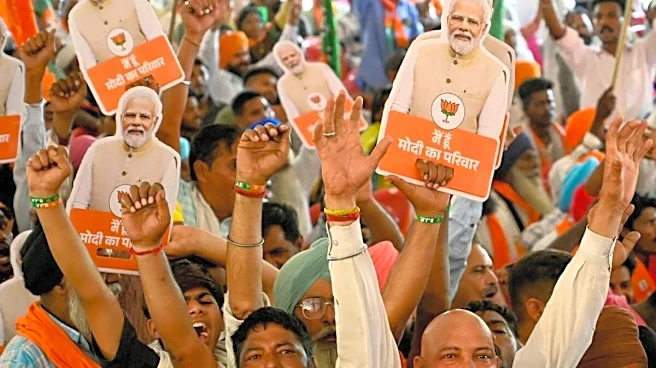
Over the past decade, the phrase “Jan Bhagidari” (people’s participation) has become a recurring theme in government programmes. Encapsulated in the slogan “Sabka Saath, Sabka Vikas, Sabka Vishwas, Sabka Prayas”, the idea seeks to position citizens not merely as recipients of government schemes but as active participants in national missions.
Swachh Bharat: Turning A Govt Scheme Into A Public Movement
Perhaps the most visible example was the Swachh Bharat Mission.
While the government financed toilet construction and sanitation infrastructure, the campaign was built around public participation. Celebrities, schoolchildren, resident welfare associations, NGOs and ordinary citizens were encouraged to join cleanliness drives and promote behavioural change.
The programme’s success was measured not only through infrastructure creation but also through public involvement.
Water Conservation Beyond Government Action
The same principle was visible in campaigns such as Jal Shakti Abhiyan and Catch The Rain.
Rather than relying solely on government departments, local communities, panchayats, civil society groups and citizens were encouraged to participate in rainwater harvesting, water conservation and groundwater recharge initiatives. The messaging consistently emphasised collective responsibility rather than government action alone.
Digital Payments As A People’s Movement
The push for digital payments after demonetisation offers another example.
Government policy created the framework through UPI and digital infrastructure, but adoption depended on millions of citizens, small traders and businesses changing their daily habits. Today, India processes billions of UPI transactions every month, a transformation driven as much by citizen adoption as by government policy.
The Vaccination Drive And Citizen Participation
During the Covid-19 pandemic, the government repeatedly highlighted public participation as central to India’s vaccination programme.
Citizens registered through digital platforms, community volunteers assisted outreach efforts, and local networks played a role in awareness campaigns. Public campaigns encouraging vaccination, mask usage and Covid-appropriate behaviour relied heavily on citizen cooperation rather than administrative enforcement alone.
Governance Through Public Participation
The government has also attempted to institutionalise citizen engagement through platforms such as MyGov, which invites suggestions on policies, campaigns and governance initiatives.
Similarly, initiatives ranging from Fit India and International Yoga Day to the Vocal for Local campaign have relied heavily on public participation and behavioural change rather than traditional government delivery mechanisms.
From Beneficiaries To Stakeholders
Supporters of PM Modi’s governance model argue that it reflects greater trust in citizens’ ability to contribute to national development rather than simply receive benefits from the state.
This is visible across campaigns related to cleanliness, water conservation, digital payments, yoga, local manufacturing under Vocal for Local, and the promotion of millets, where behavioural change and public participation have been treated as policy tools.
As PM Modi prepares to overtake Nehru’s tenure record, the comparison highlights two distinct visions of governance: one where development was led primarily by the state, and another where the government seeks to position citizens as active participants in achieving national goals.

/images/ppid_a911dc6a-image-178048270708322043.webp)

/images/ppid_a911dc6a-image-178055811401698589.webp)
/images/ppid_59c68470-image-178040014191388220.webp)