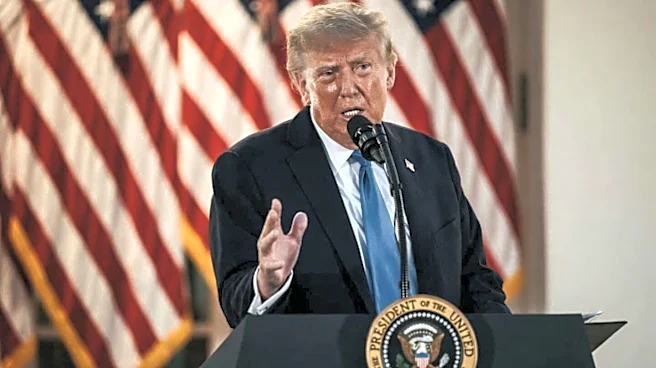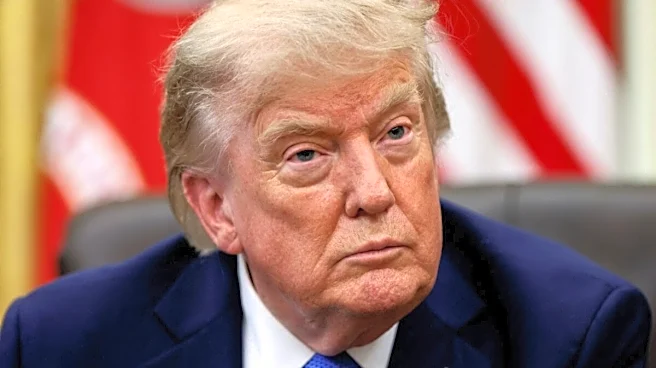

US President Donald Trump has once again turned oil into part of his war rhetoric, this time suggesting that the United States could stay in Iran and “keep the oil”, much as Washington has sought to secure a stake in Venezuela’s energy sector.
“We’ll ultimately get out (of Iran), unless we decide to stay and keep the oil like Venezuela,” Trump said on Sunday.
Trump made the remark while reiterating that he expected the Iran war to end this year, possibly after the US midterm elections in November. He also claimed that US revenue from Venezuela had “paid for the war many times”.
But what does Trump mean by “keeping” Iran’s oil? A look at the Venezuela deal he invoked shows what that could entail, and why Iran is a very different case.
What Has The
US Done In Venezuela?
The deal Trump was referring to was announced by the White House in August this year and involves North American Blue Energy Partners (NABEP), a company controlled by Venezuelan businessman Alejandro Betancourt.
According to the Financial Times, NABEP has been awarded control of more than 17 oilfields, which it can develop or license to other companies. The broader US push covers about one-fifth of Venezuela’s vast oil reserves, according to Reuters.
The US government has a direct interest in the arrangement. A White House factsheet says the Pentagon’s Office of Strategic Capital (OSC) is due to receive a 35 per cent equity stake in NABEP’s corporate parent.
Washington will also be able to buy at cost 20 per cent of the oil produced under the agreement.
Trump’s description of “keeping” the oil, therefore, refers in Venezuela’s case to an arrangement designed to give the US a financial stake and privileged access to some of the oil produced from fields covered by the deal.
But Even The Venezuela Deal Faces Legal Questions
The Venezuela agreement is far from settled. Politicians, lawyers and oil industry figures have challenged whether parts of the deal comply with Venezuelan law.
Henrique Capriles, a leading member of the political opposition within Venezuela, said there were “legal and constitutional problems” with the agreement.
One major dispute concerns its duration. Trump has described the arrangement as a 100-year concession, while Venezuela’s acting president Delcy Rodríguez has said any licences would last only 25 years.
David Goldwyn and Andrea Clabough of the Atlantic Council told the FT that a 100-year concession “appears to stretch the limits of what is allowable” under Venezuela’s constitution.
There are questions over how the rights were awarded as well. Capriles has challenged the absence of a tender or public auction before oil rights covering 65 billion barrels were handed to NABEP.
Then There Is The PDVSA Question
Another potential obstacle is the apparent absence of Venezuela’s state-owned oil company, Petróleos de Venezuela (PDVSA), from the arrangement.
Venezuelan legal expert José Ignacio Hernández told the FT that the constitution gives PDVSA the mandate to control the oil industry. Private investors, he said, cannot directly hold oil rights and instead have to operate as contractors for PDVSA or its subsidiaries, or through a joint venture with the company.
Others disagree. Elías Matta, a former president of the National Assembly’s oil and energy commission, argues that Venezuela’s constitution and recent legislation allow private capital and private companies to participate in the sector.
Questions In Washington Too
The arrangement is facing scrutiny on the American side as well.
Pentagon spokesperson Sean Parnell told the FT that the Office of Strategic Capital — a Pentagon financing arm set up to support investments considered important to US national security — does not have statutory authority to take equity stakes in private companies. Its powers, he said, are limited to loans, guarantees and other forms of assistance.
Yet the White House says NABEP has granted the office a 35 per cent equity stake in its corporate parent.
A senior US official defended the arrangement, saying: “All financial positions granted to OSC are consistent with the statute.”
Peter Harrell, an attorney and former White House senior director for international economics, said insufficient information had been released to determine whether the proposed stake was legal.
“They’ve not fully explained their legal story,” he told the FT.
But Iran Is Not Venezuela
Trump made the remark while discussing a possible end to the war, saying he would only make the “right deal” and claiming that Iran was “calling constantly” for peace talks, an assertion Tehran has dismissed in the past.
But the circumstances in Iran are very different from those that preceded the Venezuela deal. US forces captured and removed Nicolás Maduro in January, Delcy Rodríguez subsequently took over as interim president, and Washington struck the oil agreement with her government months later.
In Iran, the war is still under way and the Islamic Republic remains in power. Trump has not explained how his suggestion to “keep the oil” would work under the current circumstances.
There are legal constraints as well. Article 153 of Iran’s constitution prohibits agreements that result in foreign control over the country’s natural resources or economy.
That does not mean foreign companies are shut out of Iran’s energy sector altogether. They can participate in oil and gas projects through contractual arrangements, but the resources themselves remain under state control.
The Iran war has entered its seventh month, with no immediate end in sight despite Trump’s repeated predictions that the conflict is nearing an end.
/images/ppid_59c68470-image-17894900235912538.webp)



/images/ppid_59c68470-image-17894825283407599.webp)