
/images/ppid_59c68470-image-177066254567845048.webp)

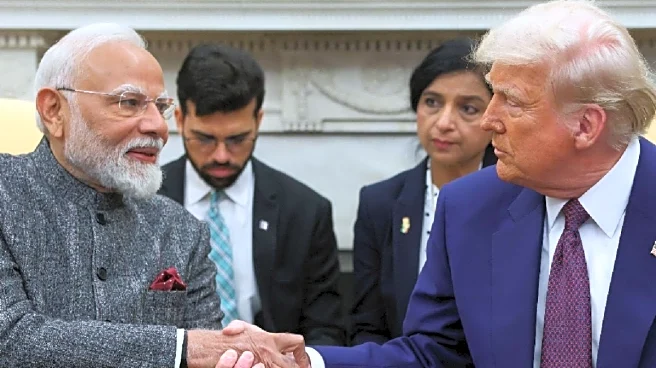
The India-US Trade Framework, announced earlier today, stands as a historic milestone in bilateral relations between these two great double engines of economic strength and democratic credentials. This carefully calibrated framework, following intense negotiations, reverses punitive tariffs imposed on Indian exports, unlocks trade potential amid geopolitical pressures, and lays the foundation for a comprehensive Bilateral Trade Agreement (BTA). Far from a surrender, it exemplifies India’s emergence as a confident, self-reliant negotiating power under Prime Minister Narendra Modi’s leadership. The framework protects core domestic interests while unlocking unprecedented market access to the world’s largest economy, valued at $30 trillion in annual
GDP.
This pact is historic because it transforms a year of tariff uncertainty and escalation—from 50% into a very competitive 18% and even zero tariffs for several Indian goods. It safeguards India’s strategic autonomy, refusing to yield on foreign policy red lines or domestic priorities. India achieved this without compromising on sensitive sectors, countering narratives of subservience. The deal complements recent FTAs with the EU, UK, Australia, UAE, EFTA, Oman, New Zealand, and others—bringing India’s tally to around nine major agreements under the Modi government, covering dozens of developed nations and markets. This shift to aggressive, proactive trade diplomacy has diversified our markets for exports, enhanced resilience, and positioned India as a key player in global supply chains.
Indian exports stand to gain immensely. The US has reduced reciprocal tariffs on Indian goods to 18% from a peak of 50%, providing immediate relief to exporters and giving our exports a competitive edge over our neighbours. Key sectors include:
- Textiles and made-ups ($10.3 billion in FY24-25): Tariffs drop from 59% to 18%, aiding Tamil Nadu (28% national share) and Tiruppur clusters. This supports ~75 lakh workers and enables ~20% US market share recovery, with projected 15-20% order increases versus competitors like Vietnam and Bangladesh.
- Knitted and woven apparel ($63.9 billion and $60.3 billion, respectively): 18% tariff restores cost edge, reviving exports from Tiruppur, Ludhiana, Delhi-NCR, and Gujarat.
- Carpets (~$0.5 billion): From 52.9% to 18%, reviving demand in Bhadohi (UP) and Jaipur.
- Diamonds, gems, and jewellery ($12 billion): From 52.1% to 18% to even 0%, stabilizing Surat, Mumbai, and Jaipur hubs with $9-10 billion annual exports.
- Organic chemicals ($2.34 billion): From 54% to 18%, offering 20-30% input cost relief and stronger pharma linkages.
- Machinery and appliances (~$9 billion): From 51.3% to 18%, boosting engineering exports by ~12% from Chennai and Pune.
- Shrimp and seafood ($2.24 billion, 40% US share): From 33.26% to 18%, safeguarding ~$900 million market and 35-48% revenue in Andhra Pradesh and coastal Gujarat for our fisherfolk.
Additionally, zero tariffs apply to high-value items like generic pharmaceuticals, gems and diamonds, aircraft parts, spices, tea, coffee, coconut oil, cashew nuts, select fruits (avocado, banana, mango, pineapple), mushrooms, bakery products, and silk. These concessions open the $30 trillion US market, create lakhs of jobs—especially for women, youth, MSMEs, farmers, and fishermen—boosting employment in labour-intensive and coastal regions.
India has steadfastly safeguarded its interests and strategic autonomy. Agriculture, dairy, fisheries, and allied areas remain fully protected—no GM products enter, and staples like wheat, rice, maize, milk, poultry, meat, ethanol, tobacco, and certain vegetables face no concessions. PM Modi reaffirmed this non-negotiable priority, stating he was “ready to pay a heavy price” to defend farmers, fishermen, and dairy producers, and he has walked the talk. US agricultural trade (~$6.2 billion, in India’s favour) persists with advantages preserved; concessions are narrow—reduced duties on non-competing items like dried distillers’ grains (DDGs), red sorghum, tree nuts, fruits, soybean oil, wine, and spirits—which lower feed costs for livestock without displacing domestic producers. Dairy remains a complete red line, with no market flooding. India retains net exporter status in agriculture (US exports to India ~$2.25 billion vs. India’s ~$6.2 billion). As stated by Piyush Goyal in his press conference, agriculture has been meticulously protected through firm red lines. Items explicitly kept out include genetically modified crops, dairy products, meat, poultry, and staples such as rice, wheat, maize, sugar, ethanol, and tobacco. Minister Goyal emphasised with absolute certainty that “the farmers, MSMEs, artisans, and craftsmen of India will not suffer any kind of loss,” confirming zero tariff concessions for US agricultural products entering India while allowing Indian farm goods zero-duty access to the US. This approach ensures food security, protects small producers, and maintains India’s core sensitivities in food and agriculture.
Trust is the currency of New India, and a win-win situation is the objective of our deals. But for Congress, lies, fakery, and cynicism are their only currency. They peddled narratives that the Indian economy was “dead” under PM Modi—yet India has secured nine FTAs (including this interim framework as a bridge to deeper ties), covering developed markets and accelerating diversification. Opposition claims that agriculture was “opened up” or “flooded” with US goods, but staples, dairy, and millets remain shielded.
This cynicism is rooted in Congress’s own history of surrender. During their tenure, they nearly dragged India into the Regional Comprehensive Economic Partnership (RCEP), a massive trade bloc dominated by China, which would have exposed Indian farmers, MSMEs, and industries to unfair competition and trade imbalances. Negotiations began under the UPA government in 2012, and Congress pushed forward despite warnings about flooding markets with cheap imports, potentially devastating domestic sectors like agriculture and manufacturing. It was PM Modi who decisively pulled India out in 2019, safeguarding national interests by refusing to join a deal that lacked adequate protections for sensitive sectors.
Furthermore, Congress surrendered strategic autonomy in security matters, most glaringly after the 26/11 Mumbai terror attacks in 2008. Despite clear evidence of Pakistani involvement, the UPA government refrained from any decisive military or diplomatic response, buckling under international pressure, particularly from the US, which urged restraint to avoid escalation. This inaction not only emboldened adversaries but also projected India as weak and indecisive on the global stage, eroding national morale and deterrence. In contrast, under PM Modi, India has responded assertively to provocations—be it Operation Sindoor or through surgical strikes post-Uri in 2016 and airstrikes in Balakot after Pulwama in 2019—it was PM Modi who restored strategic credibility without yielding to foreign dictates on national security issues.
In essence, this historic deal stabilises damage, extracts concessions, protects priorities, and paves the way for sustained growth. It deserves recognition that India has held its ground, secured tangible wins, and refused compromise where it matters most—advancing national interest with dignity and determination.
The author is National Spokesperson of the BJP. Views expressed in the above piece are personal and solely those of the author. They do not necessarily reflect News18’s views.

/images/ppid_a911dc6a-image-177066753285030524.webp)

/images/ppid_a911dc6a-image-177066761775063970.webp)
/images/ppid_a911dc6a-image-177066757083136960.webp)
/images/ppid_a911dc6a-image-177066504785467952.webp)
/images/ppid_a911dc6a-image-177066409223017092.webp)
/images/ppid_a911dc6a-image-177066405770410781.webp)