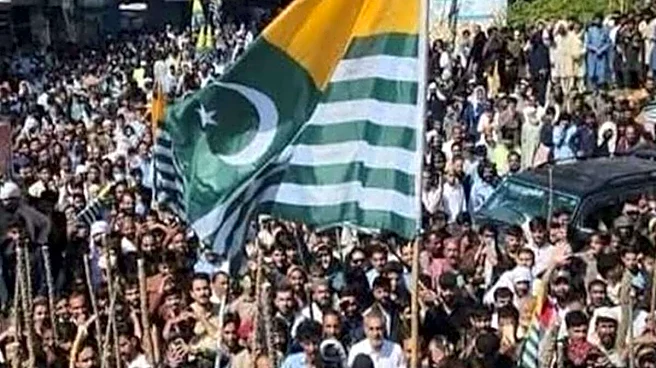



In a major escalation of the ongoing civil unrest across Pakistan-occupied Kashmir (PoK), the Jammu Kashmir Joint Awami Action Committee (JAAC) has announced a monumental two-day protest movement set for July 26 and 27, culminating in a historic long march towards Muzaffarabad. Prominent rights leaders Umar Nazir Kashmiri and Advocate Khawaja Mehran have issued a joint rallying cry to local populations, calling for a total shutter-down strike in Dadyal alongside widespread public mobilisation across the Mirpur division.
The announced strategy marks a pivotal transition in the region’s protest movement, aiming to consolidate localised sit-ins into a unified, peaceful march towards the regional capital. Central to the leaders’ directives is an urgent
appeal for disciplined non-violence, maintaining that the primary target of public grievance is the administrative structure of governance rather than front-line security personnel.
Under the newly outlined blueprint, existing regional sit-ins—including those stationed in Hajira and Abbaspur—will be temporarily wrapped up to allow activists to consolidate their strength. The first phase of the movement begins with protest convoys departing from the Mirpur division to merge with the ongoing sit-in movement in Rawalakot.
Following the post-Zuhr prayers on July 27, the unified protest forces plan to initiate the final, coordinated push towards Muzaffarabad. Organisers have emphasised that the movement seeks structural accountability and economic justice, rejecting any intentions of initiating physical clashes or armed conflict with local authorities.
Focusing heavily on local participation, Advocate Khawaja Mehran has called upon the residents of Dadyal to enforce a complete commercial and civic shutdown on July 27. Describing the upcoming days as a potential turning point for the region, leadership figures have urged citizens to take to the streets in record numbers to reject what they describe as an oppressive and unsustainable administrative system.
In a direct message to the public, rights advocates urged protesters to maintain strict discipline and unity. Stressing that low-level police officers and uniformed personnel are not the adversary, the leadership reaffirmed that the protest remains focused strictly on dismantling systemic governance failures and ending long-standing socio-economic marginalisation in PoK.
The movement’s shift towards a consolidated long march reflects months of compounding public anger over soaring inflation, electricity tariffs, and rights restrictions across the territory. As protest convoys assemble across major routes connecting Dadyal, Rawalakot, and Muzaffarabad, regional authorities face renewed pressure to address the public charter of demands.
With the leadership pledging a strictly peaceful yet uncompromising stand, the July 26-27 mobilisation represents one of the most significant, coordinated demonstrations of public dissent in the region’s recent history.




/images/ppid_59c68470-image-178477753076851947.webp)

/images/ppid_a911dc6a-image-178479005870429621.webp)


/images/ppid_59c68470-image-178480257225046633.webp)