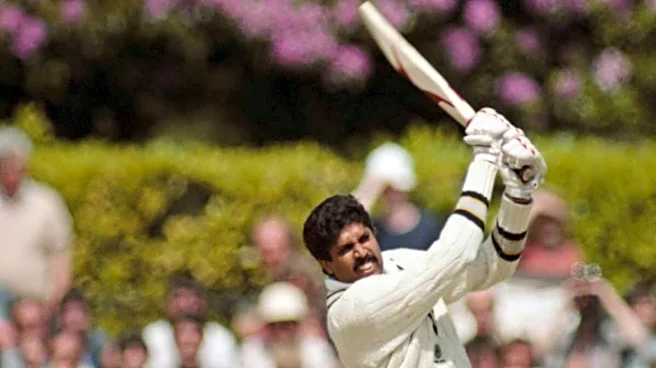




On June 18, 1983, Indian cricket witnessed one of its most defining performances, Kapil Dev’s unbeaten 175 against Zimbabwe in the Cricket World Cup at Tunbridge Wells. Decades later, the innings is still remembered not only for its brilliance but also for its impact on India’s cricketing identity.
What makes it even more remarkable is how this innings continues to stand tall when viewed through the lens of modern ODI cricket.
The Collapse That Changed The Game
India’s innings was in deep trouble at 17/5, with the top order collapsing under disciplined Zimbabwe bowling. A premature exit from the World Cup looked increasingly likely.
At this critical moment, captain Kapil Dev stepped in, not just to stabilise the innings, but to redefine it.
What followed was one of the greatest rescue
acts in World Cup history.
A Captain’s Knock Under Pressure
Kapil Dev combined controlled aggression with remarkable clarity under pressure. Batting with the lower order, he rebuilt India’s innings through crucial partnerships, including a vital stand with Syed Kirmani.
🗓️ #OnThisDay in 1983
📍Tunbridge Wells
The legendary @therealkapildev played one of the greatest World Cup innings of all time, smashing 175* off 138 balls against Zimbabwe 🙌#TeamIndia pic.twitter.com/R9ERIJ2r4O
— BCCI (@BCCI) June 18, 2025
His unbeaten 175 transformed a near-certain collapse into a commanding total, setting up one of the most important wins in India’s 1983 World Cup campaign.
Modern Data Lens: How Kapil Dev’s 175 Would Rank Today
Kapil Dev’s unbeaten 175 against Zimbabwe in the 1983 World Cup was not just a match-saving innings, it also stands out when viewed through a modern ODI lens.
In today’s era of faster scoring rates, flatter pitches, and powerplay restrictions, such a knock would still rank among elite World Cup performances.
What makes it even more remarkable is the context: Kapil Dev achieved it under extreme pressure after India were reduced to 17/5.
Unlike modern ODI cricket, where batting depth and aggressive intent are more structured, Kapil’s innings came in an era with limited protective gear, slower outfields, and minimal analytics support.
Even by today’s standards, a captain scoring 175* in a World Cup match after a top-order collapse would be considered a match-defining, tournament-shifting performance.
Advanced metrics like pressure index and match impact ratings would place it among the highest-rated ODI innings in World Cup history.
The innings also highlights how far ahead of its time Kapil Dev’s approach was, combining controlled aggression with situational awareness long before modern strike-rate driven cricket evolved.
The Match That Was Never Fully Seen
Another unique aspect of this innings is its limited live broadcast coverage. Due to technical and scheduling constraints of the era, much of Kapil Dev’s innings was not widely televised in real time.
As a result, the innings lives on largely through scorecards, radio commentary, and historical retellings – adding to its mythic status in cricket history.
In today’s digital-first world, such an innings would have dominated global highlights instantly.
The Turning Point Of 1983 World Cup
Kapil Dev’s knock did more than save a match, it reshaped India’s World Cup journey. The momentum from this innings played a crucial role in India’s historic run, which eventually culminated in their first-ever World Cup victory.
It marked a psychological shift in Indian cricket, from underdogs to world champions.
Legacy in Modern Cricket
Even today, Kapil Dev’s 175 is referenced in discussions about:
- Greatest ODI innings under pressure
- Captaincy in crisis situations
- World Cup match-turning performances
It remains a benchmark for resilience and leadership, often compared with modern great innings across formats.
Kapil Dev’s 175 against Zimbabwe is more than a historic score, it is a performance that transcends eras. When viewed through modern cricketing frameworks, its value only increases.
More than four decades later, it still stands as one of the most complete examples of leadership, adaptability, and match-winning brilliance in World Cup history.