
/images/ppid_59c68470-image-178540755508946985.webp)

/images/ppid_59c68470-image-17853451781431742.webp)
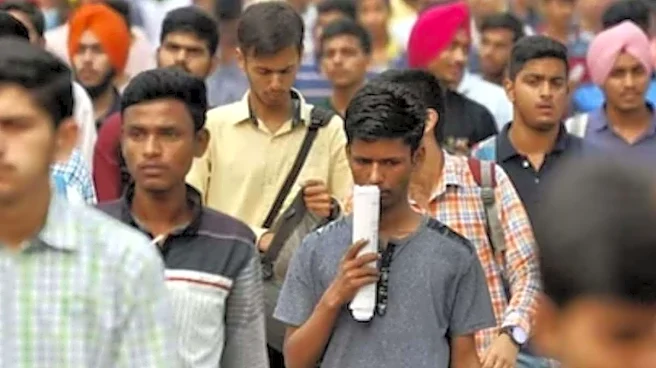
The Gen Z protest has not succeeded in achieving anything. Removing a minister or several bureaucrats, tightening the examination process, or introducing harsher laws for leaks does not address the core problem.
These are reasonable steps and are worth implementing well. But it is important to be clear-eyed about what they can and cannot fix. A cleaner examination system sorts the same fixed number of young people into the same fixed number of seats more fairly. It does not create an additional seat or, more importantly, any jobs for those who pass out of the system. The real challenge is that the system is no longer creating employability and employment.
The visible anger was about what the leak exposed, but that anger is a symptom of a deeper
malaise. There are few formal, secure and well-paying jobs, and automation in manufacturing and AI in services are reducing their number. While the number of young people competing for them is rising, this slowdown in the jobs engine has to be acknowledged.
Young India is staking its life on examinations in the hope that they will lead to a career or a job, but the world of work is changing rapidly. There is now a need for job creators, not job takers. This anger among Gen Z has to be channelled towards the real problem and should not be allowed to spill on to the streets, where it can be exploited by foreign or domestic forces inimical to the country’s interests.
The consequential and solvable issue is whether India can get its entrepreneurship and MSME engine firing at the scale required to fulfil the aspirations of its youth. That engine is what actually determines how many “seats” — jobs — exist in the first place. Getting it right is also the more durable way to prevent the kind of social strain that the past two months have previewed.
India adds roughly 12 million people to its working-age population every year and needs to place 8–9 million of them in jobs to keep pace. One part of the economy has the scale to absorb numbers like that: India’s more than 7.8 crore Udyam-registered MSMEs, which the Ministry of MSME says employ over 28 crore people, contribute approximately 30 per cent of GDP, roughly 35 per cent of manufacturing output and close to 46 per cent of exports (PIB, 2025–26 figures). Larger industries, unless they are labour-intensive, are moving towards capital-led automation in one form or another.
It is worth stating plainly what is not that engine: tech start-ups. India’s start-up ecosystem is a genuine achievement — in innovation, capital formation and global visibility — but it is not, and was never designed to be, a mass-employment engine. The economics of a venture-scale start-up reward doing more with fewer people, not more with more. A handful of unicorns generating a few thousand high-skill jobs each cannot address a requirement of 8–9 million new formal jobs a year. Policy conversations that treat “more start-ups” as the answer to the jobs problem are addressing a different, smaller problem. MSMEs — foundries, textile units, component manufacturers, food processors and tourism service providers — are the only part of the economy that can solve this problem at scale.
The task, then, is not to invent a new engine. It is to make the one India already has run at a better rate.
For a decade, the default policy instinct has been to treat underemployment as a training gap and to respond with skilling programmes. PMKVY has trained over 1.64 crore youth since 2015, yet placement rates fell from 18.4 per cent in Phase 1 to 10.1 per cent in Phase 3, and placement tracking was discontinued under Phase 4. That record is worth learning from rather than repeating: it suggests that skilling alone, delivered in isolation, is not the lever that improves employment outcomes. Skilling is an input; jobs are the output we desire. Policies and systems focused on inputs do not serve the desired outcome.
The Hundred Million Jobs Mission (HMJM) has been working on the ground to understand this problem for some time. Indian MSMEs are not globally competitive. They produce, per worker, roughly 20 to 25 per cent of the output produced by a large Indian enterprise — Deloitte India estimates approximately 18 per cent, compared with 45–70 per cent in OECD economies, while the McKinsey Global Institute’s independent estimate is roughly 25–26 per cent. McKinsey estimates that closing this gap could add something in the order of 10.5 per cent to India’s GDP. That is the prize on the table.
The HMJM paper identifies six specific areas where targeted intervention could close that gap — each one as much an opportunity as a deficit:
Building a manufacturing culture, not just a skill set.
The Hundred Million Jobs project in a foundry cluster found that Indian workers trained for a year still lagged behind global manufacturing benchmarks in consistency — not for lack of aptitude, but because three habits had not yet been embedded: process discipline, including an internalised sense of one’s own cycle time; a clear connection between output and one’s own wages; and continuous small improvements as a daily habit rather than an annual training event. The policy fix is practical and workplace-based: shop-floor coaching, visible incentive structures and locally built “method” frameworks that are owned by clusters and delivered through district-level governance.
Closing the credit gap with milestone-linked lending.
MSME credit penetration stands at roughly 14 per cent, compared with 37 per cent in China and 50 per cent in the US, with only about 19 per cent of MSME credit demand met formally. A Competitiveness Credit Facility — blending government guarantees, development finance debt and philanthropic capital — that releases funds in tranches as firms meet verified productivity or energy-efficiency milestones would put capital to work where it compounds, rather than treating it as undifferentiated working capital.
Giving promoters back their time.
Most MSMEs are run by a single promoter who simultaneously acts as managing director, purchasing head and quality controller, leaving no bandwidth for growth-related decisions. Reducing the regulatory and compliance burden on these entrepreneurs is the most important reform. This regulatory sclerosis drains the very energy entrepreneurs need to scale and perform at a higher level. We need to consider shared management-support services at the cluster level that can improve quality and unlock growth.
Tackling energy costs as a shared problem.
Fragmentation currently prevents MSMEs from aggregating power purchases in the way larger firms do, while existing rules require individual licensing even when clustered units want to buy power together. Enabling cluster-level power purchase agreements — a straightforward regulatory change — along with subsidised energy audits could meaningfully reduce one of manufacturing’s largest input costs. Alternative options, such as SMR nuclear technology or renewables, could then become viable.
Recognising quality at all levels.
A model in which large buyers co-invest in a cluster’s quality and skilling systems in exchange for reliable sourcing has worked at scale elsewhere. China’s “Little Giants” programme, which has integrated more than 14,600 firms into strategic supply chains in this way, is one reference point.
Reducing attrition through better incentive design.
Annual attrition of more than 40 per cent in many clusters means firms are constantly retraining people who leave before that investment pays off. Providing facilities such as housing for migrant labour as shared cluster infrastructure can help improve retention.
Mission approach
These six levers sit with different institutions — skilling with the MSDE, credit with the Finance Ministry and SIDBI, energy with the Petroleum Ministry and state regulators, market linkages with DPIIT and the Corporate Affairs Ministry, and employment data with the EPFO and ESIC. That is not a criticism of any one of them; it reflects how India’s institutions are organised. But it does mean that no single ministry, acting alone, can move all six levers together — and MSME competitiveness genuinely requires all six to move at once for results to become visible.
This is the case for organising the response as a time-bound, PMO-anchored Mission for MSME Competitiveness, using the same coordinating model that made Swachh Bharat, PMGSY and JAM work: a single accountable mission director, one set of outcome metrics and several ministries aligned around a shared target rather than working in parallel. The cluster — not the individual firm or the state — would be the unit of intervention, while formal employment verified through EPFO, ESIC and Udyam data would be the metric that counts, rather than enrolment numbers or certificates issued.
India’s youth have every reason to want a fairer, better-run examination system, and that reform should happen on its own merits. But the number of formal jobs available a decade from now will be determined by whether the country’s MSME sector — 7.8 crore enterprises, 28 crore workers and the one part of the economy operating at the scale this problem requires — becomes measurably more competitive, not by how well the next examination is proctored. That is a solvable problem, with a specific set of levers; a coordinated structure is the more durable way to give India’s young people what they are actually asking for: a real chance at a good job.
K Yatish Rajawat is CEO of Centre for Innovation in Public Policy and a founding partner in the Hundred Million Jobs. Views expressed in the above piece are personal and solely those of the author. They do not necessarily reflect News18’s views
/images/ppid_59c68470-image-178551753047415686.webp)

/images/ppid_59c68470-image-17855150220023933.webp)
/images/ppid_59c68470-image-178550505469897543.webp)