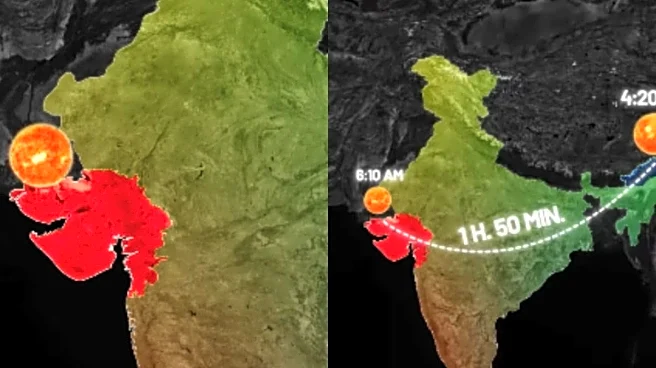

Does India need more than one time zone? A debate has started online after a video questioned whether India’s single time zone truly works for a country this vast. The clip argues that following just Indian
Standard Time (IST) may no longer match how people across different regions experience daylight.
India currently runs on one official clock no matter where you live. But the video points out that sunrise and sunset timings vary sharply across the country, especially between the far east and the far west.
‘India Needs Three Time Zones’
Explaining this gap, the narrator says: “Humare India ko asal mein teen time zone ki zaruart padti hai – Mumbai, Delhi and Kolkata. Lekin hum pura desh sirf ek hi time zone – Indian Standard Time (IST) – par chalate hai (India actually needs three time zones – Mumbai, Delhi and Kolkata. But the entire country runs on just one time zone – Indian Standard Time).”
The narrator further highlights how sunrise in Arunachal Pradesh can happen as early as 4:20 AM, while parts of Gujarat’s Kutch region remain dark until around 6:10 AM. This creates a difference of nearly one hour and 50 minutes in sunrise times within the same country.
View this post on Instagram
What Does Geography Have To Do With It?
According to a report by BBC, India stretches about 3,000 kilometres from east to west which means it covers nearly 30 degrees of longitude. This naturally translates into almost a two-hour difference in solar time which is based on the sun’s position in the sky rather than the clock.
Despite this, the country continues to follow a single time standard.
Why A Single Time Zone Is Being Questioned?
Experts quoted in the report argue that eastern India loses usable daylight every day. Offices and schools open according to IST, not sunrise. This forces people to rely on artificial lighting earlier than necessary. This in turn increases electricity consumption.
The issue becomes more serious in winter when daylight hours shrink even further.
How Daylight Affects Sleep And Health?
As the report explains, human sleep patterns depend heavily on light. The rising and setting of the sun impacts our body clocks or circadian rhythm. When evenings stay brighter for longer, the body delays the release of melatonin, the hormone that helps us fall asleep.
Why Children From Poor Families Suffer More?
Because school schedules are similar nationwide, children in areas with later sunsets often sleep less even though they wake up at the same time as others.
The BBC report cited research by Maulik Jagnani, an economist at Cornell University, who found that children exposed to later sunsets tend to perform worse in school.
The effect is sharper in low-income households where sleep conditions are already difficult due to heat, noise, mosquitoes, overcrowding and lack of proper bedding.
“The poor may lack the financial resources to invest in sleep-inducing goods like window shades, separate rooms, indoor beds and adjust their sleep schedules,” Jagnani told BBC.
What The Data Reveals
Using national surveys, Jagnani observed that children’s educational performance differs depending on the average sunset time, even between eastern and western parts of the same district. His analysis suggested that losing one hour of evening darkness could reduce schooling by almost a year over time.
Could Multiple Time Zones Help?
The research estimates that shifting to two time zones (one for eastern India and another for the west) could significantly improve sleep, learning and productivity. Over time, this could translate into billions of dollars in economic gains through better education and human capital.
Why India Has Stuck To One Time Zone?
The idea of multiple time zones in India isn’t new. In the late 1980s, a team of researchers from a leading energy institute proposed dividing the country into different time zones to save electricity. A similar proposal resurfaced in 2002 but a government panel rejected it. The panel cited the complexities involved: railways and other transport systems could face accidents or confusion if clocks had to be adjusted at every time zone crossing.
Still, scientists at the National Physical Laboratory have warned that the current system wastes daylight in the east and increases power use, particularly during winter months.



/images/ppid_a911dc6a-image-177084603066450478.webp)





/images/ppid_a911dc6a-image-177084257810510483.webp)
/images/ppid_a911dc6a-image-177084253417916956.webp)

/images/ppid_59c68470-image-177084004043125742.webp)
