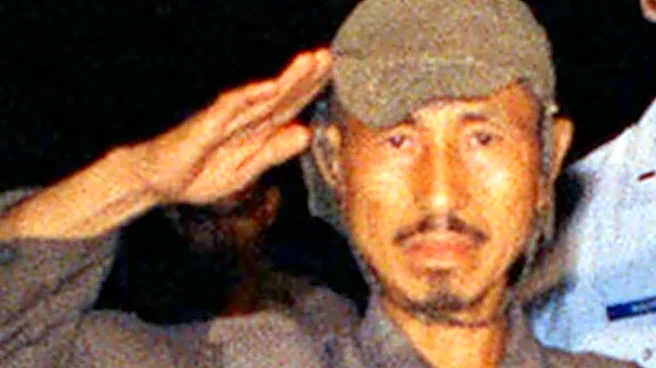




When former Japanese soldier Hiroo Onoda emerged from the Philippine jungles in 1974, it was 29 years after the end of World War II. The Japanese government had long since pronounced him dead, while several generations had grown up thinking that this conflict had been consigned to the pages of history books.
However, Onoda did not think that the war had come to an end.
As a former intelligence officer, Onoda had been ordered to conduct guerrilla warfare on Lubang Island in the Philippines in late 1944 and refuse to surrender in all situations. As the Americans and Filipinos took control of the region, many Japanese soldiers died, surrendered, or retreated. Onoda and his remaining comrades fled deep into the mountains and dense forest.
Japan formally
surrendered in August 1945 following the bombing of Hiroshima and Nagasaki. The news of Japan’s surrender was widely broadcast through leaflets dropped in isolated regions like Lubang Island. According to reports later published about the event, Onoda and the rest of the soldiers believed that the leaflets were enemy propaganda designed to force them to surrender.
For a while, they survived by stealing rice, killing cows, and carrying out occasional raids. Philippine police forces and local residents searched for them several times. Some of the confrontations ended with casualties on both sides.
The number of surviving members gradually declined. One of them surrendered in 1950, while another was killed during a confrontation with police in 1954. In 1972, Onoda’s last surviving comrade, Kinshichi Kozuka, was killed by Philippine police during another confrontation.
Onoda was left alone in the jungle.
Back in Japan, Onoda was considered dead. Memorial services had reportedly already been organised for him, and many unanswered questions remained from the war.
The course of events changed dramatically in 1974, when a young Japanese traveller named Norio Suzuki decided to search for Onoda after hearing stories about him. Suzuki managed to find Onoda in the forest, but Onoda refused to surrender because he believed that only a direct order from his superior officer could officially end his mission.
The Japanese government then located Major Yoshimi Taniguchi, who had once been Onoda’s commander, and flew him to the Philippines, where he formally relieved Onoda from duty.
On March 10, 1974, Onoda surrendered to Philippine President Ferdinand Marcos while still wearing his worn-out military uniform and carrying his rifle, sword, and ammunition.
Investigators later confirmed that Onoda’s rifle was still functional and that he had continued living according to wartime rules even though World War II had ended nearly three decades earlier.

/images/ppid_59c68470-image-177848003710261605.webp)

/images/ppid_a911dc6a-image-177849363476327334.webp)





/images/ppid_59c68470-image-177839252939772456.webp)
/images/ppid_a911dc6a-image-177850967921427449.webp)