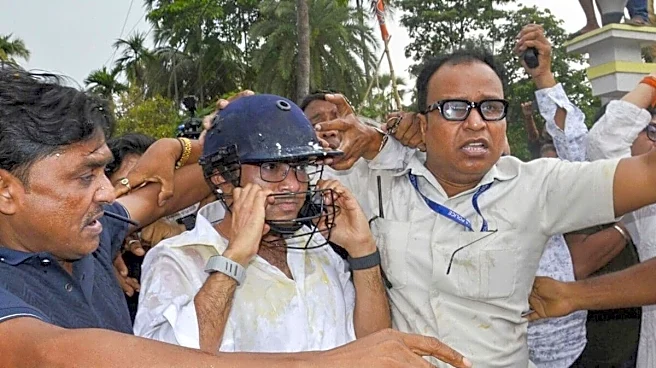



If you grew up in the 1980s, you’ll remember the earworm jingle “Ande Ka Funda” run by the National Egg Co-ordination Committee on TV. Catchy and to the point, it positioned the humble egg as a super-food – affordable, nutritious and delicious to boot. So successful was the campaign that the egg made its way into the diets of a section of India’s vegetarian population, carving out a new niche of eggetarians for itself. This week though, the “anda” was in the news for an entirely different reason. TMC MP and national general secretary Abhishek Banerjee’s recent experience with egg-pelting by the public has swung the spotlight on this unique form of political protest. The use of eggs, particularly rotten eggs, for political protest has a long
history. But as an agitation accessory, it’s an import and a post-Independence one at that. Civilisationally, the importance of showing respect to food means that chucking edibles was never on the menu in ancient or medieval India. Even during the freedom movement, agitated public would occasionally hurl footwear but never food. That’s what happened at the contentious Congress Session in Surat in 1907 when the ideological split between the status quo brigade of moderates and the new-order brigade of nationalists became glaringly clear. As moderate candidates like Pherozeshah Mehta, Surendranath Banerjee and Rash Behari Ghosh among others commanded the stage and refused Bal Gangadhar Tilak, Lala Lajpat Rai and Sri Aurobindo a chance to present their points of view, angry onlookers hurled footwear missiles at them. Later, Jawaharlal Nehru faced something similar when he had chappals hurled at his car while campaigning in Balia (UP) during the 1957 elections. By the 1970s, though, egg-pelting slowly began to make an appearance in Indian politics. Among the most well-documented instances featured the then Prime Minister Indira Gandhi who was egged at Heathrow and Southall during her UK trip in 1978 as a reaction to the imposition of the Emergency. Gandhi of course faced similar hostile reactions domestically as well, a factoid that made its way into Gulzar’s cult classic Aandhi in which Lallu Lal, a political wheeler-dealer played by Om Prakash, is seen paying the crowd to pelt the dias with eggs. More recently, several Indian political leaders have had eggs hurled at them. The most recent one involved the BJP legislator from Karnataka Munirathna who was attacked in Bengaluru two years ago. Earlier, in 2015, Youth Congress members attacked Odisha’s then chief minister Naveen Patnaik’s cavalcade with eggs. The incident triggered off several me-too pelting sprees, prompting the police to crack down on this form of protest. Other senior politicians like former Delhi CM Arvind Kejriwal have also faced egg-ire when he was pelted multiple times late 2014 and early 2015. In Kerala, the students’ wings of all political parties use rotten eggs as a form of protest. When ED officials raided former Kerala CM Pinarayi Vijayan’s house, demonstrators protested by hurling rotten eggs at the officials. Nor is the political class the only target of egging agitations. After the leak of NEET-UG papers, Maharashtra Navnirman Sena workers hurled eggs at the Latur headquarters of Renukai Chemistry Classes following the arrest of RCC’s founder, Shivraj Raghunath Motegaonkar, by the CBI. While the practice of chucking rotting food at a well-known figure to name and shame them is a very old tradition, it is something modern India has imported from the West, particularly from Britain where egging is an established form of protest. The oldest example of food pelting goes back to Roman times. Before he became emperor, Vespasian was the Roman governor of Africa. He was clearly not very popular and the growing exasperation and public anger erupted during a period of famine and drought when he pushed through with some back-breaking laws. According to Roman historian Suetonius, the people of Hadrumetum were so angry with him, they pelted him with rotten turnips in 63 CE. A century and a half later, the whimsical and widely hated Roman Emperor Elagabalus faced widespread food riots as people chucked rotting vegetables, garbage and eggs in protest against his arbitrary laws. In medieval Europe, criminals and political dissenters were often tied to a stake or a pillory and the gathered mob was allowed to hurl all manner of stuff at them, including eggs. That’s where the term ‘pilloried’ comes from. Coming back to the UK, its long tradition of egging has a roster of well-known political victims like Rishi Sunak, David Cameron, Nigel Farage among many others. The most well-known incident involving “ande-ka-funda” though was former British deputy PM John Prescott who, when egged by an agri-worker, got so incensed, he promptly punched him. In Australia, egg-pelting went back to the First World War and the then prime minister’s conscription laws. The incident came to be known as the Warwick Egg Incident. Of course, it was not the only example of Australian politicians being egged. Just seven years ago, teenager Will Connolly decided to crack an egg over Senator Fraser Anning’s head, gaining instant notoriety as the ‘egg boy’. France too has a history of egg pelting with president Emmanuel Macron being hit during a food fair in Lyons just 5 years ago. In countries like Brazil, eggs are hurled at non-performing celebs from politicians to footballers. For example, in 2018, protestors chucked eggs at former president Luiz Inácio Lula da Silva’s cavalcade and in 2013, fans of soccer club Botafogo egged the team bus at the Rio de Janeiro airport after a poor performance. In Ukraine, egg protests broke out between the pro and anti-Russian groups in 2014 and opposition leader Vitali Klitschko also had eggs hurled at him by demonstrators. Nor was this a one-off – in 2004, former PM Viktor Yanukovych was also egged while campaigning and Ukrainian agitators would often hurl eggs at the Russian embassy in Kyiv before hostilities broke out between the two countries. Clearly, “anda” agitation has its followers both across India and in different parts of the world. Given its political reputation, the humble egg has as much going for it as the jingle suggested.
Nandini Sengupta is a freelance writer and author of several books. Views expressed in the above piece are personal and solely those of the author. They do not necessarily reflect News18’s views.

/images/ppid_59c68470-image-178023253288468124.webp)

/images/ppid_59c68470-image-178029255114332868.webp)






/images/ppid_59c68470-image-178020752264456683.webp)