

/images/ppid_a911dc6a-image-178306183045379595.webp)


India’s decision to help restore Indonesia’s iconic Prambanan Temple marks more than another conservation project. It reflects India’s growing use of heritage diplomacy to strengthen cultural ties across Asia by preserving centuries-old monuments that trace their origins to shared civilisational links. The restoration of the 9th-century Shiva temple complex in Indonesia is expected to be formally launched during Prime Minister Narendra Modi’s visit to Yogyakarta this week, making it one of the key cultural outcomes of his three-nation tour.
The project also adds Prambanan to a growing list of Hindu temple sites across Southeast Asia where the Archaeological Survey of India (ASI) has been entrusted with restoration and conservation work.
The Prambanan Project
Located
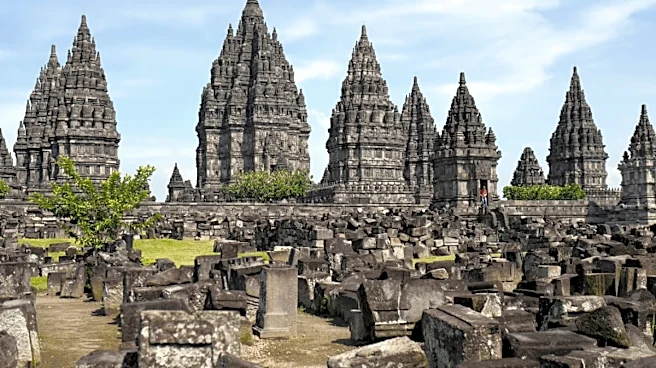
in Indonesia’s Special Region of Yogyakarta, Prambanan is the country’s largest Hindu temple complex and a UNESCO World Heritage Site. Built in the 9th century, the sprawling complex is dedicated to the Hindu Trimurti—Brahma, Vishnu and Shiva, with the towering Shiva temple forming its centrepiece.
Indonesian Culture Minister Fadli Zon recently met an ASI team to finalise the collaboration. Indonesian authorities have emphasised that conservation will extend beyond the main temple to the wider cultural landscape that includes the nearby Sewu and Plaosan temple complexes.
ASI experts will restore the monument using the anastylosis method – a conservation technique that rebuilds monuments primarily using their original stones. Only where structurally necessary are new stones introduced, helping preserve the monument’s historical authenticity. The work is expected to involve painstaking cataloguing of thousands of scattered stone blocks, with Indonesia also exploring digital technologies and artificial intelligence to assist the reconstruction.
Angkor Wat: India’s Flagship Restoration Abroad
Long before Prambanan, India’s most significant overseas conservation project was Cambodia’s Angkor Wat. Between 1986 and 1993, ASI undertook major restoration work at the world’s largest Hindu temple complex. The work included vegetation removal, drainage improvements and conservation of intricate stone bas-reliefs, helping stabilise one of the world’s most celebrated archaeological sites.
India’s engagement in Cambodia has continued well beyond Angkor Wat. Since 2004, ASI has been restoring Ta Prohm, the iconic temple intertwined with giant tree roots, while conservation work has also expanded to Preah Vihear Temple and Ashram Maha Russei, reflecting a long-term partnership in heritage preservation.
Reviving The Temples Of Ancient Champa Kingdom
Vietnam is another important chapter in India’s heritage diplomacy. At the UNESCO-listed Mỹ Sơn Sanctuary, ASI began restoration work in 2017. The temple complex once served as the religious heart of the ancient Champa kingdom and consists largely of Shaivite temples constructed between the 4th and 14th centuries.
During the conservation work, Indian archaeologists uncovered a centuries-old Shiva Linga, a discovery that underscored the site’s historical links with Hindu traditions originating in the Indian subcontinent. Restoration of Groups A, H and K was completed in 2023.
Conserving Laos’ Ancient Shiva Shrine
India has also been working at Vat Phou in southern Laos since 2009. Today recognised as a UNESCO World Heritage Site, Vat Phou began as an 11th-century Khmer temple dedicated to Shiva before gradually evolving into a Buddhist place of worship. India has supported multiple phases of structural conservation and provided technical expertise to preserve the centuries-old monument.
Sri Lanka’s Thiruketheeswaram Temple
Across the Palk Strait, ASI has been involved in conserving Sri Lanka’s historic Thiruketheeswaram Temple, one of the revered Pancha Ishwarams dedicated to Lord Shiva. The conservation project began in 2012 and has progressed towards completion, although the restored complex is yet to be formally inaugurated.
More Projects Under Consideration
India’s heritage conservation efforts are not limited to completed restorations. ASI has prepared conservation plans for Nepal’s Pashupatinath Temple and has surveyed additional heritage sites in Vietnam, including Dong Duong Buddhist Monastery and Nhan Tower, for possible future restoration work.
Beyond Hindu temples, India has also contributed to conserving Buddhist monuments such as Myanmar’s Ananda Temple and earthquake-damaged pagodas in Bagan, alongside historic Islamic monuments, reflecting a broader approach to international heritage conservation rather than one confined to a single faith tradition.
India’s Heritage Diplomacy Push
India’s overseas restoration projects increasingly serve both archaeological and diplomatic purposes. The Modi government has institutionalised heritage diplomacy as a foreign policy tool. According to the Ministry of External Affairs, India has completed more than 50 cultural and heritage projects abroad and currently has around 25 more under implementation. These include conservation work at Prambanan (Indonesia), Mỹ Sơn (Vietnam), Vat Phou (Laos), Ta Prohm and Preah Vihear (Cambodia), alongside Buddhist, Islamic and other heritage sites.
Most are concentrated in Southeast Asia, where Indian cultural, religious and maritime influences shaped kingdoms for centuries. Conservation partnerships have therefore become an extension of India’s Act East policy, combining technical expertise with cultural engagement.
The Prambanan restoration fits squarely within this strategy. By helping preserve one of the world’s most significant Hindu temple complexes, India is reinforcing civilisational ties with Indonesia while expanding a conservation legacy that already stretches from Cambodia and Vietnam to Laos and Sri Lanka. As ASI adds Prambanan to its international portfolio, the project highlights how ancient monuments continue to play a role in shaping modern diplomatic relationships.




/images/ppid_a911dc6a-image-178326726951027395.webp)