

Bangladesh Nationalist Party (BNP) chief and former Prime Minister Khaleda Zia has long been a figure of political symbolism, protest and resilience. The 80-year-old three-time premier died in Dhaka after a prolonged illness, with her funeral prayers scheduled for Wednesday, December 31. Bangladesh on Tuesday declared three days of state mourning and a one-day national holiday following her demise.
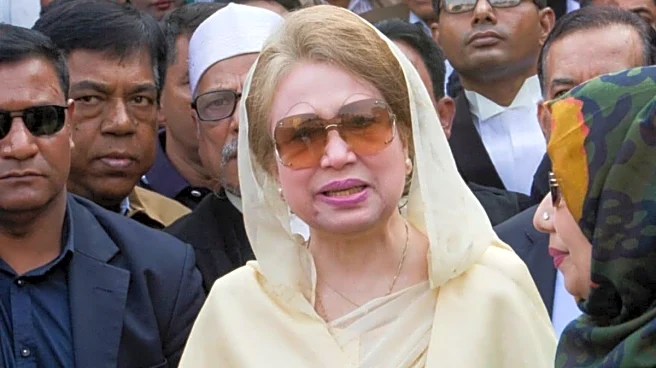
Even as the country grieves the loss of one of its most influential political figures, conversations around Khaleda Zia’s distinctive public persona, particularly her sharply arched eyebrows and trademark sunglasses, continue to resurface online, reflecting how closely her image became tied to her politics.
The discussion gained renewed momentum some
years ago after her release from jail, and return to the country following protests against Sheikh Hasina, when a photograph of the then-79-year-old leader went viral. Although she appeared visibly weak, social media users focused largely on her high, defined eyebrows. Speculation followed over whether they were natural, cosmetic or enhanced through makeup. There has been no official confirmation either way, but observers note that her brows, sharp, sculpted and unmistakable, had long been part of her identity as a strong and assertive political presence.
Early photographs show well-groomed but less dramatically arched brows. Over time, they appeared higher and more sculpted. In recent years, illness has reportedly caused hair thinning, leading to speculation that makeup may have been used to fill and define the brows, a change that quickly fuelled online chatter.
In South Asia, where the appearance of female political leaders often comes under scrutiny, the conversation around Khaleda Zia’s eyebrows has remained persistent.
Beyond her eyebrows, Khaleda Zia’s broader fashion choices have also stood out for their understated consistency. She is best known for her light-coloured sarees, usually cotton or silk in shades of white, cream, pale pink or sky blue and often simple, minimally embroidered and devoid of flamboyance. A plain white saree with a black border became one of her most identifiable looks, seen by supporters as a quiet symbol of struggle and restraint.
Her oversized black sunglasses, almost always brand-neutral, evolved into a political accessory in their own right. Seen during rallies, court visits and public appearances, they contributed to what analysts describe as an image of steely resolve, and a touch of mystery.
True to that tone, her jewellery has remained sparse with small gold earrings, pearls, light chains and simple bangles. Heavy ornaments and luxury labels rarely featured in her wardrobe, reinforcing the image of a leader positioning herself closer to the ordinary citizen than to elite privilege.



/images/ppid_59c68470-image-177102753183257032.webp)

/images/ppid_a911dc6a-image-17710264327998831.webp)

/images/ppid_a911dc6a-image-177102646607765106.webp)