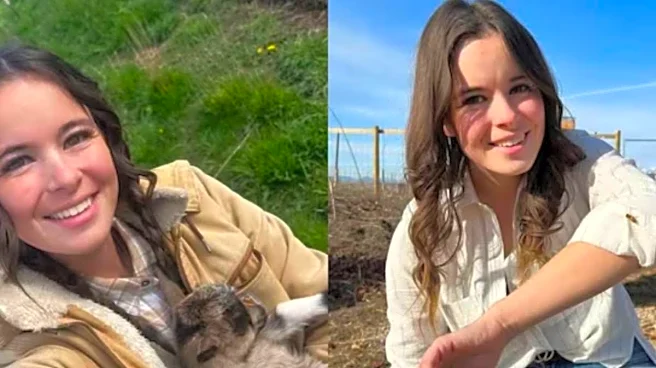

How the world might end remains a mystery, but for many, the idea of doomsday has always been rooted in fear, prophecy and speculation. Among the many voices predicting catastrophe over the centuries,
the 16th-century astrologer Nostradamus continues to command attention, especially as some of his alleged predictions for 2026 resurface on social media.
Fuelled by these renewed interpretations, a 25-year-old woman from the United States has emerged as a prominent and controversial figure online. Known as Gubba, she describes herself as a “doomsday prepper” and has amassed nearly 20 lakh followers on Instagram by sharing advice on how to survive what she believes could be an impending global crisis.
Gubba’s videos, which range from food preservation techniques to emergency survival tips, have sparked intense discussion. Her growing influence coincides with viral claims about Nostradamus’s prophecies for 2026, which speak of ominous imagery such as “a great swarm of bees” and land “turning red with blood”. While historians and scholars have long disputed the accuracy and interpretation of such writings, their circulation has clearly struck a chord with audiences already anxious about the state of the world.
According to Gubba, her preparations are not driven by superstition alone. She argues that modern systems are increasingly fragile, pointing to the threat of large-scale wars, the rapid and unchecked growth of artificial intelligence, environmental degradation and economic instability. “You don’t need a prophet to see what’s happening,” she has said in her posts, insisting that current global tensions make preparedness a rational choice rather than an eccentric obsession.
Much of her income, she claims, is spent on stockpiling food, medical supplies and everyday essentials in anticipation of supply chain disruptions or even the outbreak of a third world war. She frequently criticises governments for what she describes as reckless money printing during crises, which, according to her, only deepens economic collapse once supply systems begin to fail.
Watch the viral video:
Gubba has also taken steps to reduce dependence on modern infrastructure. She raises animals, prepares soups, broths and canned meat at home, and manufactures her own soap and skincare products, which she sells under the brand name ‘Arvoti’. For personal security, she has openly acknowledged owning weapons, a detail that has further polarised opinion about her lifestyle.
One of her most widely shared videos details what she would carry in a “survival bag” if a global conflict were to erupt. The essentials, she says, would include water purification tools, a durable knife, basic shelter materials, fire-starting equipment, a first-aid kit, warm clothing, some form of currency, communication devices and high-calorie food. Each item, she argues, is chosen to minimise reliance on what she calls a failing global system.
At the heart of her message is a broader argument about inequality in preparedness. Gubba maintains that if the wealthy and powerful can afford bunkers and long-term food reserves, ordinary families should also have the right to feel secure in uncertain times.





/images/ppid_59c68470-image-177072755109797092.webp)

/images/ppid_59c68470-image-177072763083318755.webp)
/images/ppid_59c68470-image-177072759233928219.webp)
/images/ppid_59c68470-image-177072754680482508.webp)