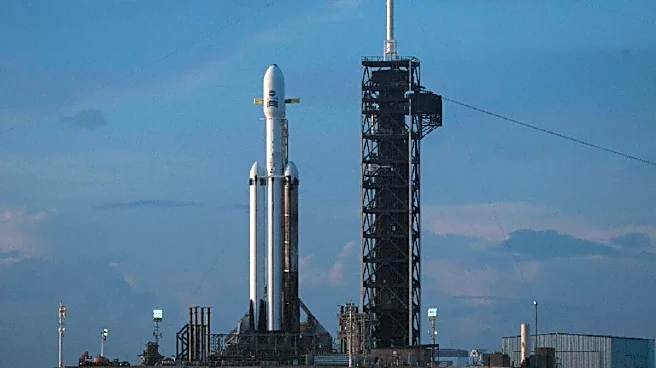




NASA’s newest space telescope blasted off Sunday on a mission to search for planets around distant stars, map billions of galaxies and investigate one of the biggest mysteries of the universe — dark energy.
The $4.3-billion Nancy Grace Roman Space Telescope lifted off shortly after daybreak aboard SpaceX’s powerful Falcon Heavy rocket from NASA’s Kennedy Space Center in Florida.
The bus-sized telescope is now headed for a point in space roughly 1 million miles (1.6 million kilometres) from Earth, the same region of space where NASA’s James Webb Space Telescope operates.
But Roman is not going there to do the same job as Webb.
Its great strength is breadth and speed. While Webb can stare deeply and precisely at relatively small patches of the cosmos,
Roman is designed to scan enormous stretches of the universe, creating a vast catalogue of galaxies, stars and planets for astronomers to investigate.
It will take Roman more than three months to reach its destination.
Once it begins observing, scientists expect it to find tens of thousands of planets, thousands of supernovae, billions of galaxies and tens of billions of stars.
“It’s going to be able to do things that we’ve never been able to do before with its massive field of view,” NASA science mission director Nicky Fox said.
Roman Will See The Universe In A Way Hubble Can’t
Roman’s field of view is expected to be more than 100 times wider than Hubble’s.
That difference is crucial.
Imagine trying to understand an entire forest by examining one tree at a time. Hubble and Webb are extraordinarily powerful at studying individual cosmic objects in detail. Roman is being sent to look across the forest.
Its speed is just as remarkable.
According to senior project scientist Julie McEnery, one month of observations of the Milky Way by Roman would take Hubble about a century to complete.
Roman will therefore be able to survey the densely packed central region of the Milky Way at unprecedented speed, giving scientists their deepest look yet at the heart of our galaxy.
And its huge field of view could turn up the objects astronomers least expect.
“Roman’s vast reach will allow us to find the weird, the rare and the unusual,” McEnery said before the launch. “We’ll redefine what it means to find a needle in a haystack.”
Thousands Of New Worlds Could Be Waiting
One of Roman’s major missions will be to hunt for planets outside our solar system.
These exoplanets are worlds orbiting stars other than the Sun, and Roman’s enormous survey area means it can search for them across vast portions of the Milky Way.
Once Roman identifies interesting worlds, NASA’s more powerful Webb telescope can potentially take a closer look.
That makes the two observatories complementary rather than competitors.
Roman will essentially help astronomers find the needles. Webb can then examine some of those needles in much greater detail.
Roman will also carry an experimental coronagraph, an instrument designed to block the overwhelming glare of a star so that the much fainter planet orbiting it can potentially be seen directly.
The Telescope Will Hunt Dark Energy, Too
Perhaps Roman’s most ambitious task has little to do with individual planets. Scientists believe dark matter and dark energy account for most of the universe, yet neither can be directly seen in the conventional sense.
Dark energy is particularly mysterious because it is associated with the accelerating expansion of the universe. Roman will create an enormous catalogue of galaxies and other cosmic objects that astronomers can use to study how the universe has expanded over time.
That could help scientists better understand what dark energy actually is — or whether their current understanding of the universe needs to change. Roman’s observations will be combined with those from Webb, Hubble, the European Space Agency’s Euclid spacecraft and the National Science Foundation’s Vera C. Rubin Observatory in Chile.
Together, the observatories will give scientists something close to a multi-layered map of the universe, from its largest structures down to individual stars and planets.
Who Was Nancy Grace Roman?
The telescope is named after Nancy Grace Roman, NASA’s first chief astronomer and one of the key figures behind the agency’s early space-observatory programme. Roman joined NASA in 1959 and pushed for space-based observatories that could look beyond the distortions caused by Earth’s atmosphere. She later became closely associated with the development of what eventually became the Hubble Space Telescope, earning the nickname “Mother of Hubble.” Roman died in 2018 at the age of 93.
Retired NASA scientist Ed Weiler, who coined the “Mother of Hubble” description, said it was fitting that the telescope named after her would tackle some of astronomy’s biggest unanswered questions.
“I think Nancy would be very proud,” Weiler said. Roman is also notable for another first: it is NASA’s first space telescope named after a woman.
A Telescope Built From A Spy Satellite Mirror
There is an unusual story hidden inside Roman itself. Its primary mirror is nearly the same size as Hubble’s — about 8 feet (2.4 metres) across — but it was not originally built for astronomy.
The mirror was donated to NASA by the National Reconnaissance Office, which operates US reconnaissance satellites. More than a decade ago, the agency gave NASA two surplus mirrors originally intended for spy satellites. One became part of the Roman project; the other remains in storage.
Roman is also designed with the possibility of being refuelled in space, potentially allowing its mission to continue longer if robotic servicing technology becomes available in the coming decade.
The telescope launched nearly a year ahead of schedule and within budget, NASA said.