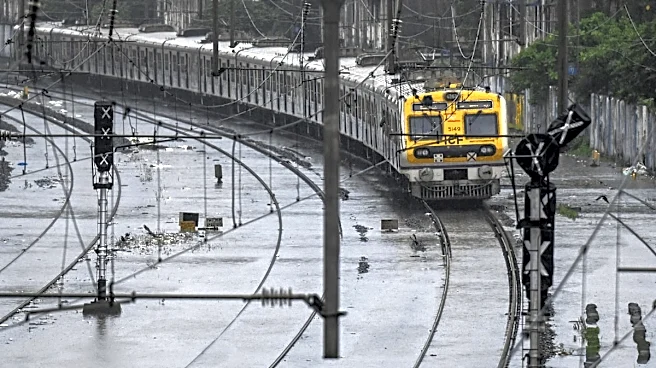






Mumbai is known for its extensive local train network that carries millions everyday. Then why do local trains ground to a halt during high tides?
Because the city’s drainage network relies entirely on gravity to empty into the Arabian Sea. News18 explains.
When a high tide occurs, the sea level rises above the city’s drainage outfalls. This effectively creates a hydraulic lock, sealing the floodgates. If torrential rain falls simultaneously, the waterhas nowhere to go. Instead of draining away, it flows backward, rapidly submerging low-lying railway tracks.
MUMBAI’s LIFELINE: CENTRAL AND WESTERN RAILWAY LOCAL TRAINS
Between 75 lakh and 95 lakh (7.5 to 9.5 million) people travel by Mumbai local trains every single day. Recent railway data indicates that daily weekday ridership is inching closer to the
1 crore (10 million) mark due to rapid housing expansion across the Mumbai Metropolitan Region. The daily passenger load is shared between two main zonal divisions operated by Indian Railways: Central Railway (CR): Carries the bulk of the traffic with roughly 62 lakh (6.2 million) weekday passengers across the Main, Harbour, and Trans-Harbour lines. Western Railway (WR): Carries approximately 31 lakh (3.1 million) daily passengers along its line from Churchgate to Dahanu Road.
A standard 12-coach rake is designed to hold about 1,200 passengers, but during peak rush hours, it regularly carries over 4,000 commuters. This results in what officials call a “Super Dense Crush Load,” squeezing 14 to 16 passengers into a single square metre of floor space.
WHAT MAKES THE LIFELINE VULNERABLE?
The specific structural, geographical, and technical reasons behind this systemic vulnerability involve several interconnected factors:
1. The “Bowl” Geography and Reclaimed Land
Modern Mumbai was created by reclaiming land to connect seven distinct islands. Large sections of the railway network, especially crucial transit bottlenecks like Kurla, Sion, Chunabhatti, and Masjid, sit in low-lying, bowl-shaped depressions that are actually below the high-tide sea level. Rainwater naturally gravitates to these low pockets, say experts.
2. Saturated Track Ballast and Electrical Risks
Railway tracksare laid on a bed of crushed stones called ballast. When water pools on the tracks, it can wash this ballast away, destabilising the tracks. More critically, if water rises more than 3 to 4 inches above the rails, it threatens to short-circuit the sensitive electronic signaling equipment and the traction motors beneath the local train rakes, forcing operators to suspend services for public safety, say experts.
3. Outdated Drainage Design Capacity
The city’s stormwater drain network was originally built during the British era with a capacity to handle just 25 mm of rain per hour, assuming a low tide. While upgrades via the BRIMSTOWAD project aimed to increase this to 50 mm per hour, Mumbai routinely experiences climate-induced extreme spikes of 100 mm to 300 mm of rain in a single afternoon. The sheer volume simply overwhelms the physical dimensions of the drains, say experts.
4. Hyper-Concretisation and Blocked Outlets
Mumbai has lost portions of its natural sponges — the wetlands and mangrove ecosystems—which used to absorb excess runoff. Extensive paving prevents rainwater from seeping into the ground, turning roads into fast-flowing concrete canals that dump water directly onto the tracks. Additionally, micro-plastics, household trash, and heavy construction debris from mega-projects block the drainage slits, choking the system from within, say experts.
5. Natural Waterways Under Pressure
The city’s natural drainage arteries, such as the Mithi River, are severely encroached upon, heavily silted, and narrowed by urban development. When a high tide pushes seawater into the mouth of the Mithi River, the river swells instantly, preventing the smaller nullahs (drains) adjacent to Central and Harbour line tracks from emptying their water, say experts.
With agency inputs





/images/ppid_59c68470-image-178385752218725882.webp)




/images/ppid_a911dc6a-image-178385553240916887.webp)
