

/images/ppid_a911dc6a-image-177081457256338436.webp)
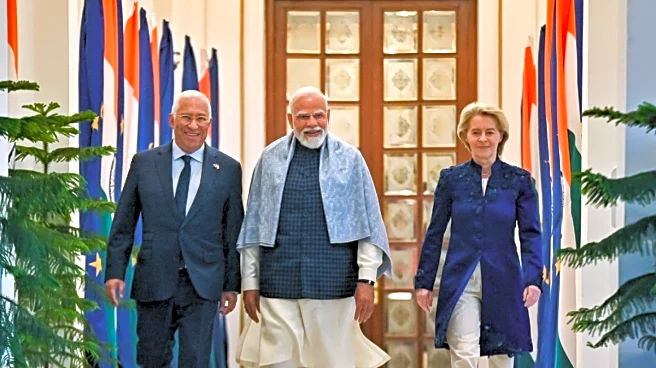
Over the past six months, India has orchestrated one of the most consequential sequences of trade agreements in its recent economic history. In late July 2025, it sealed a landmark deal with the United Kingdom. In mid-December, it secured agreements with Oman and, most recently, with New Zealand. Then, on 27 January 2026, as the ink was drying on the European Union’s reciprocal tariff threats against Washington itself, India and the EU announced the conclusion of nearly two decades of negotiations, finalising what Prime Minister Narendra Modi has termed “the mother of all deals.”
The Modi government did not move out of desperation to sign these agreements. India negotiated hard on each, extracting substantial concessions, duty-free access for
99 per cent of its exports to the United Kingdom, zero-duty entry into New Zealand’s market, and meaningful tariff cuts across the European Union.
These agreements are a recognition of a new and durable reality and India’s adaptability. The United States, under President Donald Trump, has fundamentally altered the parameters of global trade. With reciprocal tariffs of 50 per cent on Indian goods, among the highest levied on any trading partner. Washington has signalled that the post-Cold War era of relatively open American markets is over. India’s response has been neither capitulation nor confrontation, but rather seeking and locking in alternative pathways that simultaneously signal to Washington that it possesses genuinely attractive options beyond the American market.
The EU-FTA and Architecture of Strategic Hedging
The India-EU Free Trade Agreement sits at the centre of this strategic repositioning. After stalling for nearly a decade, negotiations began in 2007, paused in 2013 amid disagreements over automobiles, intellectual property, and agriculture, and resumed seriously only after 2020 and accelerated dramatically through 2025. The recent push to a conclusion, negotiated across fourteen formal rounds and countless working sessions, culminated in a comprehensive accord covering twenty-four chapters of trade in goods, services, investment protection, and intellectual property.
The bilateral relationship now encompasses a market representing 25 per cent of global GDP and one-third of global trade, a scale of economic integration that few bilateral agreements can match. The EU itself faces mounting pressure from Washington, with Trump’s administration threatening 10 per cent tariffs on eight European nations beginning 1 February, escalating to 25 per cent in June unless the EU yields on unspecified demands concerning technology regulation and Greenland.
Under these circumstances, the EU-India agreement becomes not simply a trade pact between two partners, but a signal of intent: that major economies will not remain passive in the face of American protectionism, and that they will actively construct economic blocs that operate according to rules-based frameworks rather than presidential whim.
The US Treasury Secretary Scott Bessent publicly rebuked the India-EU deal announcement, complaining that India sells refined Russian petroleum to Europe—a complaint that underscores the deeper geopolitical contest at play. Yet India’s response has been disciplined: it has neither capitulated on strategic sectors nor attempted rhetorical tit-for-tat with Washington. Instead, by locking in market access across three continents, Europe, the Asia-Pacific, and the Middle East, it has constructed a genuine alternative to complete dependence on American consumers.
FTAs With The UK, New Zealand and Oman
The United Kingdom agreement, signed on 24 July 2025 after three years of negotiation, establishes the template for India’s recent diplomatic success. Under the Comprehensive Economic and Trade Agreement, Indian exporters gain duty-free access for 99 per cent of their products, covering textiles, leather goods, marine products, gems, jewellery, and engineering goods.
The pact is projected to expand annual bilateral trade by £25.5 billion, adding £4.8 billion to the UK economy and £5.1 billion to India’s economy annually. Critically, this agreement protects India’s sensitive agricultural sectors, particularly dairy, which India has never opened to foreign competition in any free trade agreement.
The India-New Zealand agreement was concluded in December 2025 after just nine months of negotiations. New Zealand grants zero-duty access to 100 per cent of Indian exports whilst committing USD 20 billion in foreign direct investment over fifteen years, backed by a rebalancing mechanism allowing India to suspend benefits if investment fails to materialise.
The agreement covers 118 services sectors, India’s most ambitious services liberalisation, and includes provisions eliminating caps on Indian students and guaranteeing extended post-study work visas of up to four years for PhD holders. India secured full exclusion of dairy and protection for vulnerable agricultural items such as onions and almonds.
The India-Oman Comprehensive Economic Partnership Agreement was signed on 18 December 2025. Oman granted duty-free access on 98 per cent of its tariff lines, covering 99.38 per cent of Indian exports by value. Oman’s first bilateral trade pact since its 2006 accord with the United States signals a deliberate pivot towards deeper engagement with India.
The agreement positions India as the gateway for market access to the broader Gulf Cooperation Council, whilst simultaneously providing India pathways to Central Asia, Africa, and Eastern European markets through Omani networks. A Joint Vision Document on maritime cooperation established frameworks for shared maritime security and blue economy collaboration.
Acceleration of Necessity
What distinguishes this moment is the velocity with which the deals have been concluded. The India-New Zealand agreement was concluded within nine months of preparation. The EU-India deal, after languishing for more than a decade, was revived, negotiated, and brought to a conclusion within roughly eighteen months of formal recommencement.
Washington’s protectionist measures operate according to a fundamentally different logic than previous American trade policy. Under prior administrations, tariffs functioned as negotiating tools, a pressure to extract specific concessions before resolution. Under Trump’s current regime, tariffs operate as a permanent structural feature of American trade policy, applied reciprocally across all trading partners and justified as a geopolitical instrument equivalent to export controls and sanctions. The US Trade Representative has explicitly abandoned the concept of permanent normal trade relations that has underpinned global commerce for the past quarter-century.
Under such circumstances, India’s diversification was not optional. With 50 per cent tariffs on Indian goods, amongst the highest globally, India’s labour-intensive export sectors faced genuine jeopardy. The traditional paths for Indian exports, including textiles, leather products, jewellery, and gems, all faced severe compression in the American market.
The Signal to Washington
Yet the deepest strategic purpose of these FTAs operates at the geopolitical rather than commercial level. By locking in market access across the European Union, the United Kingdom, Oceania, and the Middle East simultaneously, India has accomplished what Washington’s tariff regime explicitly sought to prevent: the creation of genuine economic alternatives to dependence on the American consumer market. Each agreement, in isolation, provides supplementary markets. Collectively, they constitute a hedge against American hegemonic control over India’s external economic relations.
The hedge carries particular significance given India’s own protectionist posture. India maintains tariff rates comparable to Brazil, with agriculture averaging 39% duties. Trump has repeatedly criticised India as a “Tariff King.” India has steadfastly refused to liberalise the agriculture and dairy sectors, viewing these as non-negotiable components of domestic stability.
Washington has demanded that India cease Russian crude purchases and open protected agricultural sectors, demands India has rejected on grounds of strategic autonomy. Even though Russian crude oil purchases have declined, it has more to do with strategic autonomy than with heeding American demands.
By signing substantial agreements with the EU, UK, New Zealand, and Oman whilst maintaining a firm negotiating position with Washington, India has achieved something remarkable: it has made itself simultaneously valuable to the West as a counterweight to China, and simultaneously independent of Western pressure on core economic interests. Washington’s leverage has diminished significantly.
The Long Game
These agreements will not immediately compensate for lost American market access. No alternative market can provide the combination of scale and purchasing power that the American consumer market offers. Yet their significance operates at a different pace. Over the next five to ten years, as supply chains respond to American tariff barriers, the availability of duty-free or low-tariff entry into European, British, New Zealand, and Omani markets becomes increasingly valuable. Export-dependent sectors will gradually shift production and supply chains to take advantage of these new market access conditions.
More fundamentally, these agreements demonstrate that American protectionism generates consequences Washington may not have anticipated. The very tariffs intended to coerce Indian compliance instead accelerated India’s pivot towards economic partnerships with other major economies. Instead of capitulating, India has become more strategically autonomous. Washington wanted India as a subordinate ally; instead, India has made itself an ally on its own terms. India has shown that it is strategically valuable and economically stable, but no longer vulnerable to economic coercion through tariff manipulation. In the calculus of grand strategy, this represents a significant realignment.
/images/ppid_59c68470-image-177081525337143071.webp)

/images/ppid_59c68470-image-177081508095753303.webp)
/images/ppid_59c68470-image-177081517392040553.webp)
/images/ppid_59c68470-image-177081512358914704.webp)
/images/ppid_59c68470-image-177081521903588681.webp)





/images/ppid_59c68470-image-177081503618238277.webp)