


For nearly three years, Bhawani has known only one world. The forests and elephant camp of Dudhwa Tiger Reserve, the familiar voice and touch of mahout Irshad Ali, another orphaned elephant calf, Durga, who became her constant companion, and the adult female elephants who gradually became the surrogate herd for a calf that had lost her own family in the wild. But a proposal to move her to Gorakhpur Zoological Park threatened to sever all of those bonds.
On Monday, that relocation was stalled after a legal intervention by advocate S. Mohammed Haider Rizvi, who challenged the proposed transfer on animal welfare and legal grounds.
For Ali, the development was deeply personal. “I felt as if my own daughter was being taken away from me,” he said.
HOW ALI MET BHAWANI
Ali
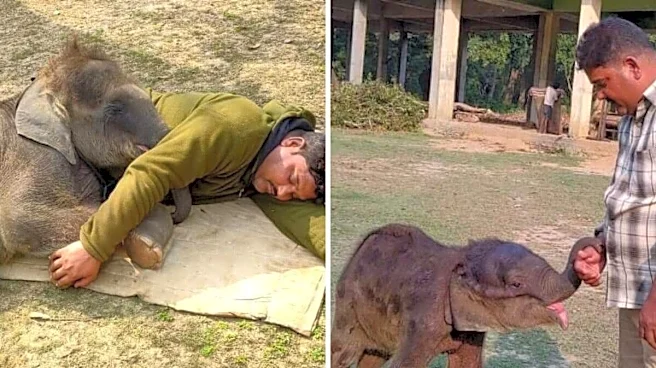
has worked as a mahout for 35 years, but Bhawani, he says, was different from every elephant he had cared for before. “She came to me when she was just a newborn. She needed someone every moment. She was not merely an elephant calf for me. I raised her like my own child,” Ali said.
Bhawani was rescued from the Najibabad forest division in Bijnor district after becoming separated from her mother and herd. According to Ali, she was barely 12 days old when she was brought to the Salukapur Rhinoceros Rehabilitation Centre in Dudhwa.
A newly delivered elephant had reportedly entered farmland, after which farmers tried to drive the herd away. In the process, the calf became separated from her mother.
“Elephants are extremely protective of their calves. They never leave them behind easily. But in such situations, when a herd is driven away from farmland, a newborn can sometimes get separated,” Ali said.
By the time Bhawani reached Dudhwa, she was frail and completely dependent on human care. “The biggest challenge was feeding her. She needed milk at very short intervals,” Ali recalled.
He would feed her Lactogen and cow’s milk repeatedly through the day and night. “I used to feed her almost 10 times during the day and 10 times at night. Many nights, I did not sleep at all. I would remain awake, waiting for the next time she needed to be fed,” he said.
The quantities were enormous. “In a day, she would consume a mixture of around 15 kg of milk, water and Lactogen. At night, she needed nearly 12 kg more,” Ali said.
The mahout had a wife and two sons at home, but Bhawani required constant attention. “I have a family of my own — my wife and two sons. But Bhawani needed me more at that time. I used to go home only once a month,” he said.
“For me, she was like a child. If a human baby cries, the mother wakes up. It was the same with Bhawani. I had to be there whenever she needed me.”
He would often sleep beside the calf. “She would sleep with her trunk resting on me. Slowly, she began recognising me. She knew my voice, my smell and my presence,” Ali said.
Today, Bhawani is nearly three years old. She no longer depends on milk as she once did. “She eats porridge and khichdi. She eats gram too. But even today, I have to feed her with my hand,” Ali said, adding, “Just like we feed our children, I feed her. She still behaves like a baby.”
The bond has also extended to another orphaned elephant.
BHAWANI’S COMPANION DURGA
Durga, herself a rescued female calf, became Bhawani’s companion. Adult female elephants at the camp also gradually began accepting the younger calf. “She has grown up here. This is her home. Durga is with her. The other elephants know her. She knows everyone here,” Ali said.
That is why the proposed transfer to Gorakhpur Zoo left him devastated. “When I heard that Bhawani would be shifted, I was very upset. I could not understand how she would suddenly be taken away from the place where she had grown up,” he said.
“She has already lost her mother once. If she is taken away from us now, she will lose her family all over again.”
THE TRANSFER THREAT
The Forest Department had proposed shifting Bhawani to Gorakhpur, citing concerns over her safety from tigers and adult male elephants. The proposal also referred to the Captive Elephant (Transfer or Transport) Rules, 2024.
But advocate S. Mohammed Haider Rizvi challenged the proposal, arguing that Bhawani’s welfare and social bonds had to be the primary consideration.
“This is not a case of an elephant being transferred from one private owner to another. Bhawani is a wild-born orphan rescued by the Forest Department. She is a State animal property and has been hand-reared by the Forest Department,” Rizvi said. He argued that the proposed transfer would destroy the social bonds Bhawani had developed after losing her biological mother.
“For a hand-reared orphan, the relationship with the mahout and the companion calf is not some sentimental attachment that can simply be ignored,” Rizvi said. “These bonds are the closest substitute for the maternal and social structure that the calf lost in the wild.”
According to Rizvi, removing Bhawani from Dudhwa would amount to imposing a second separation on an animal that had already suffered the first one. “She lost her biological family as an infant. She then formed a new family at Dudhwa. The proposal would have severed that family once again,” he said.
Rizvi also questioned the legal basis of the proposed transfer.
“The Captive Elephant (Transfer or Transport) Rules, 2024, are framed around captive elephants in respect of which ownership certificates have been issued. Bhawani is a wild-born orphan rescued and reared by the Forest Department. She is government property under Section 39 of the Wildlife (Protection) Act,” he said.
“The question is whether rules meant for privately owned captive elephants can be used as the legal foundation for transferring a rescued wild-born orphan from a forest camp to a zoo.”
He also invoked provisions relating to zoo acquisition and the need for Central Zoo Authority approval, besides citing animal welfare principles and Supreme Court judgments. “The law cannot look at an animal merely as an object that can be moved from one location to another,” Rizvi said.
“The first question must be: what is in the best interest of the animal?”
He said the decision to halt the relocation was an important recognition of that principle. “This is a victory for the species-best-interest principle. Administrative convenience cannot override the welfare, psychological well-being and social needs of an animal,” Rizvi said.
MONDAY’S DECISION
On Monday, the Forest Department stalled the proposed relocation.
Bhawani will remain at Dudhwa, at least for now, with the mahout who raised her and the elephant calf that became her companion.
For Ali, the decision brought relief. “I had become very emotional when I heard about the transfer. I kept thinking about how she would live without us,” he said.
“I have spent almost three years with her. I have fed her, stayed awake with her and looked after her when she was helpless. How can I not feel that she is my own child?”
He pauses before adding: “Bhawani is not just an elephant for me. She is a member of my family.”
And for now, that family remains together. For Bhawani, it means she will not have to lose her home — or her family — a second time.
/images/ppid_a911dc6a-image-178506917212653807.webp)





/images/ppid_a911dc6a-image-17850691354656803.webp)

/images/ppid_59c68470-image-178512760283520785.webp)
