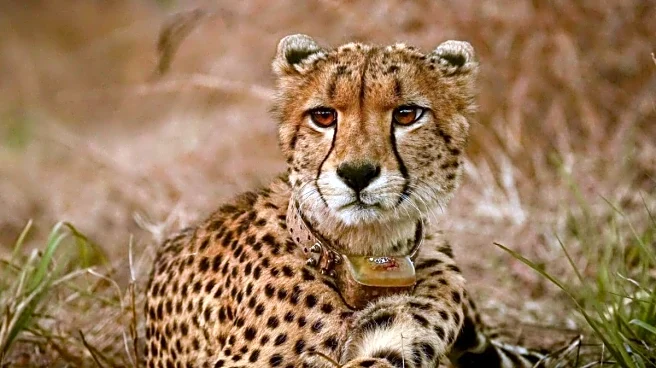



Cheetah Aasha recently gave birth to five cubs at Madhya Pradesh’s Kuno National Park, taking the population to 35. Aasha was translocated to India from Namibia as part of the ambitious project to revive the population of the world’s fastest land animal in India, which had gone extinct decades ago. “Kuno has witnessed a moment of pure pride as Aasha gives birth to five healthy cubs, strengthening India’s cheetah conservation journey. With this, the number of Indian-born cubs rises to 24, and the total cheetah population reaches 35,” MP CM Mohan Yadav wrote on X. Environment minister Bhupender Yadav wrote: “Kuno Welcomes the Birth of FIVE Cubs. Aasha’s legacy leaps forward—India welcomes her five adorable cubs! A moment of immense pride and joy
for Project Cheetah as Aasha, the Namibian cheetah and a proud second-time mother, gave birth to five cubs on 7th February 2026 at Kuno National Park. With this, the tally of Indian-born surviving cubs rises to 24, marking the eighth successful cheetah litter on Indian soil—a significant milestone in India’s cheetah conservation journey, undertaken and nurtured under the environmentally-conscious leadership of PM Shri @narendramodi ji.”
Kuno Welcomes the Birth of FIVE Cubs 🐆✨
Aasha’s legacy leaps forward—India welcomes her five adorable cubs!
A moment of immense pride and joy for Project Cheetah as Aasha, the Namibian cheetah and a proud second-time mother, gave birth to five cubs on 7th February 2026 at… pic.twitter.com/vTXFkZJoso
— Bhupender Yadav (@byadavbjp) February 7, 2026
EIGHT MORE CHEETAHS ON THEIR WAY
MP CM Mohan Yadav recently said that eight additional cheetahswould arrive in the state from Botswana at the end of February.
CM Yadav also emphasised that he held detailed discussions with the Union Minister for Environment, Forest and Climate Change Bhupender Yadav regarding the required cooperation and arrangements for the cheetah reintroduction program.
The Chief Minister met with Union Minister Yadav in New Delhi on Wednesday and discussed issues related to tourism development, expansion of reserve forests, and wildlife conservation in the state.
After the meeting, he told reporters, “We are transporting wild buffalo from Assam to Madhya Pradesh and need assistance with the relocation. Additionally, eight cheetahs will also arrive in MP from Botswana on February 28, and we discussed the necessary cooperation and arrangements for the arrival of the big cat.”
Kuno Welcomes the Birth of FIVE Cubs 🐆✨
Aasha’s legacy leaps forward—India welcomes her five adorable cubs!
A moment of immense pride and joy for Project Cheetah as Aasha, the Namibian cheetah and a proud second-time mother, gave birth to five cubs on 7th February 2026 at… pic.twitter.com/vTXFkZJoso
— Bhupender Yadav (@byadavbjp) February 7, 2026
WHAT IS INDIA’S PROJECT CHEETAH?
India’s Project Cheetah is a high-profile wildlife conservation and species reintroduction effort aimed at restoring cheetahs to India’s wild after the species was declared extinct in the country in 1952. It aims to reintroduce and establish a self-sustaining wild cheetah population in India. It began at Kuno National Park (Madhya Pradesh) was chosen as the primary site because it offers suitable grassland habitat and controlled conditions.
TRANSLOCATION OF CHEETAHS
Because the native Asiatic cheetah population had died out, India sourced African cheetahs (a different subspecies) from partner countries:
Namibia: India’s first batch (8 cheetahs) was flown in September 2022. On September 17, 2022 — which was also PM Modi’s birthday — he personally released these cheetahsat Kuno National Park in Madhya Pradesh into specially prepared enclosures to begin their acclimatisation.
South Africa: A second batch (12 cheetahs) arrived in February 2023.
Botswana: Additional cheetahs are being brought in 2026 to strengthen the population.
These animals undergo quarantine and careful acclimatisation before being released into fenced or wild areas.
WHY BIRTHS OF CUBS MATTER
1. Cheetahs were extinct in India for 70 years. Cubs being born means the African cheetahs have adapted to India’s climate, found enough prey, felt safe enough to breed. That’s the hardest part of any reintroduction.
2. Without cubs, cheetahs would survive only as managed animals. With cubs, India moves toward a self-sustaining wild population — the core goal of Project Cheetah.
3. Cubs raised in India learn local hunting patterns, adapt better than translocated adults, are more likely to survive and reproduce later
4. Successful breeding shows grasslands are suitable, human disturbance is manageable, conservation planning wasn’t just theoretical. It strengthens the case for expanding cheetahs to other reserves.
5. Cubs in India make Project Cheetah a global case study, a model for future wildlife restorations, and a diplomatic win for international conservation cooperation.
With PTI, ANI Inputs