
/images/ppid_a911dc6a-image-176988352589092951.webp)


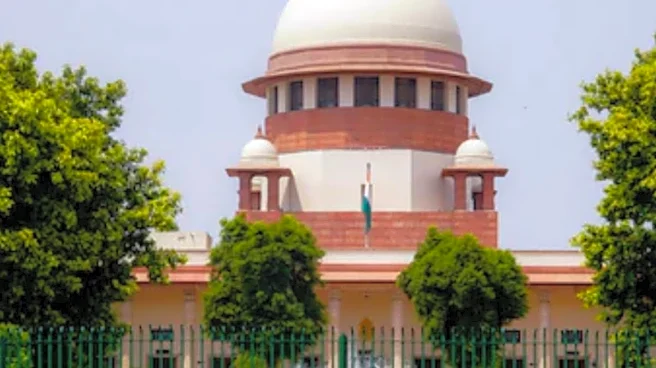
The Supreme Court on Thursday flagged trade unionism as a major factor contributing to industrial stagnation in the country, with Chief Justice Surya Kant observing that the functioning of trade unions has led to the closure of several industrial units across India.
Questioning the impact of trade unions on economic growth, the CJI remarked that numerous traditional industries had shut down due to the actions of what he described as “flag-bearing unions.”
He stated that resistance to work and aggressive union leadership had significantly impeded industrial development.
While acknowledging the existence of labour exploitation, the Chief Justice noted that alternative reforms, such as improving workers’ skills and increasing awareness of individual
rights, should have been prioritised instead of disruptive union practices.
The remarks were made by a bench comprising CJI Surya Kant and Justice Joymalya Bagchi while hearing a public interest litigation filed by Penn Thozhilargal Sangam and other trade unions seeking welfare measures for domestic workers, including their inclusion under minimum wage notifications.
At the outset, the Chief Justice expressed reluctance to entertain the petition, cautioning that such measures could result in widespread litigation involving individual households.
Senior Advocate Raju Ramachandran, appearing for the petitioners, submitted that several countries, including Singapore, mandate registration of domestic workers and ensure minimum wages and weekly holidays.
Responding to this, the CJI warned that well-intentioned welfare interventions could sometimes produce unintended consequences, including further exploitation.
He observed that fixing minimum wages without considering employment demand could discourage households from hiring domestic help, thereby worsening workers’ conditions.
When Ramachandran argued that collective bargaining was effective and clarified that the petitioners were registered trade unions, the Chief Justice reiterated his criticism of trade unions, prompting the senior counsel to request that broad generalisations be avoided.
The CJI, however, shifted focus to employment agencies, describing them as the real exploiters of domestic workers.
Highlighting a specific instance, the Chief Justice disclosed that when the Supreme Court itself engaged workers through an agency at a cost of Rs 40,000 per worker, the employees ultimately received only Rs 19,000.
He stated that agency-based hiring often erodes the trust-based relationship traditionally shared between domestic workers and employers, which could have serious social consequences.
The CJI further cautioned that enforcing minimum wages through union pressure could result in households being dragged into legal disputes.
In response, Ramachandran contended that inadequate wages amounted to bonded labour under the Supreme Court’s ruling in Bandhua Mukti Morcha, and argued that the exclusion of domestic workers from minimum wage protection violated Articles 21 and 23 of the Constitution.
The bench declined to entertain the petition, holding that the reliefs sought amounted to a direction to legislate, which was beyond the Court’s jurisdiction.
The petition was disposed of with an observation urging States to examine the grievances raised by domestic workers’ unions.
/images/ppid_a911dc6a-image-176989122870081004.webp)

/images/ppid_a911dc6a-image-176989053155556907.webp)



/images/ppid_a911dc6a-image-176988709728163448.webp)
/images/ppid_a911dc6a-image-176988713184237741.webp)
/images/ppid_a911dc6a-image-17698870292374771.webp)
/images/ppid_a911dc6a-image-176988706283960885.webp)