
/images/ppid_59c68470-image-177901753364552167.webp)
/images/ppid_a911dc6a-image-177906562777217641.webp)
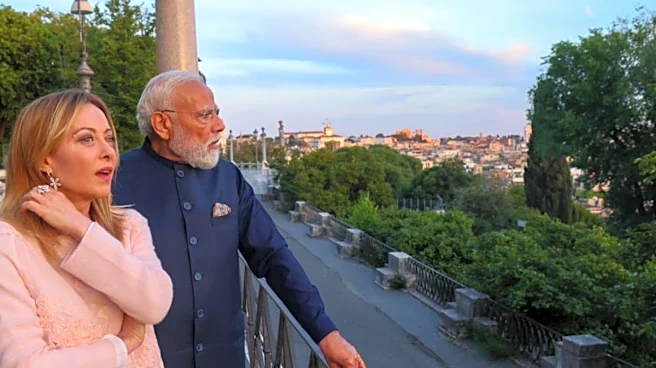
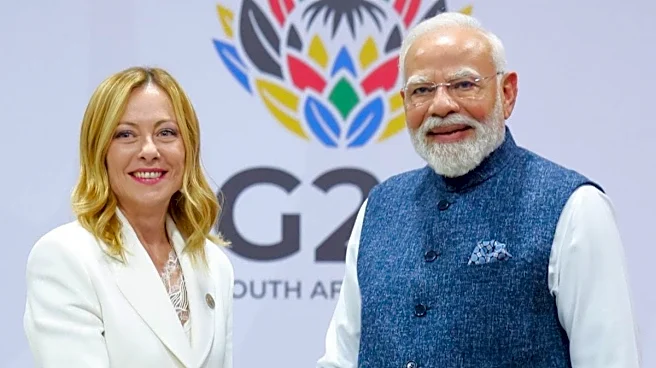
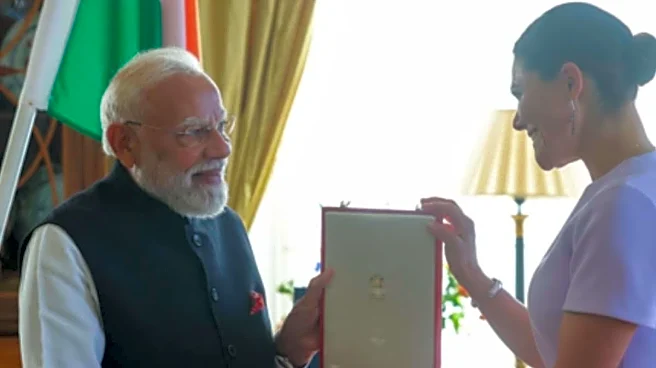
Prime Minister Narendra Modi landed in Rome on May 19 as the last stop on a five-nation Europe sweep, and the timing could not have been more loaded. The Strait of Hormuz has been shut since February 28. Energy markets are still reeling. Supply chains that multinationals spent decades building are being torn up and rerouted in real time. In that context, the India-Middle East-Europe Economic Corridor (IMEEC)—born at the New Delhi G20 in September 2023 amid considerable self-congratulation—has quietly transformed from a long-horizon infrastructure dream into something far more pressing.
What PM Modi and Italian Prime Minister Giorgia Meloni will want to settle in Rome is simple: does the political will exist to push this mega project forward,
or does it remain a corridor in name only?
The original idea was genuinely ambitious. IMEEC envisions a connected web of rail and sea routes—an eastern leg running from India to the Gulf, a northern leg running from the Gulf up to Europe— stitching together two of the world’s great economic regions with something more resilient than a single chokepoint. India, the United States, France, Germany, Italy, Saudi Arabia, the UAE and the European Union signed the founding MoU in New Delhi in September 2023. The stated goals were practical: cut transit times, reduce Suez dependence, build supply chains that could survive regional convulsions.
Then, October 7 hit and none of that survived first contact with reality.
Hamas attacked Israel. The Gaza war consumed the world’s political attention. Houthi strikes in the Red Sea turned one of IMEEC’s complementary waterways into a shooting range. The corridor stalled. By mid-2025, there were signs of life on the eastern end—India, the UAE and Saudi Arabia quietly working the India-Gulf leg—but the western half, from the Gulf to Europe, went nowhere. S Jaishankar, during a Rome visit, called the conflict “undoubtedly a major complication” while insisting the eastern segment was still moving. Then February 28, 2026, arrived. The Iran war started. The Strait of Hormuz closed. And overnight, IMEEC stopped being a nice-to-have and became an argument for national survival for several of its members.
Fortune magazine assessed the corridor last April and called it “tested in real time”—not a concept but a live resilience framework sitting at the intersection of infrastructure, geopolitics and global markets. That is exactly right. Hormuz closing showed the world what happens when critical energy arteries are controlled by a single actor. IMEEC’s entire logic is that the future of Asia-Europe trade cannot keep depending on whoever controls a given waterway on a given morning. The Iran crisis did not damage that argument, rather proved it.
Italy’s role in all this is not simply that of another EU signatory. It is the western anchor of the entire project. Trieste and Genoa are the natural endpoints for a corridor that, if built, would run from Mumbai across the Gulf and up through the Levant to European shores. Without Rome’s genuine commitment, IMEEC is a corridor that stops at the Mediterranean and goes no further. So Meloni’s engagement matters enormously—and to her credit, she has not been passive.
In early April, she flew to Saudi Arabia, Qatar and the UAE on an unannounced two-day visit. No EU or NATO leader had gone to the Gulf since the Iran war broke out. She met Crown Prince Mohammed bin Salman in Jeddah, Emir Sheikh Tamim in Doha and President Sheikh Mohamed bin Zayed in Abu Dhabi. Energy security drove the agenda—Italy’s Gulf LNG suppliers had already paused deliveries, Iranian strikes had knocked out 17 per cent of Qatar’s LNG export capacity, and Rome’s gas situation was deteriorating fast. But there was a larger takeaway from those three meetings: Meloni had built real, working relationships in all three Gulf capitals that happen to sit along IMEEC’s eastern spine. That is not nothing. When she sits down with PM Modi, she brings those relationships into the room with her.
The personal dynamic between the two leaders matters too, more than the usual diplomatic boilerplate would suggest. Meloni’s first state visit after becoming Italy’s prime minister was to India in March 2023, before she had fully consolidated her government. She was also in New Delhi for the G20 that year, when Italy signed onto IMEEC. In September 2025, a phone call between the two prime ministers covered the India-EU free trade agreement and IMEEC both—neither topic treated as secondary. PM Modi’s last Italy visit, for the G7 in June 2024, went well by all accounts. Today, Joint Strategic Action Plan 2025-2029 covers defence, space, science, technology, clean energy and connectivity in one document. Bilateral trade hit $16.77 billion in 2025.
Defence is also on the table. India and Italy have been expanding joint manufacturing and co-development work, and after Operation Sindoor—where India demonstrated it would act, overwhelm the enemy and not blink—European partners are recalibrating how they deal with New Delhi.
Then there is the Vatican. Pope Leo XIV, the first American-born pope, may receive PM Modi. A “Hindu nationalist prime minister” as his critics often describe him, at the Holy See, representing a country of 20 million Catholics—the symbolism writes itself. But the Pope, however consequential, is not what this visit is about.
IMEEC is. And it faces obstacles that won’t dissolve just because two leaders have good chemistry. The Gulf-to-Europe leg needs simultaneous infrastructure investment, regulatory harmonisation and political commitment across a string of sovereign governments whose interests do not always align. Saudi Arabia’s rail links need to feed UAE ports. There is also the awkward reality of Riyadh’s recent cozying up to Pakistan, which does nothing for the spirit of a corridor that depends on coordinated Gulf commitment. Getting the northern leg built will require sustained pressure from the top, not just framework agreements and ministerial communiques.
But pressure from the top is precisely what moves these things. The India-UAE intergovernmental framework agreement on IMEEC, signed in February 2026, showed that the eastern segment advances when leaders treat it as a priority rather than a talking point. Jaishankar made clear that India, UAE and Saudi Arabia are actively working their shared portion even with the region on fire. What Rome can add is a credible European signal—that the western end of the corridor is not waiting, not wavering, and ready to receive what the east eventually sends.
Meloni is positioned to give that signal better than almost any other European leader. Her politics centres on economic sovereignty and strategic autonomy. Her Gulf visits demonstrate she is willing to move into unchartered territory when the situation demands it. Her country’s energy exposure to the Middle East gives her a personal, not merely theoretical, stake in seeing IMEEC become real. And the relationship with PM Modi, built over three years and multiple meetings, gives the conversation a directness that new partnerships rarely have.
The Iran crisis has ended the era of treating IMEEC as a decade-long project that bureaucracies can manage at their own pace. Hormuz closed. The Red Sea became a war zone. Two of the world’s critical trade corridors came under threat within 18 months of each other. The case for building a resilient alternative has never been stronger, and it has never been more obvious what the cost of delay looks like.
/images/ppid_59c68470-image-177911502674525655.webp)

/images/ppid_a911dc6a-image-177923463419897575.webp)

/images/ppid_59c68470-image-177925252148696610.webp)
/images/ppid_a911dc6a-image-177918789136596159.webp)