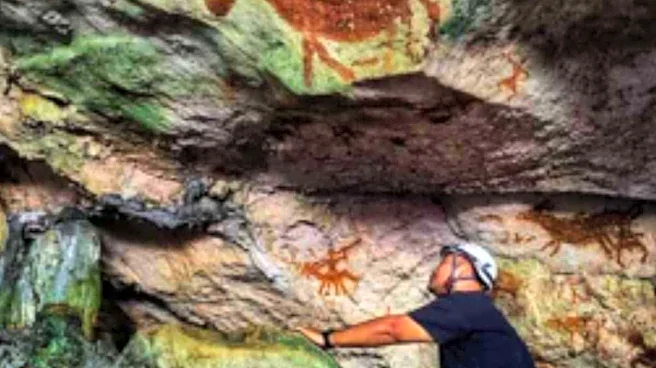




A red stencil of a hand on the wall of a cave in Indonesia is the oldest rock art discovered so far, scientists said on Wednesday, adding that it revealed how humans first migrated to Australia.
The research published in the journal Nature by a team of Indonesian and Australian archaeologists stated that the cave art is dated at least 67,800 years.
“We have been working in Indonesia for a long time,” study co-author Maxime Aubert of Australia’s Griffith University said.
AFP quoted Aubert saying this time they ventured to caves on the island of Muna in the Sulawesi province on the advice of Indonesian archaeologist Adhi Agus Oktaviana, the study’s lead author.
He further said the researchers found “handprints in negative, stencilled, probably using
red ochre”.
The fingers of one of the hands were “retouched to become pointed like claws – a style of painting only seen in Sulawesi,” he said.
According to AFP, the team took five-millimetre samples from “cave popcorn”, which are small clusters of calcite that form on the walls of limestone caves, to determine the art’s age. They then zapped the layers of rock with a laser to measure how the uranium decayed over time. This “very precise” technique gave the scientists a clear minimum age for the painting, AFP quoted Aubert.
The study stated that the stencil is more than a thousand years older than other hand stencils found in a Spanish cave which has been attributed to Neanderthals.
AFP quoted the scientists stating that the Muna caves had been used for rock art many times over a long period.
Some of the ancient art was even painted over up to 35,000 years later, Aubert added.


/images/ppid_a911dc6a-image-177099523372082313.webp)

/images/ppid_a911dc6a-image-177099523000247381.webp)
/images/ppid_59c68470-image-177099507473134483.webp)

/images/ppid_59c68470-image-177099511909742240.webp)
/images/ppid_59c68470-image-177099503123072195.webp)