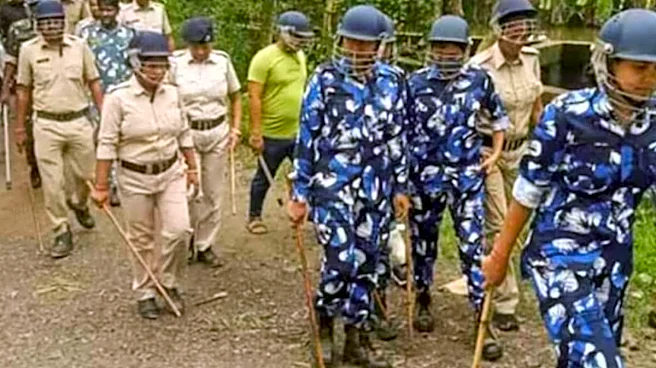




Ahead of the second and politically crucial phase of the 2026 West Bengal Assembly Election, Howrah has been placed under an extraordinary security blanket, with authorities transforming the district into what officials and observers are calling an ‘Iron Fort’. But unlike a battlefield marked by conflict, this time the sound dominating the streets is that of marching security personnel.
The heavy security build-up reflects deep administrative concern over the district’s history of poll-related violence and intelligence inputs warning of possible attempts to disrupt voting. From the narrow lanes of North Howrah to the ghats along the Hooghly River, a multilayered security network has been put in place aimed at preventing unrest and ensuring peaceful
polling.
Officials have also imposed Section 163 of the Indian Civil Security Code, a move being seen not merely as a legal restriction but as a strong signal against any attempt to turn the democratic exercise violent.
Why Howrah Has Been Turned Into An ‘Iron Fort’
The extensive preparations stem largely from Howrah’s long and troubled electoral history. The district has witnessed repeated allegations of clashes, booth capturing and bomb-related violence in past elections, with areas such as North Howrah and Shibpur often seen as politically sensitive.
According to reports, intelligence agencies have warned that anti-social elements may attempt to trigger disturbances during voting, prompting the administration to effectively seal the district 48 hours before polling.
Officials say the unprecedented security arrangements are intended to prevent both organised disruption and localised flashpoints.
Section 163 Imposed To Restrict Gatherings And Curb Intimidation
A key element of the security strategy is the enforcement of Section 163, which restricts public gatherings and is being used to prevent crowd mobilisation around polling stations.
With the restrictions in place, no more than five people can gather at one location, a measure authorities believe could weaken attempts by political groups to use crowd pressure or ‘muscle power’ near booths.
Officials view the provision as crucial to smoother polling and as a deterrent against fake voting or intimidation tactics often linked to large political gatherings.
Outsiders Asked To Leave As District Borders Tightened
Authorities have also focused on preventing the alleged use of outsiders to trigger election-day trouble. Given Howrah’s strategic location and easy access from Kolkata and surrounding Hooghly areas, security agencies have intensified border monitoring.
Search operations have reportedly been carried out in hotels and guesthouses, while people not registered as voters in Howrah have, according to reports, been directed to leave the district to ensure local voters can participate without fear.
The measures are aimed at reducing the possibility of external mobilisation often associated with poll-day violence.
Sensitive Booths Under CAPF And Digital Surveillance
Security deployment has been especially intense at polling stations identified as vulnerable. More than 40% of booths in Howrah have reportedly been categorised as ‘sensitive’, leading to enhanced security arrangements.
At these locations, state police are being backed by personnel from the Central Armed Police Forces (CAPF), including armed commandos.
Alongside physical deployment, authorities have introduced extensive digital monitoring. Webcasting from every polling booth is expected to feed directly to election authorities, enabling real-time oversight.
The system is intended to ensure that if violence or irregularities emerge anywhere, officials in both Delhi and Kolkata can respond immediately. Officials believe this level of surveillance acts as a strong deterrent for potential troublemakers.
Drones Deployed Over Narrow Lanes And Rooftops
In a significant technological addition, the administration is also using drone surveillance, particularly in areas where dense neighbourhoods and narrow lanes have historically posed policing challenges.
According to reports, suspicious rooftops and sensitive lanes have been mapped to prevent stockpiling of stones or crude explosives. Officials say the ‘Iron Fort’ approach is not limited to ground-level security but now extends to aerial monitoring as well.
The use of drones is aimed at eliminating blind spots and improving rapid response capability in areas traditionally difficult to secure.
Route Marches Meant To Reassure Voters
For the past three days, route marches by central forces have reportedly been conducted across every block in Howrah. Heavily armed personnel moving through neighbourhoods are intended not only to deter potential disruptors but also reassure residents.
Authorities say the strategy is psychological as much as operational, reducing fear among voters while signalling a visible security presence.
Officials believe voter confidence is central to preventing violence, arguing that when people feel protected, attempts to intimidate them are less likely to succeed.
Can Security Measures Prevent Election Violence?
Despite the unprecedented preparations, questions remain over whether even such extensive restrictions can eliminate every possible incident. Experts say measures such as Section 163, district sealing, CAPF deployment and drone surveillance can significantly push back troublemakers, though isolated disruptions can never be entirely ruled out.
Still, many observers note that the scale of security in Howrah this time appears unlike anything seen in previous elections.
As the second phase of the West Bengal Assembly Election approaches, residents in Howrah are hoping the district’s troubled electoral past does not repeat itself, and that polling day passes not with violence, but in peace.