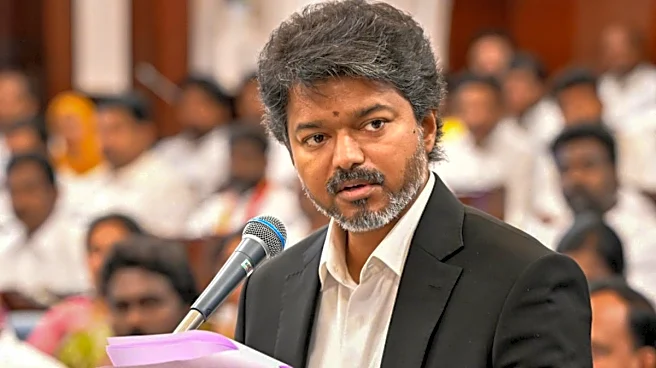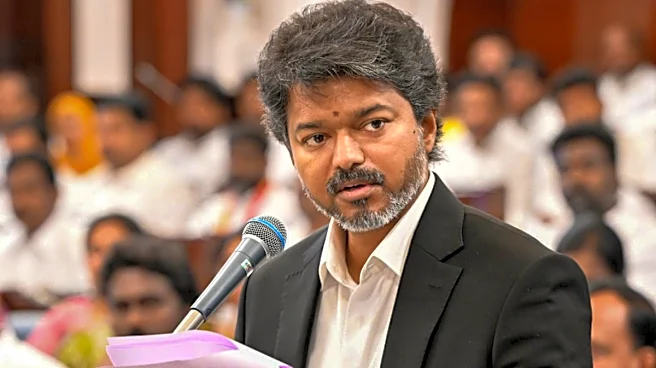


Despite a change in government in Tamil Nadu, the state’s long-standing two-language policy will remain unchanged under the administration led by C. Joseph Vijay.
Tamil Nadu School Education Minister A. Rajmohan said the new Tamilaga Vettri Kazhagam (TVK) government would continue the policy of teaching only Tamil and English in schools.
“Two-language policy is not just a policy of the Tamil Nadu government, it is also one of the fundamental principles of the TVK. We are clear that the state will continue to follow the two-language policy and there is no change in that,” Rajmohan said, as reported by Deccan Herald.
The statement signals continuity in Tamil Nadu’s strong opposition to the Centre-backed three-language formula under the National Education
Policy (NEP) 2020. The previous Dravida Munnetra Kazhagam (DMK) government had refused to implement the PM SHRI Scheme, arguing that it indirectly promoted Hindi through the “back door”.
Rajmohan said the government was yet to take a final decision on the PM SHRI scheme but reiterated the state’s position on language policy. “People should learn Tamil because it is their mother tongue and English for outside communication. We will discuss threadbare about other issues and schemes and take a decision,” he said.
Tamil Nadu has followed the two-language formula since 1968, when then Chief Minister C. N. Annadurai rejected the three-language formula and declared that government schools in the state would teach only Tamil and English.
What Is PM SHRI?
The PM SHRI (PM Schools for Rising India) scheme was launched by the Union government in 2022 to develop more than 14,500 schools across the country as model institutions aligned with the National Education Policy (NEP) 2020 vision. The centrally sponsored scheme has a total outlay of Rs 27,360 crore, including a central share of Rs 18,128 crore, for the period from 2022-23 to 2026-27.
Under the scheme, selected schools managed by the Centre, states, Union Territories and local bodies are upgraded with improved infrastructure and teaching standards. The programme is implemented through the existing administrative framework of Samagra Shiksha, Kendriya Vidyalayas and Navodaya Vidyalayas.
The Union government had reportedly withheld or delayed the release of Samagra Shiksha funds to several states — including Kerala, Tamil Nadu, West Bengal, Delhi and Punjab — during the 2024-25 financial year after they refused to sign memorandums of understanding linked to the PM SHRI scheme. However, Delhi and West Bengal have now implemented the PM SHRI scheme.
In Kerala, the state had signed an MoU with the Centre in October 2025, but later put the agreement on hold.