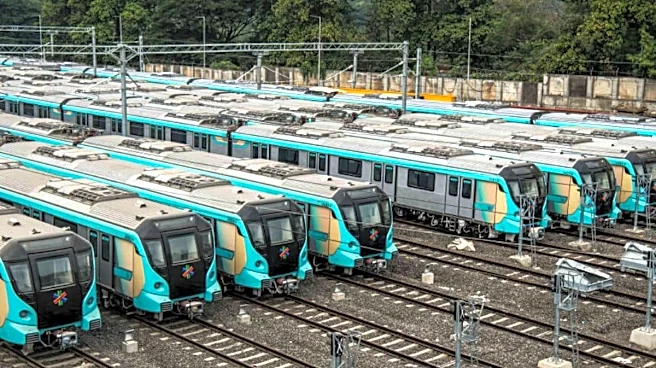


In a significant leap for urban mobility, the Mumbai Metropolitan Region (MMR) has crossed the 100-km mark in operational metro lines, emerging as the country’s second-largest network after Delhi-NCR and surpassing Bengaluru’s 96-km stretch. The milestone coincides with the launch of two key corridors that extend metro connectivity into previously unserved zones.
On Tuesday, Chief Minister Devendra Fadnavis, along with deputy chief ministers Eknath Shinde and Sunetra Pawar, inaugurated Phase I of Metro Line 9 (Dahisar-Kashigaon) and the first operational segment of Metro Line 2B (Mandale–Diamond Garden). Passenger services on both stretches began Wednesday morning, officials said.
According to a report by The Times of India, the addition of these
corridors, along with the 10-km Navi Mumbai Metro developed by CIDCO, has pushed the region’s operational metro network beyond 101 km. While Delhi-NCR continues to dominate with around 416 km and over 300 stations, Kolkata trails with approximately 74 km.
The newly opened 4.4-km stretch of Metro Line 9 is particularly notable as it marks the first-ever metro access for Thane district, formally bringing Mira-Bhayander into the network. The corridor also serves as the first direct metro link between a Mumbai suburb and Thane city, PTI reported. The line includes four stations – Dahisar East, Pandurangwadi, Miragaon and Kashigaon.
Meanwhile, the Mandale-Diamond Garden section of Metro Line 2B introduces metro connectivity to Mumbai’s eastern suburbs and harbour belt, while also becoming the first metro corridor to interface with the Harbour Line, according to PTI. The 5.53-km stretch comprises five stations: Diamond Garden (Deshbhakt N G Acharya Udyan), Chhatrapati Shivaji Maharaj Chowk, Deonar, Mankhurd and Maharashtra Nagar-Mandale.
Fadnavis, as quoted by TOI, indicated that several ongoing metro projects are already nearing completion, with progress ranging between 80%-96%. He suggested that the pace of expansion is expected to accelerate in the coming years, potentially taking the total network to 337 km, placing Mumbai among cities with some of the longest metro systems globally.
The Rs 6,500-crore Metro Line 9 is being executed in phases. While the first segment is now operational, the second phase, spanning 4.3 km from Sai Baba Nagar to Subhash Chandra Bose Nagar, is being expedited and is likely to open later this year, TOI reported.
The expansion has also triggered operational changes along the western corridor. Metro Line 7 has now been integrated with Line 9, enabling direct connectivity between Gundavali, Dahisar and Kashigaon. PTI added that this combined corridor spans nearly 19.79 km and will run from 5:50 am to 11 pm, with peak frequency of under six minutes and around 276 services on weekdays.
However, Metro Line 2A will now function independently between Andheri West and Dahisar East. Commuters heading towards Gundavali or Kashigaon from Andheri will need to switch trains at Dahisar, though the interchange will remain within the paid concourse. An updated timetable for Lines 2A and 7 came into effect from Wednesday to improve frequency and passenger experience, PTI reported.
Officials told TOI that the 2B corridor will play a critical role in improving east Mumbai connectivity. PTI further noted that Phase I of Line 2B will operate from 6 am to 10.30 pm, with trains running roughly every nine-and-a-half minutes and about 209 services daily.
In a major boost for daily commuters, travel time between Mira-Bhayandar and Mumbai is expected to drop to around 30 minutes from the earlier one to two hours, according to PTI.
Fadnavis emphasised that the metro expansion is part of a broader plan to create a seamless and commuter-friendly transport ecosystem, supported by feeder bus services and improved last-mile connectivity around stations.
Shinde reportedly noted that once the second phase of Line 9 becomes operational, it will integrate with Metro Lines 7 and 7A, providing access to the airport. Future interchanges with Metro Line 3 will allow direct connectivity to Colaba, while the proposed Wadala-Gaimukh corridor is expected to further enhance suburban mobility by linking Bhayandar.
/images/ppid_59c68470-image-177555003938539345.webp)

/images/ppid_a911dc6a-image-17755781221043081.webp)