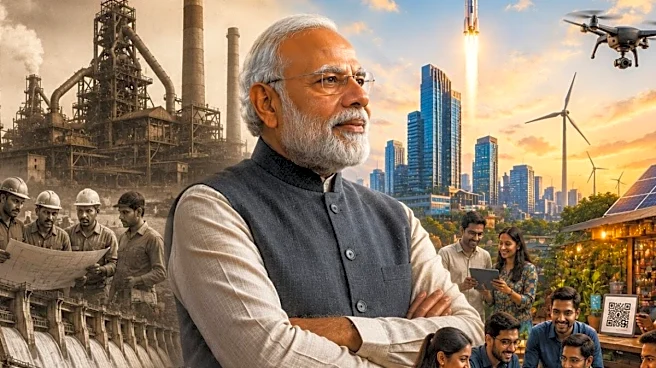





As Prime Minister Narendra Modi moves closer to overtaking Jawaharlal Nehru as India’s longest-serving democratically elected prime minister, comparisons between the two leaders have focused not only on politics and governance but also on their sharply different economic philosophies.
One of the clearest contrasts lies in how each era viewed private enterprise, entrepreneurship and the role of business in nation-building.
The difference is not simply ideological. It reflects two very different Indias.
When Nehru became prime minister in 1947, there were few Indian companies capable of building steel plants, power networks, dams or heavy industries on the scale required for national development. So, Nehru’s answer was a state-led model.
The government
took responsibility for building the foundations of the economy through public-sector enterprises, heavy industries, scientific institutions, and large infrastructure projects. This eventually evolved into a highly regulated system where government permissions became central to business decisions, a structure later known as the Licence-Permit-Quota Raj.
Nehru believed private capital should operate within a framework defined by national planning and social priorities. The dominant vocabulary of the era emphasised socialism, public ownership, economic planning, and state intervention.
The entrepreneur was important, but not usually celebrated as the central figure in India’s development story.
When PM Modi took office in 2014, India was no longer the fragile economy of 1947.
The country had already experienced economic liberalisation, private-sector expansion, IT and services growth, rising consumer markets, and global integration.
The challenge was no longer creating an industrial base from scratch but accelerating growth, creating jobs, and making India globally competitive.
PM Modi’s response was to place entrepreneurs and businesses at the centre of the national narrative.
Startup India: Turning Entrepreneurship Into A National Aspiration
One of the most visible manifestations of this shift was the launch of Startup India in 2016. The initiative sought to encourage innovation, reduce regulatory hurdles, support startup funding, and build incubation ecosystems.
More importantly, it changed the political conversation. For decades, the ideal career path in India often revolved around government service, public-sector jobs, and traditional professions.
Under PM Modi, start-up founders began to be celebrated as symbols of a new India. Young entrepreneurs became regular participants in government events and public campaigns, and the startup founder emerged as a national success story.
Mudra Loans: Bringing The Small Entrepreneur Into The Spotlight
While Startup India targeted high-growth businesses, the Modi government also focused heavily on micro-entrepreneurs.
The Pradhan Mantri Mudra Yojana was launched to provide collateral-free loans to street vendors, small traders, artisans, local business owners, and first-time entrepreneurs. The political significance was substantial.
Rather than focusing only on large industries, the government increasingly portrayed the local shopkeeper, tailor, mechanic and street vendor as contributors to national development. This broadened the definition of who could be considered an entrepreneur.
Digital India And The Rise Of The QR-Code Economy
Perhaps the most visible transformation of the Modi era has been the digitalisation of commerce.
Through initiatives such as Digital India and Unified Payments Interface, India witnessed an unprecedented expansion of digital payments.
Today, tea stalls accept QR-code payments, vegetable vendors use smartphones, small businesses operate without card machines, and informal transactions increasingly occur through digital platforms. For millions of small businesses, digital payments have become a gateway into the formal economy.
This represents a very different development model from Nehru’s era, where progress was measured through factories, dams and public infrastructure.
Manufacturing Without State-Owned Factories
Another major departure is PM Modi’s approach to industrial policy. Instead of the government directly creating and operating factories, the focus has shifted toward encouraging private investment.
Schemes such as the Production Linked Incentive Scheme seek to attract domestic and foreign investment in sectors such as electronics, mobile phones, semiconductors, pharmaceuticals, and solar manufacturing. The state acts as a facilitator and incentive provider rather than the principal manufacturer.
This is one of the sharpest distinctions from Nehru’s model of state-led industrialisation.
The Biggest Shift May Be Linguistic
Perhaps the most striking difference is the language used by the state.
In the Nehru era, the key terms were planning, public sector, state ownership, redistribution, and socialism. On the other hand, in the Modi era, the key terms are startups, innovation, ease of doing business, wealth creators, and entrepreneurship.
PM Modi has repeatedly argued that “wealth creators” should be respected because they generate jobs, investment and economic growth.
That language marks a significant departure from the political vocabulary that dominated India’s early decades after Independence.
So, while Nehru’s India was focused on building the economic foundations of a new nation, Modi’s India is focused on unleashing entrepreneurs to drive the next phase of that nation’s rise.
/images/ppid_a911dc6a-image-17810702688506658.webp)


/images/ppid_a911dc6a-image-178107292801874583.webp)
/images/ppid_a911dc6a-image-178110150037720421.webp)
/images/ppid_a911dc6a-image-178106768467764759.webp)